.1 ]2, OLIVES: 19.2 liters .2 ] OLIVES: 9.6 liters .3 wall-builder(s): BARLEY: 1.2 liters, MEN: 20 .4 sawyer(s): BARLEY: 1.2 liters, MEN: 5 .5 all-builder: BARLEY: 3.2 liters .6 .7 to Kwallans, monthly: [ ]OLIVES: 576 liters .8 to pa-ka, monthly: [ .9 to the wall-builders, monthly: BARLEY: 96 liters .10 to the sawyers, monthly: BARLEY 134.4+ liters .11 to the all-builder: BARLEY: 720 liters
Notes:
We should probably imagine that line 1 recorded the daily allocation of olives (and probably barley) to the man named Kwallans (cf. Πάλλας), and line 2 the daily allocation of olives (and probably barley) to the man (or woman) named pa-ka (there are too many possibilities here, so I have left it transliterated). The math works out, since 19.2 * 30 = 576.
We should probably imagine equal quantities of barley and olives being allocated to the two named individuals; that is common practice in such texts, and the 2 in the break in line 1 is consistent with that hypothesis.
We then have listed the daily allocations to three professions and their number: 20 wall-builders, 5 sawyers (i.e., people who saw, from Greek πρίω), and a single all-builder. These are all listed in the dative singular or nominative plural (it’s impossible to tell which). to-ko-do-mo is a compound noun, /toikhodomos/ (cf. τοῖχος, δέμω), pi-ri-e-te-re (elsewhere spelled pi-ri-je-te-re) is in the nominative singular /pri(h)etēr/ (cf. πριστήρ, from πρίω), and pa-te-ko-to is /pantektōn/ (cf. πᾶν, τέκτων).
After a blank line, the scribe has calculated the monthly allocation to each group, using the word o-pi-me-ne, /opimenei/ (cf. ἐπὶ μηνί).
The tablet clearly deals with architectural laborers. I’ve suggested that we have five teams, each with a sawyer (carpenter) and four wall-builders (masons), all of which are supervised by the “all-builder,” who must be some kind of architect/foreman. The sawyers cut beams and other wooden elements, the wall-builders were masons who built the walls. Mike Nelson has shown how walls at the Palace of Nestor in LH IIIB were built: a mix of mortar was poured into a heavy timber framework.
I’ve further argued that the named individuals, allocated large quantities of barley and olives, are responsible for providing what is obviously missing from these architectural teams: unskilled labor. Masons in Ottoman and early modern Greece typically employed local unskilled laborers and animals, who hauled and prepared materials, supervised by a skilled specialists, and I suggested that something similar is happening here. (You can download my article here: https://hcommons.org/deposits/item/hc:15171)
I just got back to Athens from the 3rd International Symposium on the Periphery of the Mycenaean World. It was an exciting and demanding conference: there were 60 talks over three days. Most days started at 9 am and didn’t finish before 8 pm. So today I’m exhausted and sleep-deprived, and my head is spinning with new information and new ideas. My observations on the whole event are:
Lamia is an incredibly welcoming place. The symposium was co-hosted by the archaeological ephorate of Phthiotis and Evrytania and the Demos of Lamia, and both were amazing hosts. The δήμαρχος was present – and not in the usual way. He didn’t just speak at the start of the conference and disappear; he sat in on a lot of sessions and personally thanked many of the speakers. The director of the ephorate and everyone associated with it were also super hospitable; at the end of the conference we got great tours of the castle of Lamia and the archaeological site of Kynos.
Who runs the world (of Greek archaeology)? Women. More than two thirds of the speakers at the symposium are women (41 out of 60 by my count), and that doesn’t take into account that eight of the male speakers aren’t Greek or don’t have positions in Greece. It is a noticeable difference if you are used to archaeological traditions in which men are dominant (numerically and otherwise). Of course it’s the archaeologists in the Greek Ministry of Culture that are overwhelmingly female (rather than, say, University professors), but they are the ones supervising and doing almost all of the archaeology in Greece.
The Greek archaeological service is chock full of talent. The archaeologists of the service work under extremely difficult conditions, to be sure. Their intellectual ability, work ethic, and dedication to archaeology is unmatched. I don’t know enough to compare the archaeologists of Greece to other countries, but it’s hard to imagine that Greece is second to any other country in terms of talent and devotion.
The “periphery” is so ’90s. By the end of the conference, it seemed clear that most participants were dissatisfied with the title of the conference and especially the use of the term “periphery.” It came up in a bunch of the talks (including mine) and in the concluding remarks too.
The “periphery” is where it’s at. There’s so much coming out of the ground in these “peripheral” areas that it’s dizzying. I came out of the conference feeling like an ignorant fool for not keeping apace of these developments.
I really need to improve my Greek.
Here’s the text of the paper that I delivered:
«άγνωστος λησμονημένος απ’όλους»? Why the “periphery” should be central to Mycenaean studies
Dimitri Nakassis, University of Colorado Boulder
From the very beginning of its study, it has been traditional to understand the Mycenaean world as a homogeneous culture. Christos Tsountas had concluded already at the end of the nineteenth century that the Mycenaeans constituted “a distinct and homogeneous civilization” («πολιτισμός…ομογενής») whose “central hearth” was the site of Mycenae (η πόλη των Μυκηνών «παρουσιάζεται σήμερον ως η κυριωτέρα εστία του πολιτισμού εκείνου») and whose northern frontier lay at Thessaly. In my paper today, I’d like to suggest that this view, venerable as it may be, presents us with a number of problems that affect the study of the “core” regions of the Mycenaean world as well as its so-called “periphery.” After briefly reviewing these problems, I will very briefly suggest some solutions, which point to the importance of the periphery for the study of the Mycenaean world.
I should say from the start that my paper will be intentionally challenging and unorthodox. I want to destabilize established ideas about “cores” and “peripheries” in the Mycenaean world. My discussion is premised on two arguments: one, that Mycenaean archaeology radically overestimates the importance of the palaces, and two, that heterogeneity across time and space has too often been overlooked. The homogeneity of the Mycenaean world is closely linked to the presumed centrality of the palaces, so much so that it is difficult to separate them conceptually.
To begin: the notion of a Mycenaean “core” is both temporal and spatial, for it is normal to define the “core” with respect to the establishment of the palaces.
For example, traditional definitions of “Mycenaean” typically invoke, as Jim Wright does here, a temporal scheme in which the “high point” – or in this case, the “fullest expression” – of the Mycenaean world is located temporally in the 14th and 13th centuries BC, and specifically in the material culture associated with the palaces.
By “Mycenaean” I mean the assemblage of artifacts that constitutes the characteristic archaeological culture that originates on the mainland of Greece in the late Middle Bronze Age, finds its fullest expression in the palaces during the Late Helladic (LH) IIIA-B, and can be traced through the postpalatial LH IIIC period.
Put another way, our internal periodization of the Mycenaean world revolves entirely around the establishment and destruction of the palaces. There are, no doubt, good reasons to organize the material this way, but this mode of organization nevertheless creates problems, both empirical and theoretical.
For example, what do we do with regions that never developed palaces? Does Arkadia have a “palatial” period if there is no Arkadian palace? The answer to this question is usually “no.” Thus, for instance, Cynthia Shelmerdine and John Bennet suggest that
regions such as Achaea and Laconia apparently never developed a monumental center like Mycenae or Pylos. These areas may have continued to operate at the level of the Early Mycenaean village-centered societies, outside the control of any particular center.
(Shelmerdine and Bennet are obviously writing prior to the discovery of Ayios Vasilios in Lakonia).
Likewise, Emiliano Arena suggests that “chiefdoms characteristic of the Early Mycenaean era probably survived alongside Mycenaean palatial states” in Achaia and other non-palatial parts of the Mycenaean world. That is to say, it is usual for scholars to assume that non-palatial parts of the Mycenaean world do not participate fully in the palatial period. Indeed, they effectively remain – socially, politically, and economically – in the pre-palatial Early Mycenaean period.
We can see, therefore, that time and space are connected in this schema. The core isn’t just more central spatially, but it is more advanced temporally. It experiences a palatial period, whereas the periphery remains stuck in the prior pre-palatial period. The schema is reminiscent of the remark of Thucydides (1.5) that καὶ μέχρι τοῦδε πολλὰ τῆς Ἑλλάδος τῷ παλαιῷ τρόπῳ νέμεται (“up to the present much of Greece lives in the old manner”): so the Ozolian Lokrians, Aitolians and Akarnanians continue to carry weapons ἀπὸ τῆς παλαιᾶς λῃστείας (“from the piracy of old”).
This situation is unsatisfactory for many reasons. It is obviously teleological: the Mycenaean world’s end goal is a monolithic and rigid palatial system. But for the purposes of my talk today, I want to highlight two other problems with this scheme. First, it does a poor job of understanding the operation of the palaces; and second, it underestimates the capacity for complexity in non-palatial regions. It is frankly depressing that it seems so logical to us that a place as dynamic and as interesting as western Achaia (for example) can be understood as essentially “pre-palatial” – that is, it is depressing that we don’t have better models with which to come to grips with such regions, and that we assume that the Mycenaean world is capable of only one form of complexity.
I would also argue that our conception of the palaces as highly rigid and hierarchical structures is an impediment. I have argued that this image isn’t consistent with the internal evidence of the Linear B tablets. At Pylos and other sites, it seems clear that the palatial system depends on the participation of a large number of individuals who appear in the texts identified by personal name. Almost all of the most important systems of production, from the manufacture of textiles to metallurgy, are premised not on palatial systems per se, but on what we might anachronistically call “private enterprise” harnessed to serve palatial interests. Just as there are no large palatial estates (as Julien Zurbach has recently argued at some length), so too are other areas split up into small pieces for which named individuals are responsible.
Even interregional exchange seems to have been transacted through the agency of elite intermediaries. Although the evidence is slim – Linear B famously tells us very little about trade – the evidence that we do have is consistent with this picture. Here, for example, we have one of two tablets from Pylos (An 35) that refers to the palace “purchasing” alum, an astringent and mordant, from a named individual probably named Aithalos (“Smoky”, Καπνώδης), who is also a smith (appropriately, given his name) elsewhere in the tablets. Because alum isn’t available in the Peloponnese, it must have been imported, perhaps by Aithalos himself as it was by another smith (named Kyprios) mentioned elsewhere as a palatial alum supplier.
This research matters, I think, because in conjunction with new discussions about how the palatial economy operates, it gives us a different view of the palaces. Rather than being monolithic institutions that are separate from society at large, the palaces function by interfacing with complex economies that either pre-existed these palatial systems or emerged in tandem with them. That is to say, the palatial system was both deeply rooted in, and densely entangled with, broader socioeconomic practices and processes.
This observation, in turn, allows us to explore a second area of concern: internal heterogeneity. If the palaces emerged through dynamic processes that responded to local conditions, as recent research has suggested, then we would expect some heterogeneity within the Mycenaean “core,” and indeed this is exactly what we find. Although many scholars have stressed the homogeneity of the Mycenaean world, in my view this has been over-emphasized. Even burial in chamber tombs, so often understood as an important marker of “Mycenaean-ness”, is practiced in a very uneven way across the Peloponnese. (This map is by now well out of date but it still illustrates the general point). Even where the material culture is superficially similar, the historical developments may differ so much that the same forms clearly have different meanings. So, for example, tholos tombs aren’t used in the same way in Messenia as they are in the Argolid or in Boeotia.
One way to deal with this heterogeneity is to speak of “Mycenaeanization,” which is a useful concept insofar as it points to the fact that Mycenaean culture is itself a process that unfolds through time. On the other hand, Mycenaeanization is vulnerable to all of the problems that have plagued Romanization: the implication that cultural change is unilateral and unilinear, the emphasis on elite culture, the deemphasis on local variation at the expense of uniformity, and so on. As Carl Knappett has perceptively observed, “Mycenaeanization” is also problematic if it imagines a central and unitary core from which “Mycenaean-ness” radiates, especially since such a core is empirically difficult to define, and so (and I quote), “it is easier to entertain the idea that Mycenaeanisation is a set of processes happening across a wide area.” At first glance, Knappett is clearly correct: many of the practices that characterize the Mycenaean world have very different histories. The history of the tholos tomb, for instance, looks nothing like the history of Linear B: neither in terms of their chronologies (that is, neither their timing nor their pace), nor in terms of their geographical origins, nor in terms of their coherence (that is, Linear B is much more homogeneous across the Mycenaean world).
A problem that I have been dancing around but have not yet fully confronted, then, is the issue of the integrity of Mycenaean culture. Many scholars stress its homogeneity; a growing number stress its heterogeneity, following the tendency in affiliated fields like anthropology to stress cultural contradictions and contestations. I think that these positions can be reconciled through the notion of “thin coherence,” as articulated by William Sewell. He points out that while culture is inherently contradictory, loosely integrated, contested, mutable, and highly permeable, it also possesses “a real but thin coherence that is continually put at risk in practice and therefore subject to transformation.”
This notion of ‘thin coherence’ has proved a useful way to think about the historical Greek world in the edited volume by Carol Dougherty and Leslie Kurke, The Cultures within Ancient Greek Culture (2003). As Josh Ober points out in this volume, umbrella terms like “Greek” or “Mycenaean” are analytically meaningful, but they do “offer only very limited purchase” when we ask questions about specific communities.
I think that “thin coherence” does a good job characterizing the patterns that we see in the Mycenaean world. The term “Mycenaean” has validity for a general analysis, but it clearly lacks explanatory value at the regional or sub-regional level. For instance, if we look closely at Mycenaean Arkadia, as Eleni Sallavoura has done, we see that certain standard Mycenaean practices, like burial in chamber tombs and the use of figurines, are rare. On the other and, Sallavoura declares that it is “unfair” to label Arkadia a periphery, since Arkadian burial customs are unexceptionally Mycenaean in character and even the most remote mountain communities use Mycenaean pottery. Calling Arkadia “Mycenaean,” then, doesn’t tell us what the archaeology looks like in specific terms, but it rather points to the fact that the region participates in a number of Mycenaean practices. This is, for me, a good illustration of Mycenaean culture’s “thin coherence.”
Another good illustration is the way that Mycenaean administration works. Here, even in the most homogeneous of Mycenaean practices, there are significant temporal and regional variations, as Cynthia Shelmerdine and others have emphasized. On the one hand, it seems logical that administration is the most homogenized field of practice. As Sewell observes, dominant actors and institutions try to impose coherence on cultural practice through a variety of strategies, and the coherence of administrative practices is plausibly due to such efforts. Yet it is clear that there is no single Mycenaean administrative system. For example, while Pylian administrative practice entails a centralized and centripetal Archive Complex managed by a single master scribe (Hand 1) and a well-organized hierarchical territory, other Mycenaean centers are not so organized. Even if the North Entrance Passage at Knossos represents a central archive, the Knossian administration is not comparable to the Pylian. Because the people who wrote our tablets were administrators, not just scribes, such differences are not just epiphenomenal but cut to the heart of administrative practice and organization. In terms of territoriality, Jan Driessen has convincingly interpreted the Knossian state as territorially discontinuous beyond its administrative core, and I suspect that the same is likely to be true for the Theban polity as well. In this context, as in many others, Pylos appears to be atypical.
Thus far my work has been largely critical, but in my conclusion I want to turn to an approach that I think is more profitable and addresses the second part of my paper’s title, “Why the “periphery” should be central to Mycenaean studies.” If we accept Knappett’s suggestion that “Mycenaeanisation is a set of processes happening across a wide area” and we accept that this area cannot (or need not) be divided into a “core” and a “periphery,” then the obvious job of Mycenaean studies is not to focus on categories such as core/periphery or Mycenaean/non-Mycenaean (especially because our understanding of ethnic identity in the Late Bronze Age is effectively zero). We should instead focus on practices and study how they unfold historically. This approach is preferable because one and the same practice may appear at different times in different places and in different contexts, and it is clear that a single practice can mean radically different things to different communities. This focus on discrete practices allows us to sidestep the problematic notions of Mycenaean unity and identity – and the even more problematic arguments about who or what is really Mycenaean – and to focus our attention instead on the constitutive practices of the Late Bronze Age as they were reproduced in space and time.
From this perspective, which is broadly representative of how archaeologists work anyway, areas traditionally understood as “peripheral” now become central to Mycenaean studies. From the traditional core/periphery perspective, someone like me who works in the “core” of the Mycenaean world – in my case, Messenia and the Argolid – the Mycenaean periphery isn’t strictly necessary, because as interesting as it may be, it is a passive recipient of “Mycenaeanization.” If, on the other hand, the practices that collectively constitute “the Mycenaean” are widely distributed, then the “periphery” becomes central insofar as it contributes as much as the “core” does to our understanding of how Mycenaean practices are organized and how they interface with other practices in different contexts.
For example, Girella and Pavuk (2016) have recently summarized the evidence for weaving activity at Troy in a broad-ranging discussion of the Mycenaeanization of the northeast Aegean, and note that the implements are largely preserved in the vicinity of the lower terraces of the citadel and in the fill of the ditch encircling the Lower Town. They then suggest “some kind of central control over the textile production at Troy during LH IIIA2 and IIIB,” presumably because “it is proved that [in the Mycenaean core] … specific segments of production, such as the textile industry, were controlled by the palatial elites.” Actually the situation is not so simple. Certainly we can conclude on the basis of the Linear B texts that some textile production was administered by the palace, but the palace actually obtained textiles in at least three ways: (1) direct production from attached workshops, (2) taxation, and (3) through direct purchases from specialists.
This last mechanism is attested by this beautiful tablet at Pylos (PY Un 1322), which records a payment to a weaver (or weavers) of a whopping 1,152 liters of grain.
This minor example is illustrative of my critique, and perhaps suggests a way forward. With respect to the former, I want to point out how quick Girella and Pavuk are to assign the entire field of textile production to total palatial control across the entire Mycenaean world in the core and even to central control (however that is imagined) in the periphery. This is a good example of how we have radically overestimated the role of the palaces and the uniformity of Mycenaean practice. But Girella and Pavuk put their finger on something important: the archaeological evidence at major centers on the Greek mainland does not allow us to understand the place of weaving in the Mycenaean economy: recent publications of the evidence at Tiryns and Midea, for example, lament how slender the evidence is. If we want to understand Mycenaean weaving, sites like Troy, where the evidence is more robust, are good places to start exploring this issue, which will undoubtedly be complex, at least as complex as the textual evidence and likely much more than that.
In his poem The King of Asine, Seferis imagines a careful search up and down the rocky hill for the ruler who is “unknown, forgotten by all, even by Homer.”
κι ο βασιλιάς της Ασίνης που τον γυρεύουμε δυο χρόνια τώρα άγνωστος λησμονημένος απ’ όλους κι από τον Όμηρο μόνο μια λέξη στην Ιλιάδα κι εκείνη αβέβαιη ριγμένη εδώ σαν την εντάφια χρυσή προσωπίδα.
Seferis’ search is in vain. So too, I suggest, will our search be in vain if we presuppose simple, binary forms for a highly complex and heterogeneous Mycenaean world. We should embrace the full complexity of the archaeological and textual evidence, especially in areas considered peripheral. These so-called “peripheries” should be central to Mycenaean studies, since it is at the interface of practices that our understanding comes most clearly into focus.
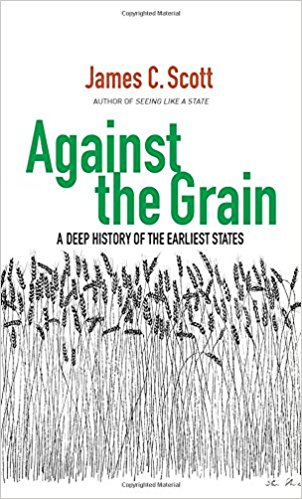
When James Scott publishes a book, I buy it; I’ve learned a lot from his earlier work, especially Domination and the Arts of Resistance (Yale, 1990) and Seeing Like a State (Yale, 1997), and I’ve also learned a lot from the critical responses to these works (like this 1990 article in American Ethnologist by Lila Abu-Lughod). Scott’s most recent book is entitled Against the Grain: A Deep History of the Earliest States (Yale, 2017), and I was excited to get it, because most of my research is also about early states, albeit a small group of early states that are, in the grand scheme of things, small potatoes. Nevertheless, I was happy to see in the index that my little corner of archaeology is mentioned in the book. This is what Scott has to say about the Mycenaeans, in the context of a general discussion about states whose inhabitants “voted with their feet”:
As the state was weakened and under threat, the temptation was to press harder on the core to make good the losses which then risked further defections in a vicious cycle. A scenario of this kind, it appears, was partly to blame for the collapse of the Cretan and Mycenaean centralized palatial state (circa 1,100 BCE). “Under bureaucratic pressure to increase yield, the peasantry would despair and move away to fend for themselves, leaving the palace-dominated territory depopulated, much as the archaeological evidence suggests,” Cunliffe writes. “Collapse would follow quickly.”
Cunliffe is the eminent archaeologist Sir Barry Cunliffe, and in a footnote Scott cites Cunliffe’s Europe Between the Oceans, 9000 BC-AD 1000 (Yale, 2008), p. 238. In that four-page (!!!) section of his book, Cunliffe explains the “collapse” of the polities of the eastern Mediterranean circa 1200 BC as a systems collapse. Cunliffe doesn’t use footnotes, but in his “Further Reading” for this section, he cites for the Aegean N.K. Sandars’ The Sea Peoples: Warriors of the Ancient Mediterranean (London 1978), and for the Levantine coast, a 1987 article by Mario Liverani, and a 1995 article by L.E. Stager.
Okay, so there are lots of problems here:
The was no “Cretan and Mycenaean centralized palatial state,” but a patchwork of small, independent states (most all Aegean prehistorians agree, but there is a minority of dissenting voices).
These states didn’t collapse circa 1100 BCE, but circa 1200 BCE.
There is zero evidence that Mycenaean states pressed the core harder to make good on losses which risked further defections. One can posit such a scenario for the Mycenaean world, it is true, and people have posited something similar (such as Sigrid Deger-Jalkotzy in the Cambridge Companion to the Aegean Bronze Age [2008]). But these are scenarios that have been developed not from empirical evidence, but as general hypotheses that might explain the “collapse.” Some evidence is consistent with this scenario, but I wouldn’t say that the majority of Aegean prehistorians would agree with Scott’s statement. The fact is, our evidence for how hard the palaces pushed their populations is primarily textual, and we don’t have the time depth to understand how hard the population was being pushed (relatively). Absolutely, most people would agree with Oliver Dickinson that “The view that the palaces’ tax demands and forced labour on their construction projects bore heavily on their subjects requires better demonstration than has so far been offered.” (The Aegean from Bronze Age to Iron Age, p. 41).
If you want to talk about the collapse of the Mycenaean palaces, you do not cite Barry Cunliffe, unless you are in some kind of contractual obligation to cite only books published by Yale University Press (this is meant as a joke, but honestly I can’t for the life of me figure out why Cunliffe is cited here otherwise). Barry Cunliffe is an eminent archaeologist, but as our undergraduates all know by the time they’re done taking our courses, some sources are better than others, and a coffee-table book that covers nine millennia in 478 pages without any footnotes is not authoritative. Cunliffe himself, I imagine, would not be comfortable with his book being used in this way (in his preface he apologizes for his selectivity). Cunliffe is not an expert in Mediterranean prehistory, either; his main interests are European archaeology in the 1st millennia BC and AD. And this is illustrated by the fact that Cunliffe’s authoritative source is a book that is a classic that is, however, very much out of date. This isn’t a knock on Cunliffe; his work is generally very good. But it is also general, and I wouldn’t be happy if an undergraduate in my Aegean Bronze Age class cited him on the causes for the Mycenaean palatial collapse. (For that, you should read Eric Cline’s 1177 BC [Princeton, 2014] as well as Oliver Dickinson’s The Aegean from Bronze Age to Iron Age[Routledge, 2006]).
Why am I so worked up about this? I’m not opposed to such big histories necessarily. Callimachus might have been; my title comes from his dictum μέγα βιβλίον μέγα κακόν, better translated “a big book is a great evil” (fr. 465 Pfeiffer), probably in a poetic context. But such books do need to be carefully researched and vetted by experts, especially if arguments are meant to be supported by historical and archaeological evidence.
I do think that it is important that Scott get these details right. It’s fine to theorize that many states collapsed because small losses were compounded by the center, pressing its core harder. I’m sure that this has happened in the past. But Scott’s claim here is that his theories have empirical backing. Otherwise there would be no point in invoking the Mycenaeans or citing Cunliffe; you could just assert it, probably with some adverb like “surely” or “no doubt” that would set off the BS alarm bells in my brain. But if you’re going to claim that your work is empirical, then you need to be right, or at least, you need to be up-to-date. Some day in the future I suppose Scott could be proved correct, but it’s hard to understand how that might be when he’s essentially relying on ideas about the Aegean Bronze Age from the 1970s. Looking at the pages where Scott talks about the Greek world, I see misunderstanding after misunderstanding.
At some point in the future, I’ll read all of this book. Scott is smart, and I’m sure that it will give me good ideas. But Scott is not an archaeologist: he’s trained as a political scientist. And I don’t see any evidence (from the stuff that I know) that he’s bothered to learn enough to know what he’s talking about. As political science, maybe it’s useful. As history, I fear that it is bunk.
One of the side projects that I’m never going to do anything with, probably, is a social network of Aegean prehistory. One of the first things I became aware of when I got serious about archaeology were academic family trees. In archaeology these connections can be very important, and talked about a lot, but the orientation of the discipline to research in the field, and especially to large field projects, means that doctoral supervisors may not be as important as in disciplines where research primarily takes place in the library.
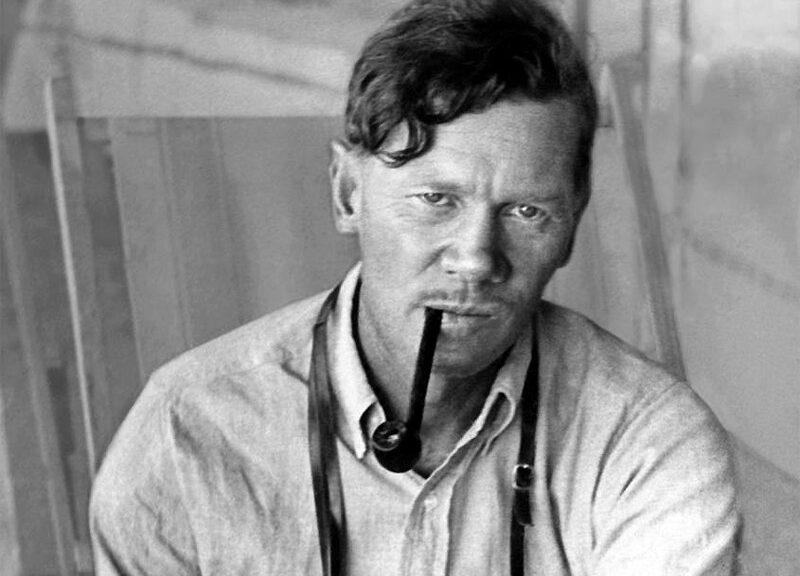
One of the side benefits of doing this project would be to interpret the data in pretty deterministic ways. I say this with a wink: it would actually be really annoying to most people, and part of me thinks that would be fun (and funny). The reason that I think hard determinism would work as an analytic mode is my own background. I’m in the Blegen doctoral tree: my dissertation supervisor, Tom Palaima, was supervised by Emmett Bennett Jr., who was supervised by Blegen. Blegen didn’t have many students by modern standards, which surprised me a bit, but pre-WW II universities in the US weren’t quite the PhD factories they became; Blegen did, however, supervise Bennett, who went on to a long career at Wisconsin, and Jack Caskey, who supervised a great number of doctoral dissertations at the University of Cincinnati. (Thanks are due here to Jack Davis for helping me understand Blegen’s role as dissertation director at Cincinnati).
Blegen’s approach to the field probably explains something like 99% of my career to date. I work primarily on the Linear B tablets from Pylos, the very tablets that were excavated by Blegen himself (ok, not with his actual hands, but in the “heroic archaeology” sense). I’m working on volume IV of the Palace of Nestor series, inaugurated by Blegen himself. The other major area of my career has been archaeological fieldwork, especially survey, in the Peloponnese, and again, Blegen is central. His prescription for fieldwork in Greek prehistory (parts of it, at least) could almost be a stand-in for the way that I currently think about the field, over 75 years later. Blegen was in fact instrumental in the development of archaeological field (or pedestrian) survey in Greece through his support of the Minnesota Messenia Expedition, or MME, the granddaddy of ’em all. Blegen was a devoted excavator not just of palatial sites, but of towns and villages across the Peloponnese: Korakou, Tsoungiza, Zygouries. These are the types of sites that I think we need to keep excavating, albeit with a much more modern and scientific toolkit than Blegen had at his disposal; but his own scholarly writing makes it clear that he would have made full and enthusiastic use of these methods if they had been available to him.
I remember reading somewhere an argument that scientific research labs should be shuttered and buried when the lead researcher retired – I think there was even an archaeological analogy to burying dead pharaohs under tons of rock – on the grounds that these labs tended to self-perpetuate approaches and results, leading to a bit of a rut. I don’t think that this was the case with Blegen. His view of the field was so expansive that he could set the agenda for multiple generations, way beyond his own lifetime. There have been revolutionary changes to method and theory since Blegen’s retirement, but his fundamental view of the field remains valid.
Today Nature published an article entitled “Genetic origins of the Minoans and Mycenaeans“; it already seems to be circulating through the media (e.g., here, here, and here). I managed to get a hold of the article and thought that a quick response was in order. Some caveats: I’m an archaeologist and Linear B specialist, not a geneticist at all, so I’m going to assume that the genetics side of the article isn’t problematic. I’ll just be responding as an archaeologist who’s interested in the results and their analysis.
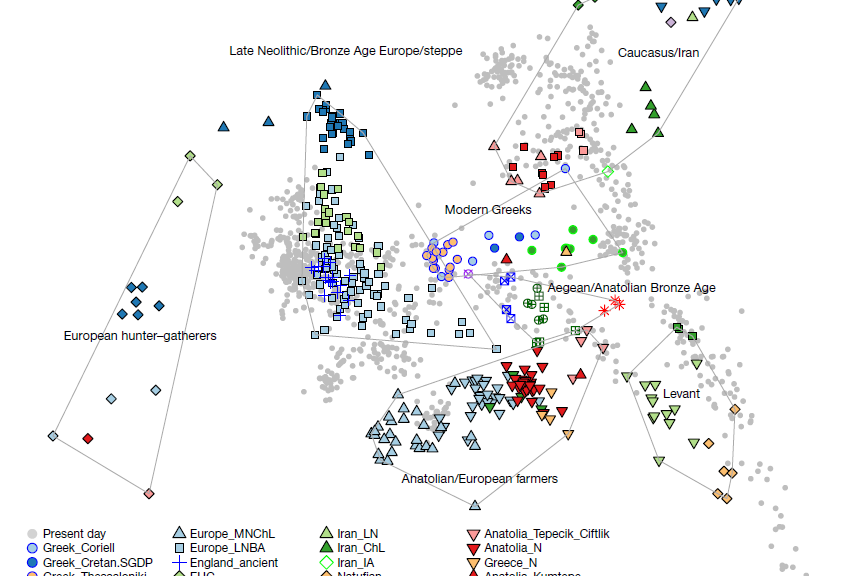
First, there’s not much new here. I mean, the data are new, but the conclusions are largely consistent with the archaeological consensus: there’s no big genetic difference between “Minoans” (Late Bronze Age Cretans) and “Mycenaeans” (Late Bronze Age inhabitants of the Greek mainland), and both are pretty close genetically to Late Bronze Age southwestern Anatolians:
This analysis showed that all Bronze Age populations from the Aegean and Anatolia are consistent with deriving most (approximately 62–86%) of their ancestry from an Anatolian Neolithic-related population (Table 1). However, they also had a component (approximately 9–32%) of ‘eastern’ (Caucasus/Iran-related) ancestry. It was previously shown that this type of ancestry was introduced into mainland Europe via Bronze Age pastoralists from the Eurasian steppe, who were a mix of both eastern European hunter–gatherers and populations from the Caucasus and Iran; our results show that it also arrived on its own, at least in the Minoans, without eastern European hunter–gatherer ancestry. This ancestry need not have arrived from regions east of Anatolia, as it was already present during the Neolithic in central Anatolia…
Genetically, the sampled “Mycenaean” individuals had 4-16% of their ancestry from a “northern” source connected to eastern Europe and Siberia, but generally “Minoans” and “Mycenaeans” were genetically homogeneous.
This doesn’t seem to me to be particularly shocking. I do wonder about the sample sizes, though. The new data are from 19 ancient individuals, 11 from Crete, 4 from the LBA mainland, 1 Neolithic individual from the Mani, and 3 BA individuals from Harmanören Göndürle in southwestern Anatolia.
I do think that some opportunities were missed here. The article specifically positions itself as investigating the origins of the Minoans and Mycenaeans. The authors do pose the question “do the labels ‘Minoan’ and ‘Mycenaean’ correspond to genetically coherent populations or do they obscure a more complex structure of the peoples who inhabited Crete and mainland Greece at this time?” but in the end there is no question of doubting that these cultural historical labels are meaningful and even have a genetic basis. Minoans were like this, Mycenaeans were like that.
Indeed, the article generally embraced the early-20th century intellectual inheritance of culture-history. A sentence like this
migrants from areas east or north of the Aegean, while numerically less influential than the locals, may have contributed to the emergence of the third to second millennium BC Bronze Age cultures as ‘creative disruptors’ of local traditions, bearers of innovations, or through cultural interaction with the locals, coinciding with the genetic process of admixture
is perfectly at home in the pre-WW II writings of Gordon Childe or some of the more traditional ideas of Aegean prehistorians prior to the war, but these ideas have been subjected to savage and devastating critiques since the 1960s. It is odd, and a little disturbing, to read in 2017 that “Relative ancestral contributions do not determine the relative roles in the rise of civilization of the different ancestral populations.” (I keep re-reading that sentence and it is far from clear what it actually means).
On a final note, I kept thinking while reading this article that many Greeks will certainly welcome the conclusion that the modern populations most similar to the Mycenaeans are Greeks, Cypriots, Italians, and Albanians. I can easily imagine many taxi rides in Athens where I talk to the drivers about this article. This occurred to me because I’ve been reading Johanna Hanink’s excellent The Classical Debt, in which she discusses (among many other things) the fury that Fallmerayer still provokes in Greece. (For those who aren’t aware, this is the guy who argued in the early 19th century that “Not the slightest drop of undiluted Hellenic blood flows in the veins of the Christian population of present-day Greece,” and I’ve had dozens of taxi rides where we talk about him and how terrible a person he was). That part of ancient genetics always gives me a little bit of pause; it can reinforce the tendency to think of people and communities in the past as belonging to well-defined nations defined by blood. Or, as Eric Wolf put it in Europe and the People Without History:
By turning names into things we create false models of reality. By endowing nations, societies, or cultures with the qualities of internally homogeneous and externally distinctive and bounded objects, we create a model of the world as a global pool hall in which the entities spin off each other like so many hard and round billiard balls.
The article in question doesn’t seem to have a problem with the “billard ball” way of thinking. The article ends with “Minoans” and “Mycenaeans” safely intact, δόξα τω Θεώ. The last sentence proclaims that “the Greeks did not emerge fully formed from the depths of prehistory, but were, indeed, a people ‘ever in the process of becoming’” (citing here JL Myres’ 1930 book Who were the Greeks?). Sure, I guess; I don’t know anyone who really thinks that they did emerge like Athena, fully armed, from her father’s head. But so what? Are these really the best questions we can ask?
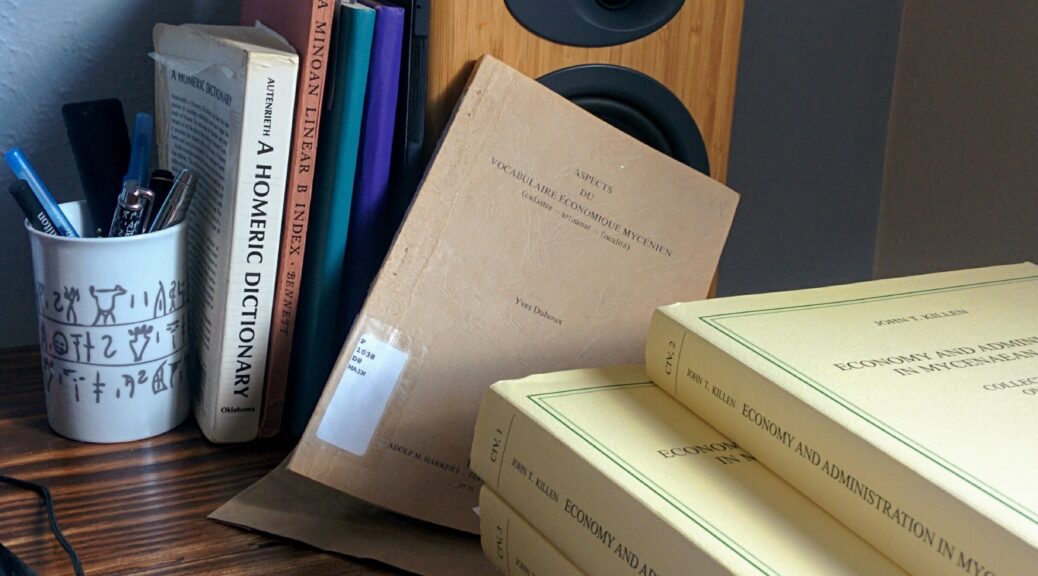
When I started working on Linear B in graduate school (late 90s), there were a handful of books (beyond corpora of texts) that I always kept on my desk for consultation:
What a difference in 2017. I’m working on a paper about Mycenaean “taxation” (really more like extractive regimes) and although I do have my Aura Jorro handy, as well as Docs2, I am leaning on a new set of super useful texts:
Maurizio del Freo’s and Massimo Perna’s Manuale di epigrafia micenea. The only downside to this volume is that it’s in Italian, which is not my strongest language. (Yes, I realize that this is my fault entirely). But it’s very recent (December 2016), authoritative, useful, and cheap: 41.56 euros for 784 pages! It’s got a glossary of Mycenaean words, and although it doesn’t have an index verborum, it does have an index locorum. It’s great to be able to consult Nosch on textiles, Zurbach on the economy, Perna on fiscality, and Garcia Ramon on Mycenaean Greek all in one handy (two-volume) book.
John Killen’s collected papers in three volumes, formally entitled Economy and Administration in Mycenaean Greece, and edited by Maurizio del Freo (2015). Oh man, this thing is the greatest. To be honest, I never really understood the point of collected papers. I had photocopies of pretty much all of these papers, now they live as PDF scans on my hard drive. So what’s to be gained from having all of the papers together physically? Answer: the index. Killen is so productive, so important, and his work so varied, that sometimes it’s hard to remember where any particular discussion is. The great thing about having all of Killen’s papers to hand and indices (verborum and locorum) attached is that you can immediately zoom to the page that you need. It’s really amazing, especially if you’re working on economic or administrative matters in the Linear B texts.
P.S. What do you listen to when you’re working on Mycenaean taxation? If you’re me, it’s Bob Marley and the Wailers pretty much all the time. For some reason I’m especially into the live version of “Punky Reggae Party” on Babylon by Bus.
I’m currently reading Carl Blegen’s “Preclassical Greece,” published in 1941 in Studies in the Arts and Architecture, based on a lecture given at the bicentennial conference of the University of Pennsylvania. It’s a really interesting read.
Looking backward
Some of Blegen’s lecture is – and we shouldn’t be surprised here – dated. For instance, he writes that “the peculiar Hellenic alloy is a complex blend of metal fused together from many elements” (7), meaning peoples: “there is reason to believe that on each occasion when a fresh culture prevailed a considerable body of the earlier racial element survived…” (7). Blegen conflates language, technology and race in a way that nobody would now, and is fond of cultural-historical explanations (e.g., progress on the mainland in the Early Bronze Age is interrupted by an invasion of horse-riding Greek-speakers). In this Blegen was following the lead of archaeologists like V. Gordon Childe, whose cultural-historical syntheses of European prehistory were standard texts in the field. It is nevertheless striking to read that the “fresh advance in the realm of culture” in the Iron Age “worked itself out more expeditiously than in the Early and Middle stages of the Bronze Age, presumably because the Dorian stock, if our conclusions are correct, was racially akin to the Mycenaean strain it conquered” (10). Blegen further wonders if the “cruelty” of historical Greeks were “not perhaps heritages from those remote ancestors who occupied the land in the Late Stone Age” whereas the “delicacy of feeling, freedom of imagination, sobriety of judgment, and love of beauty” might derive from the “progenitors of the Early Bronze Age whose great achievement was the creation of Minoan Civilization” (11). And “To the third racial stock, of Aryan lineage, one might then attribute the antecedents of that physical and mental vigor, directness of view, and that epic spirit of adventure in games, in the chase, and in war, which so deeply permeate Hellenic life” (11). In 2017 this is an uncomfortable thing to read.
Looking forward
Much of Blegen’s paper looks forward, however. He advocates for a total survey of all of Greece. He points out that surface artifacts are useful evidence for subsurface deposits, and suggests that the whole country be “methodically and thoroughly explored” (12) and then 2-3 sites per understudied district be excavated (13). No doubt he would be somewhat surprised at the patchwork of high-intensity surveys that have been conducted in the past 30 years – I imagine that MME is much closer to what he had in mind – but certainly he put his finger on an important development in Greek archaeology, and one that has had an especially important influence on my career.
Blegen also emphasizes that prehistorians are more interested in evidence than treasure. He actually credits Schliemann for being the first to do this, and for making archaeologists more “stratification-conscious”: this is fairly shocking from our 21st century perspective, from which Schliemann is barely more than a treasure-hunter who blasted through the center of the Trojan mound. Blegen emphasizes again and again that most of the most interesting evidence is unpretentious but intellectually rewarding. For instance: “The potent spell exercised by investigation of the preclassical era in Greece on its disciples is not due merely to a desire to recover objects of intrinsic value or to find something novel. It is really a manifestation of that deep impulse by which the inquiring human mind is obsessed to probe into origins and causes” (6). This is exactly the spell that drew me into Greek prehistory (although for me the seminal text was Colin Renfrew’s Emergence of Civilisation [1972]).
Alongside this, Blegen highlights the importance of scientific approaches, declaring that “In the future I believe we shall come more and more to rely on pure science for help in solving many of the problems that face us” (13). He then describes ceramic petrology, a technique that was only then being applied to archaeological ceramics in the New and Old Worlds, as something that would be really useful. (Blegen’s colleague at Cincinnati, Wayne M. Felts, was about to publish an article in the American Journal of Archaeology entitled “A Petrographic Examination of Potsherds from Ancient Troy”).
Both backward and forward
This is how Blegen ends his essay:
By combined effort [i.e., among archaeologists and scientists] we shall ultimately ascertain far more than we yet know regarding the formative period in the history of the Greek people; which, if I may be permitted to repeat what has already been intimated, constitutes at the same time an early stage in the evolution of the culture from which our western civilization is directly descended.
It’s an appropriate ending from our vantage point here in 2017: Blegen is prescient in his intuition that scientific approaches will become more important in archaeological practice, but also looks somewhat awkwardly and optimistically towards a “western civilization” that, we now know, was about to be ripped to shreds by the horrors of WW II.
One of the things I’ve always wanted to do was to start a genealogy of Aegean prehistory. It’s an interesting project, I think. One side benefit would be that I could give hard deterministic papers that erase agency and emphasize the structural constraints of academic training. If dissertations and dissertation advisors count the most, then I fall squarely in the Blegen line: my supervisor was Tom Palaima, who was supervised by Emmett Bennett Jr., who was supervised by Blegen. And I wrote a dissertation on the Linear B tablets of Pylos (which were, of course excavated by Blegen), and I now co-direct an archaeological survey in a poorly-studied area. Pretty Blegen-esque. But about this “western civilization” thing…
At the end of my last blog post, I worried that my take had been too pessimistic and negative. The point of the symposium I’m speaking at isn’t only, I hope, to spread gloom and doom but to talk about the future of our discipline(s). To do that, I think some historical context is necessary. (I should note that I’ve been helped in my thinking by many friends on Facebook especially, including two friends who blogged about this: Bill Caraher and Jim Newhard. You should read their posts).
I don’t think that anyone can deny that the sophistication of archaeological methods has exploded in the past generation. As Adam Rabinowitz writes:
Two hundred and fifty years have passed since the excavations of the Quadriporticus at Pompeii (Poehler, Ch. 1.7). For 230 of those years, field documentation practices remained largely unchanged: archaeologists took notes using pen or pencil and paper, measured features with tapes and plumb-bobs, surveyed with transits and optical theodolites, and drew plans and sections by hand. Only one major technological advance took place during that time: the introduction of photography 60 years after the Quadriporticus excavations began, 190 years before the present. The dumpy level described in John Droop’s 1915 excavation manual (Droop 1915, 11–12) was still in use when I dug at Cosa in 1995, 80 years later.
That tallies with my experience. To run an excavation in the Mediterranean when I began, you basically just needed excavation tools, a total station, paper, screens, and a (film) camera. That’s oversimplifying somewhat, but none of the excavation projects that I was initially trained on in the mid-1990s had (if I remember correctly) a systematic program for water sieving or scientific methods like radiocarbon dating. In my area of Greek prehistory, at least, a whole set of methods have been introduced that have radically transformed the data that are collected as part of systematic excavation. Here are some of the ones that come immediately to mind, in no particular order: ceramic petrography/petrology, archaeobotany (via water sieving and phytoliths), various scientific dating methods (from dendrochronology to OSL), pollen coring, soil micromorphology, bioarchaeology, DNA studies, isotopic analysis of tooth enamel and bones, analysis of bone collagen, zooarchaeology, organic residue analysis, microwear analysis, trace element analyses (ICPS, ICP-MS, MC-ICP-MS, XRF, etc.) and isotopic analyses. (I’m sure that I’m missing a bunch, don’t yell at me). Of course, regional approaches to the archaeological record have also been radically affected by the developments in geophysics, geology, geomorphology, and soil science, remote sensing using aerial photography and satellite imagery, etc.
Some might object at this point that many of these techniques are more relevant to prehistory than to other kinds of archaeology, especially the archaeology of historical periods, but in fact many of them are being used by the Roman Peasant Project, which makes use of a variety of methods to get at the archaeology of Roman non-elites living in the countryside. This is really wonderful.
All these data are great, and they’re indispensable. Without them, I couldn’t teach the prehistory of the Aegean. This is a class that I taught just last year to a mix of undergraduates and graduates, and while all of the above didn’t make it into the lectures, readings, and class discussions, scientific and methodological advances take center stage at a number of the most important debates going on right now in Aegean prehistory. Archaeological science is not something “extra” to throw into the mix to make your project seem cutting edge; it’s absolutely central to modern archaeological practice.
There are a couple of important developments from this explosion in new methodologies, however.
First, it takes a village. Collaboration is more important than ever, because nobody has all the skills or knowledge to deal with all this material. This is great: it democratizes, one hopes, archaeological fieldwork, as the structural model of the archaeological project transitions away from a top-down “heroic” model in which the archaeological director closely controls the material and its interpretation to something akin to a seminar, populated not just with skeptical graduate students and real Mediterranean archaeologists but also a series of specialists. Old projects had architects, ceramicists, and maybe a numismatist; new projects have many more specialists than this. Because these specialists have rare skills and knowledge, they often are needed by the projects more than they need the projects: they are in constant demand.
Second, this stuff ain’t cheap. As Bill Caraher pointed out, there is a real danger that elite universities will be the only ones that can point their cash cannon at these projects, especially as public funding sources like the NSF are being eroded. Archaeological labs with high-tech equipment aren’t really a thing in Classics departments, in large part because Mediterranean nations don’t generally allow for the legal export of most archaeological materials (and for good reason!). But without them, training is made difficult. Again, the elite universities are well-placed to purchase the expensive equipment needed and often have historical collections of materials from the Mediterranean when export was allowed.
Third, this growth in increasingly indispensable technical and laboratory-based studies creates, as I wrote in my last blog post, “a growing chasm…between what makes good archaeology in the Mediterranean and how one gets a job in a Classics department.” New data, and new kinds of data, help us to answer research questions, old and new. But this interpretive firepower comes at a cost: training in the canonical skills of the discipline (i.e., philology, ancient history, art-historical analysis of material culture). If these specialists cannot get jobs in the academy, then Mediterranean archaeology risks falling further behind other archaeologies in its methodological, technical, and thereby interpretive, sophistication. As I mentioned last time, archaeologists need time to make their materials sing, so if Mediterranean projects just bring in specialists whose real interests lie elsewhere to do scientific analyses, interpretive sophistication will most certainly suffer.
I think that we can say that archaeology in the Mediterranean has come an awfully long way since the 1950s, from dumpy levels to phytoliths. Archaeology done now is vastly superior to what we were doing before, as a friend of mine always points out. That’s wonderful. But there is a real danger that we won’t follow up on these advances with changes to the structures of our disciplines, that folks with the languages peddling synthetic accounts that are more easily digestible to ancient historians and literary folks (that’s me I’m describing) will get jobs while the folks doing cutting-edge work will struggle, especially in a job market that’s been battered by the financial crisis and a shift away from humanistic disciplines. That’s not so wonderful.
A series of flights across North America (Denver to LaGuardia to Toronto) gave me the opportunity to finally read a volume I picked up in New Orleans edited by Natalia Vogeikoff-Brogan, Jack Davis, and Vasiliki Florou about the life and work of Carl Blegen, the excavator of Pylos (among many other sites).
My friend Bill Caraher already wrote some thoughts about the volume, and, like Bill, rather than write a review of the book, I just wanted to add a couple of thoughts that the various papers elicited.
Archaeological teamwork
Davis and Vogeikoff-Brogan emphasize that Blegen thought of archaeology as a “team enterprise” (11), and Blegen also came up with my new favorite quote about a successful excavation (192):
On a dig, you have to live as a family lives… and if you have to live as a family, it’s better to be a happy family.
But if the excavation team was a family, it seems that Blegen was very much the paterfamilias. John Camp is quoted in the volume as commenting that
Among those who didn’t know him, Mr. Blegen was thought to be gentle; and he was. But among those who worked with him, he had a fuller reputation as a man who was somewhat hard to work for. Once he had stated an opinion, it was to be regarded as fact; one did not argue with Mr. Blegen, his word was law. … In short, his gentle manner was real, but it hid a forceful stubborn personality.
That’s interesting, especially because that the model of excavation when Blegen began his research emphasized not the archaeological team, but the singular excavator, a model that Bill Caraher has described as “heroic archaeology.” Blegen’s way of thinking seems to have departed somewhat from the “heroic archaeology” model: it is the model of a family-like or patrimonial structure, with the director playing the role of the traditional strict father, whose opinion is fact and whose word is law. Nevertheless Blegen was, if I understand things correctly, progressive for his day. By contrast, the projects that I were trained on didn’t resemble this patrimonial model. Instead they rather resembled a modern graduate seminar, with “skeptical graduate students” (SGSs) — people like me — engaging in a lively debate with the project directors, the “real Mesoamerican Mediterranean archaeologists” (RMAs) and the “great synthesizers” (GSs). In fact, I felt so comfortable working in this environment that as an SGS I felt comfortable working with and publishing project data, without feeling the need to worry too much about whether the RMAs and GSs would disagree with my interpretations and get angry. Thinking about it a little bit, that’s actually quite remarkable. In any case, this model seems to have emerged in the post-war period, after Blegen’s training was already complete. But it was embraced by those students he trained. In this sense, Blegen’s model of a successful excavation straddles the true “heroic archaeology” of the early 20th century and the more team-oriented model that characterizes late 20th century and early 21st century American archaeology.
I should emphasize that this is not a hidden criticism of Blegen, who by all account was extremely generous and kind, but a comment on the changing nature of archaeological knowledge production. If anything, Blegen was far ahead of his time, both with respect to the way he treated his archaeological family and in the way that he worked together with his colleagues in the Greek archaeological service (the latter point is emphasized especially by Davis’s chapter in the Blegen volume).
Insiders and outsiders
Blegen was sometimes an insider, sometimes an outsider. He was director of the American School of Classical Studies at Athens, but only after he had first been (somewhat voluntarily) banished from it by Edward Capps, then the chair of the American School’s managing committee. In “the most dramatic episode” in the School’s history (5), Bert Hodge Hill was forced out of the directorship of the School by Capps, and with Blegen he retreated from the School to found a salon at 9 Ploutarchou.
I’m not particularly interested in assigning blame for this episode (I don’t know nearly enough about it, although I am inclined to favor Hill and Blegen over Capps), but it is astonishing to think that Blegen — probably the most important American archaeologist in Greece over the last 100 years — was ever on the outs at the American School, an institution at which he is now revered. It’s a vivid illustration not only of the vicissitudes of archaeological fortune (i.e., today’s outsider is tomorrow’s superstar and eventual legend) but also of the wastefulness (that’s not quite the right word) of the political wrangling of archaeological heavyweights. Capps seems to have blocked Blegen from working at Pylos using “political pressure, bribery, and blackmail” (214). One of the things that I like least about archaeology is the way in which established scholars can use their influence to block access to others, and the way that research material becomes territory to be defended at all costs. I was drawn to archaeology because I had the real sense that we archaeologists are all in this together, that our data and interpretations, when combined and recontextualized and reinterpreted, are moving us closer to a better understanding of the past. That’s naive, admittedly, but I still believe it. We all benefit the more transparent and open we are with our evidence and our interpretations, and we all suffer when those doors are closed. Here too, Blegen was ahead of his time, a scholar who seems to have encouraged and enabled others. He was, after all, a man who held an open hour at his home in his retirement for anyone who wanted to talk to him (133-134). Perhaps it was the experience of having the door shut to him by Capps that encouraged him to be so open and welcoming to others.
Over the past several months, a couple of different people have asked me why I like survey. My initial response is always intellectual. I talk about the importance of understand the countryside, about the urban bias of our texts and excavations, the approach of books like The Corrupting Sea, and so on. In both cases, that wasn’t the answer that the questioner wanted. What they wanted to know was, why did I like getting up before dawn to wander around the Greek countryside for six hours or more over six+ weeks?
Strangely, that’s a more complicated answer. As a student, I wasn’t immediately drawn to archaeological survey, although I was of course exposed to it as an undergraduate at the University of Michigan, especially in the classes that I took from Sue Alcock and John Cherry. I first got seriously interested in survey because of the senior thesis that I wrote on settlement and state formation in Minoan Crete. I knew that I was interested in state formation (thanks to classes with John Cherry and Kent Flannery) and I knew that it was too big a topic for an undergraduate thesis. So I had spent the summer reading Colin Renfrew’s The Emergence of Civlisation (1972) — a book, incidentally, that convinced me that I wanted to be an Aegean prehistorian — and went into John Cherry’s office with a list of areas that interested me. One of them was settlement, and that sealed my fate: I ended up writing my thesis on published survey data from Crete from the Bronze Age, with a focus on the relationship between settlement data and state formation.
So my initial interest in survey was based on thinking, not doing. I had done survey for two weeks in Tunisia on the Leptiminus project back in 1995, and I liked it, but it wasn’t immediately my passion. But my intellectual interest in landscape and settlement led to me working on survey projects as I entered graduate school, both on the Iklaina Archaeological Project and especially the Eastern Korinthia Archaeological Survey.
So that’s part of the story… but the way that I’ve told it might suggest that I like survey as an intellectual and analytical activity but not in practice. That’s not the case. So when I’ve been asked why I like to get up before dawn and wander around the Greek countryside, I tend to talk about a couple of different things:
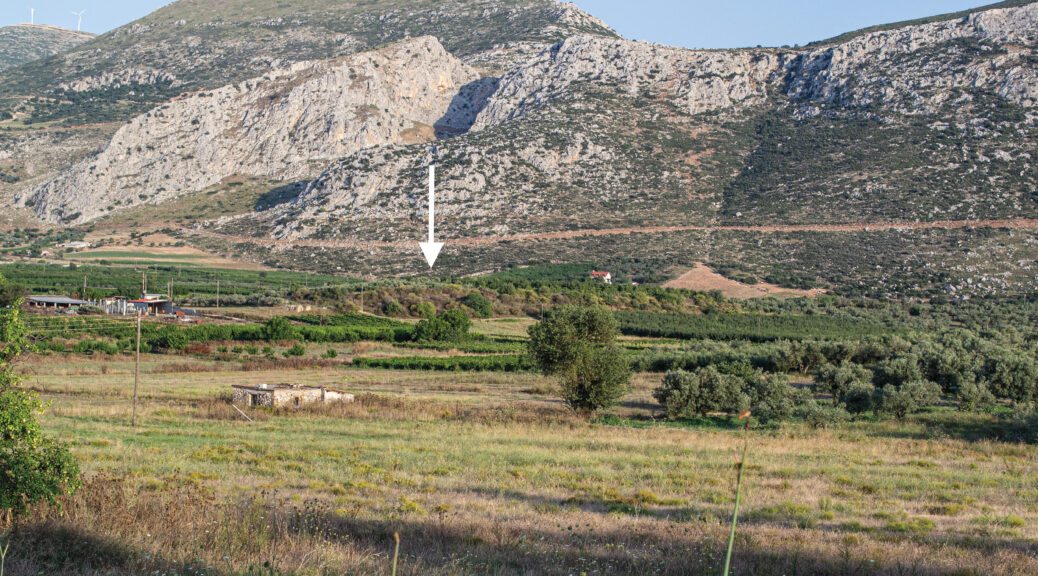
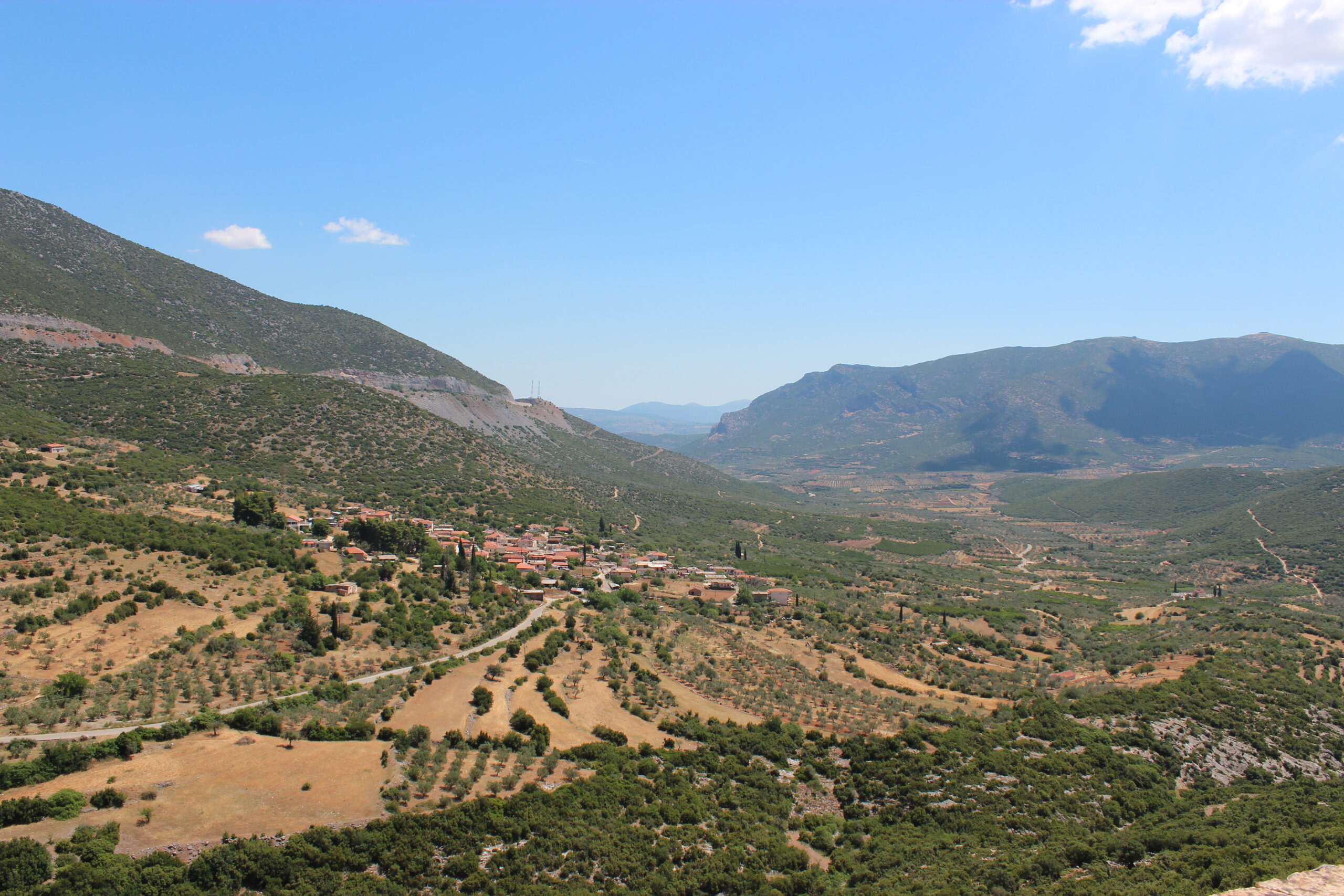
(1) The Greek landscape is really beautiful. I won’t ever get tired of looking at this:
Kaparelli
And this isn’t even the most iconic form of the Greek landscape (the deep blue Aegean up against the painted white houses of the Cyclades), but it’s still wonderful and variegated. Some of my favorite moments in Greece have been driving around a corner to be greeted to a wide and beautiful vista (the road to Kato Zakros in Crete is one of the best).
(2) The Greek landscape is endlessly surprising. This is true both generally — there are so many beautiful little valleys and harbors in Greece that you could spend your whole life visiting them — and in particular — walking through a familiar landscape will yield all kinds of little surprises.
(3) I love to explore and to hike. Loving survey is about embracing that spirit of exploration: of wanting to hike the trail that you haven’t yet hiked, not knowing where it goes. It sounds cheesy, and it is, but to love survey I do think you need to want to hike up to that hill in the distance to see what’s there.
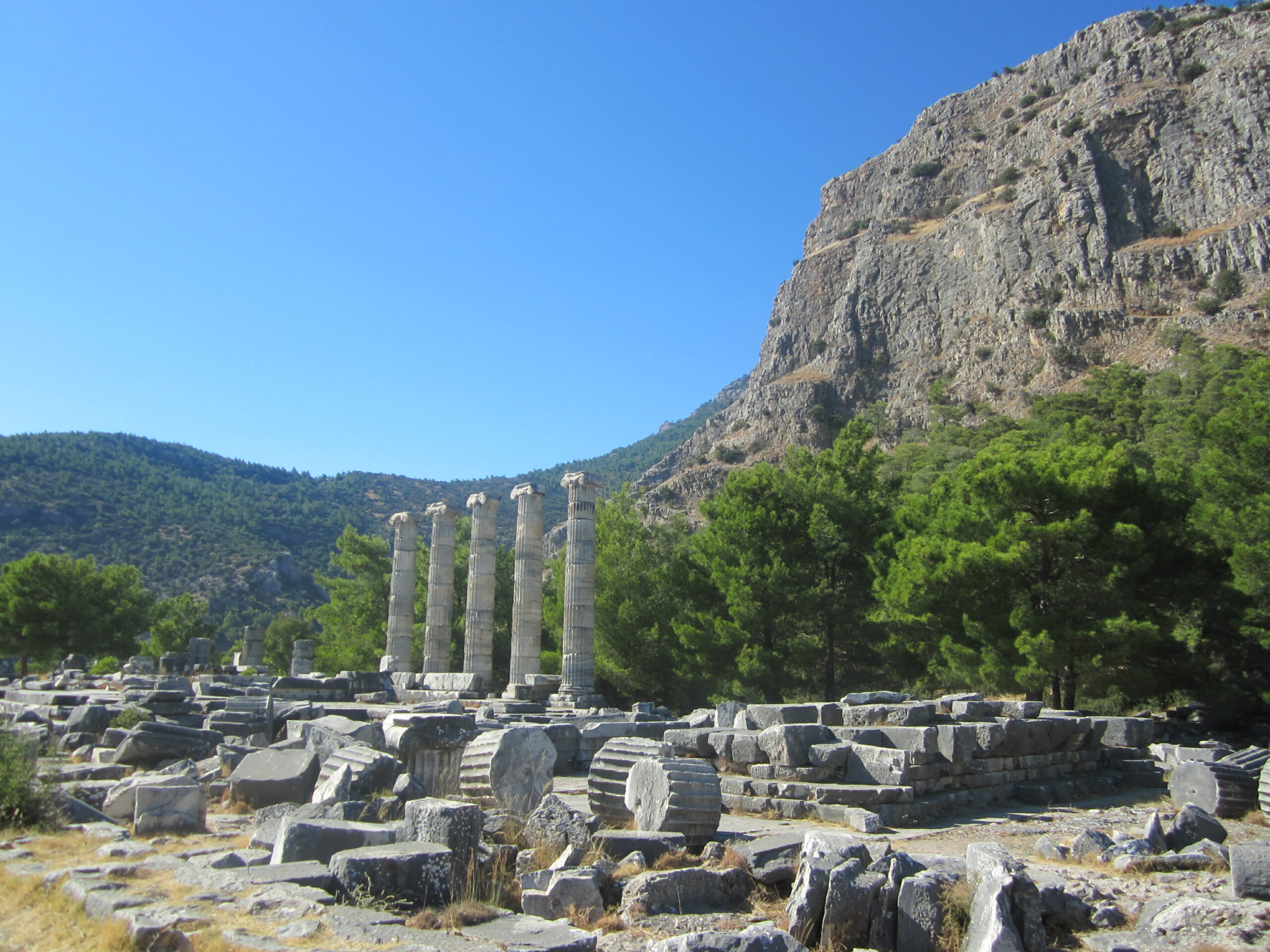
This will sound familiar to veterans of the American School’s regular program, which involves a lot of hiking up to hills to see what’s there. When I went to Priene on the Ionia trip led by John Camp, my first thought and first question to John was, “Can I hike up to the acropolis?”
After being asked why I liked survey and giving these three responses, I started to wonder where (3) came from. Why do I have this strange desire to hike up to hills and mountains to see what’s up there? Was it drilled into me at the American School? Or does it come from somewhere else?
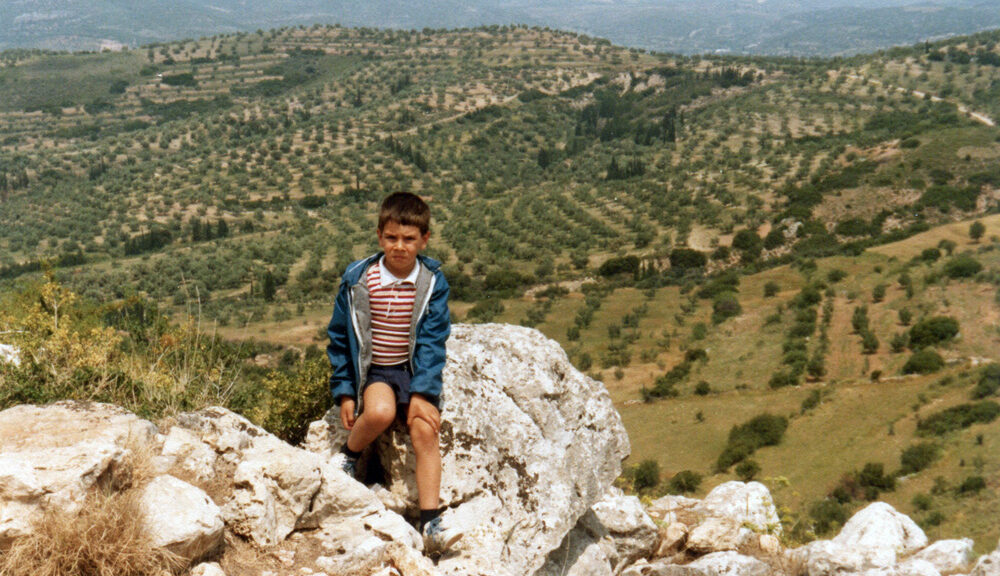
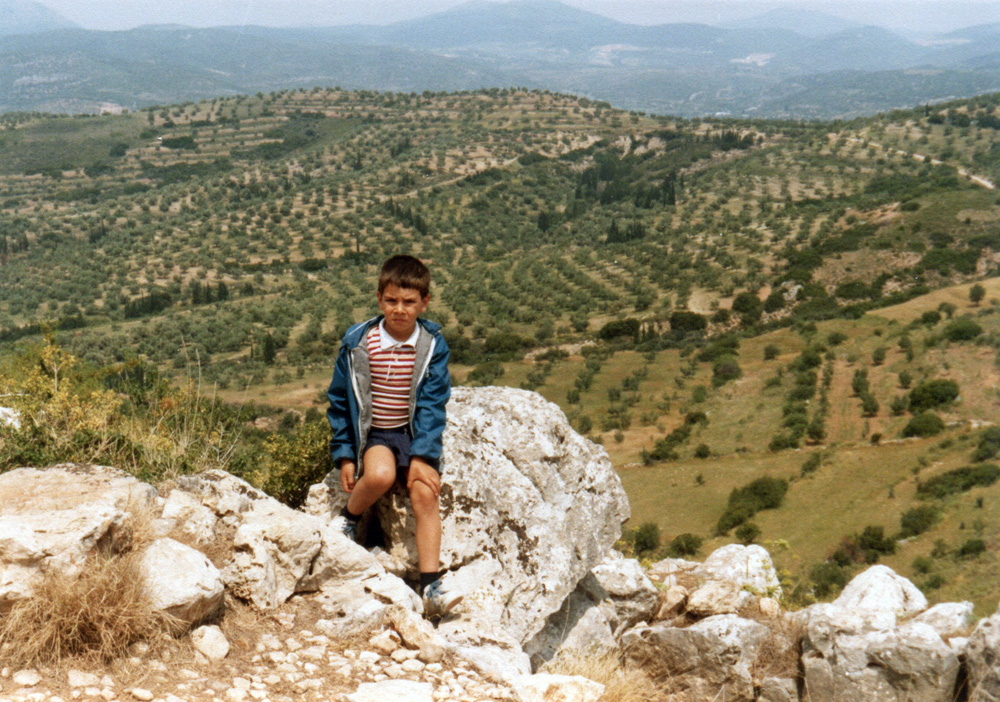
Thinking back on it, I spent an awful lot of my childhood hiking up hills in Greece. Most of my father’s family never left Greece, and so my summer vacations as a child involved going to Greece to visit my uncle, my cousin, and my grandparents. And Nakassis family vacations basically involved eating, swimming, and wandering up to hills.
Doesn’t it look like I’m having a great time? We wandered up hills like this one, with world-famous, UNESCO World Heritage archaeological sites on them, but we also hiked up to castles (like the Frankish castle above Voidokoilia beach, which we did without bringing any water with us!) and also up mountains with nothing on them at all, like when we were on vacation on Kos and Lesvos.
I do think that there’s something to this idea, that I like survey not only for intellectual reasons that emerged from my undergraduate education and my exposure to professors who were and are passionate about the ability of survey to shed light on the ancient world, but also because it involves a bodily practice and a bodily engagement with the Greek landscape that is almost literally hard wired in me from years of childhood vacations with my family. I managed to turn vacation activities into serious research. I’m not too upset about that.