Tag Archives: archaeology

Post-periphery

I just got back to Athens from the 3rd International Symposium on the Periphery of the Mycenaean World. It was an exciting and demanding conference: there were 60 talks over three days. Most days started at 9 am and didn’t finish before 8 pm. So today I’m exhausted and sleep-deprived, and my head is spinning with new information and new ideas. My observations on the whole event are:

  1. Lamia is an incredibly welcoming place. The symposium was co-hosted by the archaeological ephorate of Phthiotis and Evrytania and the Demos of Lamia, and both were amazing hosts. The δήμαρχος was present – and not in the usual way. He didn’t just speak at the start of the conference and disappear; he sat in on a lot of sessions and personally thanked many of the speakers. The director of the ephorate and everyone associated with it were also super hospitable; at the end of the conference we got great tours of the castle of Lamia and the archaeological site of Kynos.
  2. Who runs the world (of Greek archaeology)? Women. More than two thirds of the speakers at the symposium are women (41 out of 60 by my count), and that doesn’t take into account that eight of the male speakers aren’t Greek or don’t have positions in Greece. It is a noticeable difference if you are used to archaeological traditions in which men are dominant (numerically and otherwise). Of course it’s the archaeologists in the Greek Ministry of Culture that are overwhelmingly female (rather than, say, University professors), but they are the ones supervising and doing almost all of the archaeology in Greece.
  3. The Greek archaeological service is chock full of talent. The archaeologists of the service work under extremely difficult conditions, to be sure. Their intellectual ability, work ethic, and dedication to archaeology is unmatched. I don’t know enough to compare the archaeologists of Greece to other countries, but it’s hard to imagine that Greece is second to any other country in terms of talent and devotion.
  4. The “periphery” is so ’90s. By the end of the conference, it seemed clear that most participants were dissatisfied with the title of the conference and especially the use of the term “periphery.” It came up in a bunch of the talks (including mine) and in the concluding remarks too.
  5. The “periphery” is where it’s at. There’s so much coming out of the ground in these “peripheral” areas that it’s dizzying. I came out of the conference feeling like an ignorant fool for not keeping apace of these developments.
  6. I really need to improve my Greek.

Here’s the text of the paper that I delivered:

«άγνωστος λησμονημένος απ’όλους»? Why the “periphery” should be central to Mycenaean studies

Dimitri Nakassis, University of Colorado Boulder

From the very beginning of its study, it has been traditional to understand the Mycenaean world as a homogeneous culture. Christos Tsountas had concluded already at the end of the nineteenth century that the Mycenaeans constituted “a distinct and homogeneous civilization” («πολιτισμός…ομογενής») whose “central hearth” was the site of Mycenae (η πόλη των Μυκηνών «παρουσιάζεται σήμερον ως η κυριωτέρα εστία του πολιτισμού εκείνου») and whose northern frontier lay at Thessaly. In my paper today, I’d like to suggest that this view, venerable as it may be, presents us with a number of problems that affect the study of the “core” regions of the Mycenaean world as well as its so-called “periphery.” After briefly reviewing these problems, I will very briefly suggest some solutions, which point to the importance of the periphery for the study of the Mycenaean world.

I should say from the start that my paper will be intentionally challenging and unorthodox. I want to destabilize established ideas about “cores” and “peripheries” in the Mycenaean world. My discussion is premised on two arguments: one, that Mycenaean archaeology radically overestimates the importance of the palaces, and two, that heterogeneity across time and space has too often been overlooked. The homogeneity of the Mycenaean world is closely linked to the presumed centrality of the palaces, so much so that it is difficult to separate them conceptually.

To begin: the notion of a Mycenaean “core” is both temporal and spatial, for it is normal to define the “core” with respect to the establishment of the palaces.

For example, traditional definitions of “Mycenaean” typically invoke, as Jim Wright does here, a temporal scheme in which the “high point” – or in this case, the “fullest expression” – of the Mycenaean world is located temporally in the 14th and 13th centuries BC, and specifically in the material culture associated with the palaces.

By “Mycenaean” I mean the assemblage of artifacts that constitutes the characteristic archaeological culture that originates on the mainland of Greece in the late Middle Bronze Age, finds its fullest expression in the palaces during the Late Helladic (LH) IIIA-B, and can be traced through the postpalatial LH IIIC period.

Put another way, our internal periodization of the Mycenaean world revolves entirely around the establishment and destruction of the palaces. There are, no doubt, good reasons to organize the material this way, but this mode of organization nevertheless creates problems, both empirical and theoretical.

For example, what do we do with regions that never developed palaces? Does Arkadia have a “palatial” period if there is no Arkadian palace? The answer to this question is usually “no.” Thus, for instance, Cynthia Shelmerdine and John Bennet suggest that

regions such as Achaea and Laconia apparently never developed a monumental center like Mycenae or Pylos. These areas may have continued to operate at the level of the Early Mycenaean village-centered societies, outside the control of any particular center.

(Shelmerdine and Bennet are obviously writing prior to the discovery of Ayios Vasilios in Lakonia).

Likewise, Emiliano Arena suggests that “chiefdoms characteristic of the Early Mycenaean era probably survived alongside Mycenaean palatial states” in Achaia and other non-palatial parts of the Mycenaean world. That is to say, it is usual for scholars to assume that non-palatial parts of the Mycenaean world do not participate fully in the palatial period. Indeed, they effectively remain – socially, politically, and economically – in the pre-palatial Early Mycenaean period.

We can see, therefore, that time and space are connected in this schema. The core isn’t just more central spatially, but it is more advanced temporally. It experiences a palatial period, whereas the periphery remains stuck in the prior pre-palatial period. The schema is reminiscent of the remark of Thucydides (1.5) that καὶ μέχρι τοῦδε πολλὰ τῆς Ἑλλάδος τῷ παλαιῷ τρόπῳ νέμεται (“up to the present much of Greece lives in the old manner”): so the Ozolian Lokrians, Aitolians and Akarnanians continue to carry weapons ἀπὸ τῆς παλαιᾶς λῃστείας (“from the piracy of old”).

This situation is unsatisfactory for many reasons. It is obviously teleological: the Mycenaean world’s end goal is a monolithic and rigid palatial system. But for the purposes of my talk today, I want to highlight two other problems with this scheme. First, it does a poor job of understanding the operation of the palaces; and second, it underestimates the capacity for complexity in non-palatial regions. It is frankly depressing that it seems so logical to us that a place as dynamic and as interesting as western Achaia (for example) can be understood as essentially “pre-palatial” – that is, it is depressing that we don’t have better models with which to come to grips with such regions, and that we assume that the Mycenaean world is capable of only one form of complexity.

I would also argue that our conception of the palaces as highly rigid and hierarchical structures is an impediment. I have argued that this image isn’t consistent with the internal evidence of the Linear B tablets. At Pylos and other sites, it seems clear that the palatial system depends on the participation of a large number of individuals who appear in the texts identified by personal name. Almost all of the most important systems of production, from the manufacture of textiles to metallurgy, are premised not on palatial systems per se, but on what we might anachronistically call “private enterprise” harnessed to serve palatial interests. Just as there are no large palatial estates (as Julien Zurbach has recently argued at some length), so too are other areas split up into small pieces for which named individuals are responsible.

Even interregional exchange seems to have been transacted through the agency of elite intermediaries. Although the evidence is slim – Linear B famously tells us very little about trade – the evidence that we do have is consistent with this picture. Here, for example, we have one of two tablets from Pylos (An 35) that refers to the palace “purchasing” alum, an astringent and mordant, from a named individual probably named Aithalos (“Smoky”, Καπνώδης), who is also a smith (appropriately, given his name) elsewhere in the tablets. Because alum isn’t available in the Peloponnese, it must have been imported, perhaps by Aithalos himself as it was by another smith (named Kyprios) mentioned elsewhere as a palatial alum supplier.

This research matters, I think, because in conjunction with new discussions about how the palatial economy operates, it gives us a different view of the palaces. Rather than being monolithic institutions that are separate from society at large, the palaces function by interfacing with complex economies that either pre-existed these palatial systems or emerged in tandem with them. That is to say, the palatial system was both deeply rooted in, and densely entangled with, broader socioeconomic practices and processes.

This observation, in turn, allows us to explore a second area of concern: internal heterogeneity. If the palaces emerged through dynamic processes that responded to local conditions, as recent research has suggested, then we would expect some heterogeneity within the Mycenaean “core,” and indeed this is exactly what we find. Although many scholars have stressed the homogeneity of the Mycenaean world, in my view this has been over-emphasized. Even burial in chamber tombs, so often understood as an important marker of “Mycenaean-ness”, is practiced in a very uneven way across the Peloponnese. (This map is by now well out of date but it still illustrates the general point). Even where the material culture is superficially similar, the historical developments may differ so much that the same forms clearly have different meanings. So, for example, tholos tombs aren’t used in the same way in Messenia as they are in the Argolid or in Boeotia.

One way to deal with this heterogeneity is to speak of “Mycenaeanization,” which is a useful concept insofar as it points to the fact that Mycenaean culture is itself a process that unfolds through time. On the other hand, Mycenaeanization is vulnerable to all of the problems that have plagued Romanization: the implication that cultural change is unilateral and unilinear, the emphasis on elite culture, the deemphasis on local variation at the expense of uniformity, and so on. As Carl Knappett has perceptively observed, “Mycenaeanization” is also problematic if it imagines a central and unitary core from which “Mycenaean-ness” radiates, especially since such a core is empirically difficult to define, and so (and I quote), “it is easier to entertain the idea that Mycenaeanisation is a set of processes happening across a wide area.” At first glance, Knappett is clearly correct: many of the practices that characterize the Mycenaean world have very different histories. The history of the tholos tomb, for instance, looks nothing like the history of Linear B: neither in terms of their chronologies (that is, neither their timing nor their pace), nor in terms of their geographical origins, nor in terms of their coherence (that is, Linear B is much more homogeneous across the Mycenaean world).

A problem that I have been dancing around but have not yet fully confronted, then, is the issue of the integrity of Mycenaean culture. Many scholars stress its homogeneity; a growing number stress its heterogeneity, following the tendency in affiliated fields like anthropology to stress cultural contradictions and contestations. I think that these positions can be reconciled through the notion of “thin coherence,” as articulated by William Sewell. He points out that while culture is inherently contradictory, loosely integrated, contested, mutable, and highly permeable, it also possesses “a real but thin coherence that is continually put at risk in practice and therefore subject to transformation.”

This notion of ‘thin coherence’ has proved a useful way to think about the historical Greek world in the edited volume by Carol Dougherty and Leslie Kurke, The Cultures within Ancient Greek Culture (2003). As Josh Ober points out in this volume, umbrella terms like “Greek” or “Mycenaean” are analytically meaningful, but they do “offer only very limited purchase” when we ask questions about specific communities.

I think that “thin coherence” does a good job characterizing the patterns that we see in the Mycenaean world. The term “Mycenaean” has validity for a general analysis, but it clearly lacks explanatory value at the regional or sub-regional level. For instance, if we look closely at Mycenaean Arkadia, as Eleni Sallavoura has done, we see that certain standard Mycenaean practices, like burial in chamber tombs and the use of figurines, are rare. On the other and, Sallavoura declares that it is “unfair” to label Arkadia a periphery, since Arkadian burial customs are unexceptionally Mycenaean in character and even the most remote mountain communities use Mycenaean pottery. Calling Arkadia “Mycenaean,” then, doesn’t tell us what the archaeology looks like in specific terms, but it rather points to the fact that the region participates in a number of Mycenaean practices. This is, for me, a good illustration of Mycenaean culture’s “thin coherence.”

Another good illustration is the way that Mycenaean administration works. Here, even in the most homogeneous of Mycenaean practices, there are significant temporal and regional variations, as Cynthia Shelmerdine and others have emphasized. On the one hand, it seems logical that administration is the most homogenized field of practice. As Sewell observes, dominant actors and institutions try to impose coherence on cultural practice through a variety of strategies, and the coherence of administrative practices is plausibly due to such efforts. Yet it is clear that there is no single Mycenaean administrative system. For example, while Pylian administrative practice entails a centralized and centripetal Archive Complex managed by a single master scribe (Hand 1) and a well-organized hierarchical territory, other Mycenaean centers are not so organized. Even if the North Entrance Passage at Knossos represents a central archive, the Knossian administration is not comparable to the Pylian. Because the people who wrote our tablets were administrators, not just scribes, such differences are not just epiphenomenal but cut to the heart of administrative practice and organization. In terms of territoriality, Jan Driessen has convincingly interpreted the Knossian state as territorially discontinuous beyond its administrative core, and I suspect that the same is likely to be true for the Theban polity as well. In this context, as in many others, Pylos appears to be atypical.

Thus far my work has been largely critical, but in my conclusion I want to turn to an approach that I think is more profitable and addresses the second part of my paper’s title, “Why the “periphery” should be central to Mycenaean studies.” If we accept Knappett’s suggestion that “Mycenaeanisation is a set of processes happening across a wide area” and we accept that this area cannot (or need not) be divided into a “core” and a “periphery,” then the obvious job of Mycenaean studies is not to focus on categories such as core/periphery or Mycenaean/non-Mycenaean (especially because our understanding of ethnic identity in the Late Bronze Age is effectively zero). We should instead focus on practices and study how they unfold historically. This approach is preferable because one and the same practice may appear at different times in different places and in different contexts, and it is clear that a single practice can mean radically different things to different communities. This focus on discrete practices allows us to sidestep the problematic notions of Mycenaean unity and identity – and the even more problematic arguments about who or what is really Mycenaean – and to focus our attention instead on the constitutive practices of the Late Bronze Age as they were reproduced in space and time.

From this perspective, which is broadly representative of how archaeologists work anyway, areas traditionally understood as “peripheral” now become central to Mycenaean studies. From the traditional core/periphery perspective, someone like me who works in the “core” of the Mycenaean world – in my case, Messenia and the Argolid – the Mycenaean periphery isn’t strictly necessary, because as interesting as it may be, it is a passive recipient of “Mycenaeanization.” If, on the other hand, the practices that collectively constitute “the Mycenaean” are widely distributed, then the “periphery” becomes central insofar as it contributes as much as the “core” does to our understanding of how Mycenaean practices are organized and how they interface with other practices in different contexts.

For example, Girella and Pavuk (2016) have recently summarized the evidence for weaving activity at Troy in a broad-ranging discussion of the Mycenaeanization of the northeast Aegean, and note that the implements are largely preserved in the vicinity of the lower terraces of the citadel and in the fill of the ditch encircling the Lower Town. They then suggest “some kind of central control over the textile production at Troy during LH IIIA2 and IIIB,” presumably because “it is proved that [in the Mycenaean core] … specific segments of production, such as the textile industry, were controlled by the palatial elites.” Actually the situation is not so simple. Certainly we can conclude on the basis of the Linear B texts that some textile production was administered by the palace, but the palace actually obtained textiles in at least three ways: (1) direct production from attached workshops, (2) taxation, and (3) through direct purchases from specialists.

This last mechanism is attested by this beautiful tablet at Pylos (PY Un 1322), which records a payment to a weaver (or weavers) of a whopping 1,152 liters of grain.

This minor example is illustrative of my critique, and perhaps suggests a way forward. With respect to the former, I want to point out how quick Girella and Pavuk are to assign the entire field of textile production to total palatial control across the entire Mycenaean world in the core and even to central control (however that is imagined) in the periphery. This is a good example of how we have radically overestimated the role of the palaces and the uniformity of Mycenaean practice. But Girella and Pavuk put their finger on something important: the archaeological evidence at major centers on the Greek mainland does not allow us to understand the place of weaving in the Mycenaean economy: recent publications of the evidence at Tiryns and Midea, for example, lament how slender the evidence is. If we want to understand Mycenaean weaving, sites like Troy, where the evidence is more robust, are good places to start exploring this issue, which will undoubtedly be complex, at least as complex as the textual evidence and likely much more than that.

In his poem The King of Asine, Seferis imagines a careful search up and down the rocky hill for the ruler who is “unknown, forgotten by all, even by Homer.”

κι ο βασιλιάς της Ασίνης που τον γυρεύουμε δυο χρόνια τώρα
άγνωστος λησμονημένος απ’ όλους κι από τον Όμηρο
μόνο μια λέξη στην Ιλιάδα κι εκείνη αβέβαιη
ριγμένη εδώ σαν την εντάφια χρυσή προσωπίδα.

Seferis’ search is in vain. So too, I suggest, will our search be in vain if we presuppose simple, binary forms for a highly complex and heterogeneous Mycenaean world. We should embrace the full complexity of the archaeological and textual evidence, especially in areas considered peripheral. These so-called “peripheries” should be central to Mycenaean studies, since it is at the interface of practices that our understanding comes most clearly into focus.
Photo by Jan Driessen
The academic book review

Academic book reviews are tricky things. Authors – or this author, at least – are nervous about how their work will be reviewed. For those writing the reviews: it’s hard work, and reviews aren’t especially valued by the profession. Young scholars are advised, correctly I think, to avoid writing reviews for precisely these reasons. People can also be sensitive – a friend of mine got a nasty e-mail from an author for writing what seemed to me a totally reasonable book review – and so there can be a real downside to writing reviews, especially critical ones.

Because I’m not very smart, I’ve written 14 book reviews, 11 pre-tenure. I can’t say that any of the reviews was worth the time they took, and a lot of them caused a fair bit of heartache. I’m by nature a super-, even hyper-, critical person, but I also don’t want to write a book review that’s so critical that it moves into the territory of being mean-spirited. I’ve probably failed at striking a good balance, but it’s not for lack of trying. My process is usually to write a first draft that has everything that I really want to say, and then I edit out the unnecessary and petty crap over and over again until I have a review that I’m okay with: neither too critical, nor unrepresentative of my feelings about the book. That’s the idea, anyway; I’ve never been really happy with the results. I’m almost always worried about how my reviews will be received. As the result of one particularly difficult review, I’ve tried to write many fewer reviews, but inevitably I get roped into one every now and again, at which point I remember why I tried to stop writing them.

One might ask, then, why bother to publish book reviews at all? We could just publish short summaries. But good, critical reviews are incredibly useful. A take-down of a particularly bad book provides a useful corrective, and sometimes a review can lead to a useful back-and-forth that articulates important critical differences in the field, but the book review that takes a step back to consider the broader intellectual landscape is especially useful. For example, John Cherry’s review of the Berbati-Limnes survey in 1998 ends with a comment that the northeastern Peloponnese was so heavily surveyed that “we may finally have reached the stage where it is feasible to attempt synthesis and comparison on a scale much larger than that of any individual survey, throwing into sharper relief the distinctive patterns and rhythms of change in particular regions, and the factors that may ultimately help us explain them,” a call (repeated from an earlier article of his, to be sure) that has inspired an awful lot of good research and more surveys in the area.

Reviews can be especially toxic, though, when they’re uncharitable, when senior scholars attack young scholars, and when they’re used to settle scores. Once I got very annoyed when an established scholar wrote a review of a book to which I (then pre-tenure) contributed a chapter; he had also been, I am 99.99% sure, one of the reviewers of the book’s manuscript when it was submitted to the press. His review of my chapter was wrong-headed (it was the kind of review that was annoyed that I had written an article about A in B instead of what he would have written about, X in Y), and he repeated some of his dumb comments in the review. (Incidentally, is it kosher to review a book whose manuscript you reviewed?) I recently got all agitated when a book written by a friend of mine – his first book – was reviewed uncharitably, again by a senior scholar. You can read some of my thoughts on Twitter. I won’t repeat them here, except that what I found upsetting about the review was (1) that it didn’t seem to even try to understand the context of the book on its own terms, (2) didn’t (try to) understand the actual arguments of the book, (3) didn’t understand basic facts (e.g., about the Greek language) and (4) was written by a senior scholar who was attacking a younger scholar’s work. It’s hard to read a review like this and think that something else isn’t going on. What I suspect is going on is, at least in part, this: Some institutions are full of people who see themselves as gate-keepers, but their gate-keeping activity seems mostly to take the form of attacking (in print and elsewhere) any young scholar whose work doesn’t conform to their extremely narrow and out-dated definition of what’s acceptable scholarship.

Big book, big evil

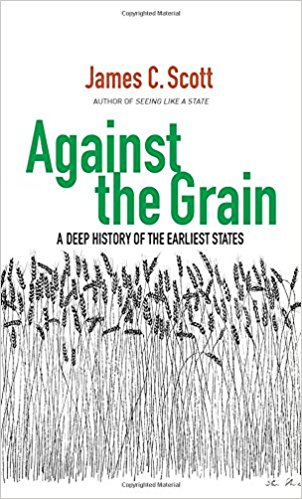
When James Scott publishes a book, I buy it; I’ve learned a lot from his earlier work, especially Domination and the Arts of Resistance (Yale, 1990) and Seeing Like a State (Yale, 1997), and I’ve also learned a lot from the critical responses to these works (like this 1990 article in American Ethnologist by Lila Abu-Lughod). Scott’s most recent book is entitled Against the Grain: A Deep History of the Earliest States (Yale, 2017), and I was excited to get it, because most of my research is also about early states, albeit a small group of early states that are, in the grand scheme of things, small potatoes. Nevertheless, I was happy to see in the index that my little corner of archaeology is mentioned in the book. This is what Scott has to say about the Mycenaeans, in the context of a general discussion about states whose inhabitants “voted with their feet”:

As the state was weakened and under threat, the temptation was to press harder on the core to make good the losses which then risked further defections in a vicious cycle. A scenario of this kind, it appears, was partly to blame for the collapse of the Cretan and Mycenaean centralized palatial state (circa 1,100 BCE). “Under bureaucratic pressure to increase yield, the peasantry would despair and move away to fend for themselves, leaving the palace-dominated territory depopulated, much as the archaeological evidence suggests,” Cunliffe writes. “Collapse would follow quickly.”

Cunliffe is the eminent archaeologist Sir Barry Cunliffe, and in a footnote Scott cites Cunliffe’s Europe Between the Oceans, 9000 BC-AD 1000 (Yale, 2008), p. 238. In that four-page (!!!) section of his book, Cunliffe explains the “collapse” of the polities of the eastern Mediterranean circa 1200 BC as a systems collapse. Cunliffe doesn’t use footnotes, but in his “Further Reading” for this section, he cites for the Aegean N.K. Sandars’ The Sea Peoples: Warriors of the Ancient Mediterranean (London 1978), and for the Levantine coast, a 1987 article by Mario Liverani, and a 1995 article by L.E. Stager.

Okay, so there are lots of problems here:

  1. The was no “Cretan and Mycenaean centralized palatial state,” but a patchwork of small, independent states (most all Aegean prehistorians agree, but there is a minority of dissenting voices).
  2. These states didn’t collapse circa 1100 BCE, but circa 1200 BCE.
  3. There is zero evidence that Mycenaean states pressed the core harder to make good on losses which risked further defections. One can posit such a scenario for the Mycenaean world, it is true, and people have posited something similar (such as Sigrid Deger-Jalkotzy in the Cambridge Companion to the Aegean Bronze Age [2008]). But these are scenarios that have been developed not from empirical evidence, but as general hypotheses that might explain the “collapse.” Some evidence is consistent with this scenario, but I wouldn’t say that the majority of Aegean prehistorians would agree with Scott’s statement. The fact is, our evidence for how hard the palaces pushed their populations is primarily textual, and we don’t have the time depth to understand how hard the population was being pushed (relatively). Absolutely, most people would agree with Oliver Dickinson that “The view that the palaces’ tax demands and forced labour on their construction projects bore heavily on their subjects requires better demonstration than has so far been offered.” (The Aegean from Bronze Age to Iron Age, p. 41).
  4. If you want to talk about the collapse of the Mycenaean palaces, you do not cite Barry Cunliffe, unless you are in some kind of contractual obligation to cite only books published by Yale University Press (this is meant as a joke, but honestly I can’t for the life of me figure out why Cunliffe is cited here otherwise). Barry Cunliffe is an eminent archaeologist, but as our undergraduates all know by the time they’re done taking our courses, some sources are better than others, and a coffee-table book that covers nine millennia in 478 pages without any footnotes is not authoritative. Cunliffe himself, I imagine, would not be comfortable with his book being used in this way (in his preface he apologizes for his selectivity). Cunliffe is not an expert in Mediterranean prehistory, either; his main interests are European archaeology in the 1st millennia BC and AD. And this is illustrated by the fact that Cunliffe’s authoritative source is a book that is a classic that is, however, very much out of date. This isn’t a knock on Cunliffe; his work is generally very good. But it is also general, and I wouldn’t be happy if an undergraduate in my Aegean Bronze Age class cited him on the causes for the Mycenaean palatial collapse. (For that, you should read Eric Cline’s 1177 BC [Princeton, 2014] as well as Oliver Dickinson’s The Aegean from Bronze Age to Iron Age [Routledge, 2006]).

Why am I so worked up about this? I’m not opposed to such big histories necessarily. Callimachus might have been; my title comes from his dictum μέγα βιβλίον μέγα κακόν, better translated “a big book is a great evil” (fr. 465 Pfeiffer), probably in a poetic context. But such books do need to be carefully researched and vetted by experts, especially if arguments are meant to be supported by historical and archaeological evidence.

I do think that it is important that Scott get these details right. It’s fine to theorize that many states collapsed because small losses were compounded by the center, pressing its core harder. I’m sure that this has happened in the past. But Scott’s claim here is that his theories have empirical backing. Otherwise there would be no point in invoking the Mycenaeans or citing Cunliffe; you could just assert it, probably with some adverb like “surely” or “no doubt” that would set off the BS alarm bells in my brain. But if you’re going to claim that your work is empirical, then you need to be right, or at least, you need to be up-to-date. Some day in the future I suppose Scott could be proved correct, but it’s hard to understand how that might be when he’s essentially relying on ideas about the Aegean Bronze Age from the 1970s. Looking at the pages where Scott talks about the Greek world, I see misunderstanding after misunderstanding.

At some point in the future, I’ll read all of this book. Scott is smart, and I’m sure that it will give me good ideas. But Scott is not an archaeologist: he’s trained as a political scientist. And I don’t see any evidence (from the stuff that I know) that he’s bothered to learn enough to know what he’s talking about. As political science, maybe it’s useful. As history, I fear that it is bunk.

On genetics and the Aegean Bronze Age

Today Nature published an article entitled “Genetic origins of the Minoans and Mycenaeans“; it already seems to be circulating through the media (e.g., here, here, and here). I managed to get a hold of the article and thought that a quick response was in order. Some caveats: I’m an archaeologist and Linear B specialist, not a geneticist at all, so I’m going to assume that the genetics side of the article isn’t problematic. I’ll just be responding as an archaeologist who’s interested in the results and their analysis.

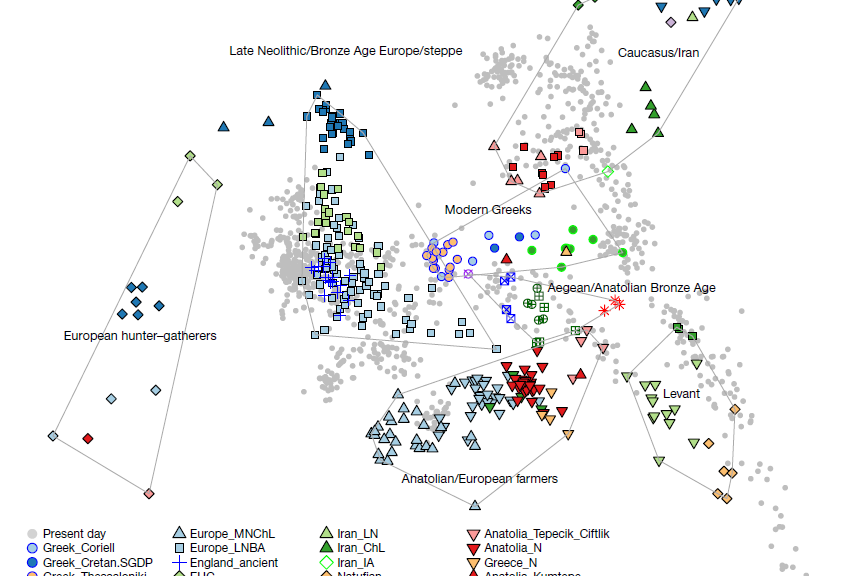
First, there’s not much new here. I mean, the data are new, but the conclusions are largely consistent with the archaeological consensus: there’s no big genetic difference between “Minoans” (Late Bronze Age Cretans) and “Mycenaeans” (Late Bronze Age inhabitants of the Greek mainland), and both are pretty close genetically to Late Bronze Age southwestern Anatolians:

This analysis showed that all Bronze Age populations from the Aegean and Anatolia are consistent with deriving most (approximately 62–86%) of their ancestry from an Anatolian Neolithic-related population (Table 1). However, they also had a component (approximately 9–32%) of ‘eastern’ (Caucasus/Iran-related) ancestry. It was previously shown that this type of ancestry was introduced into mainland Europe via Bronze Age pastoralists from the Eurasian steppe, who were a mix of both eastern European hunter–gatherers and populations from the Caucasus and Iran; our results show that it also arrived on its own, at least in the Minoans, without eastern European hunter–gatherer ancestry. This ancestry need not have arrived from regions east of Anatolia, as it was already present during the Neolithic in central Anatolia…

Genetically, the sampled “Mycenaean” individuals had 4-16% of their ancestry from a “northern” source connected to eastern Europe and Siberia, but generally “Minoans” and “Mycenaeans” were genetically homogeneous.

This doesn’t seem to me to be particularly shocking. I do wonder about the sample sizes, though. The new data are from 19 ancient individuals, 11 from Crete, 4 from the LBA mainland, 1 Neolithic individual from the Mani, and 3 BA individuals from Harmanören Göndürle in southwestern Anatolia.

I do think that some opportunities were missed here. The article specifically positions itself as investigating the origins of the Minoans and Mycenaeans. The authors do pose the question “do the labels ‘Minoan’ and ‘Mycenaean’ correspond to genetically coherent populations or do they obscure a more complex structure of the peoples who inhabited Crete and mainland Greece at this time?” but in the end there is no question of doubting that these cultural historical labels are meaningful and even have a genetic basis. Minoans were like this, Mycenaeans were like that.

Indeed, the article generally embraced the early-20th century intellectual inheritance of culture-history. A sentence like this

migrants from areas east or north of the Aegean, while numerically less influential than the locals, may have contributed to the emergence of the third to second millennium BC Bronze Age cultures as ‘creative disruptors’ of local traditions, bearers of innovations, or through cultural interaction with the locals, coinciding with the genetic process of admixture

is perfectly at home in the pre-WW II writings of Gordon Childe or some of the more traditional ideas of Aegean prehistorians prior to the war, but these ideas have been subjected to savage and devastating critiques since the 1960s. It is odd, and a little disturbing, to read in 2017 that “Relative ancestral contributions do not determine the relative roles in the rise of civilization of the different ancestral populations.” (I keep re-reading that sentence and it is far from clear what it actually means).

On a final note, I kept thinking while reading this article that many Greeks will certainly welcome the conclusion that the modern populations most similar to the Mycenaeans are Greeks, Cypriots, Italians, and Albanians. I can easily imagine many taxi rides in Athens where I talk to the drivers about this article. This occurred to me because I’ve been reading Johanna Hanink’s excellent The Classical Debt, in which she discusses (among many other things) the fury that Fallmerayer still provokes in Greece. (For those who aren’t aware, this is the guy who argued in the early 19th century that “Not the slightest drop of undiluted Hellenic blood flows in the veins of the Christian population of present-day Greece,” and I’ve had dozens of taxi rides where we talk about him and how terrible a person he was). That part of ancient genetics always gives me a little bit of pause; it can reinforce the tendency to think of people and communities in the past as belonging to well-defined nations defined by blood. Or, as Eric Wolf put it in Europe and the People Without History:

By turning names into things we create false models of reality. By endowing nations, societies, or cultures with the qualities of internally homogeneous and externally distinctive and bounded objects, we create a model of the world as a global pool hall in which the entities spin off each other like so many hard and round billiard balls.

The article in question doesn’t seem to have a problem with the “billard ball” way of thinking. The article ends with “Minoans” and “Mycenaeans” safely intact, δόξα τω Θεώ. The last sentence proclaims that “the Greeks did not emerge fully formed from the depths of prehistory, but were, indeed, a people ‘ever in the process of becoming’” (citing here JL Myres’ 1930 book Who were the Greeks?). Sure, I guess; I don’t know anyone who really thinks that they did emerge like Athena, fully armed, from her father’s head. But so what? Are these really the best questions we can ask?

My summer “vacation”

This blog post is an expansion of an article by Mary Beard in the TLS, where she is responding to Andrew Adonis’ accusation that academics have 3 months of holiday in the summer, basically for no good reason. Not that it’s necessary, but perhaps I can add to the discussion a little bit by piling on. So what am I doing with my “3 mth summer holiday“?

(1) Six weeks in Greece working on two projects, one in the field and one in the museum, during which time I had not one day off. I literally went to the beach zero times, even though that is one of my favorite things to do and we were living less than 200 meters from said beach.

(2) Another six weeks at home, during which time I am taking not one day off. I’m working on two articles, reading a dissertation, correcting proofs, doing administrative work associated with my duties as associate chair of graduate studies from the 2016-17 academic year, evaluating manuscripts for journals, and so on. I also really need to write a series of reports for the six weeks of fieldwork that we just finished. (That’s usually the first thing that I do at the end of a summer of fieldwork, but I’m late on the articles, so I’m putting that work off).

(3) That leaves me one week to prepare for the start of the semester, although I’m already doing a little bit of that so I’m sure that will bleed into my “summer holiday.”

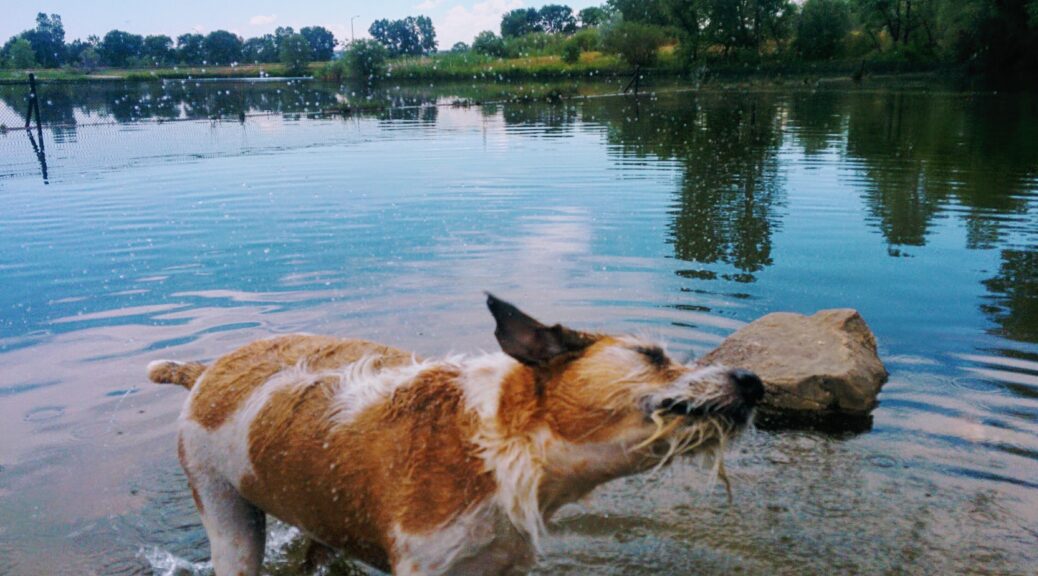
I will admit, however, that I have a bit more spare time over the summer (when I’m not in the field, that is). I’m spending that extra time with my family, listening to a lot of music while I work (especially the new Kendrick Lamar), reading the occasional book (I’m still chipping away at Johanna Hanink’s The Classical Debt), and taking the dog to a park with a pond so that she, at least, can have a swim this summer:

Slow archaeology & the prestige economy

This blog post is a response to two other blog posts. First, Andre Costopoulos wrote a post entitled “The traditional prestige economy of archaeology is preventing its emergence as an open science.” Here is his argument, broken down into outline:

  1. “Archaeologists are traditionally defined by the material they know.” That knowledge is often defined regionally and temporally, e.g. the Late Bronze Age Argolid. These specialists act as gatekeepers to research (permits and grants) and publications. The reputations of these specialists are very important to their professional success.
  2. “It isn’t surprising then, that the road to an open science of archaeology is a slow and fitful one.” This where I disagree with Costopoulos, so I’m going to quote him to make sure I represent his argument faithfully:

Young archaeologists have, naturally, been pushing hard for the opening of databases and for the sharing of raw materials. Recognition by peers for mastery of these is coin of the realm. With some notable exceptions, their senior colleagues have been less eager to open up the vaults.

Whether they consciously realize it or not, the sharing of information is a threat to the prestige and even the livelihood of many established archaeologists, both academic and professional. Their status as keepers of the review process and holders of permits is devalued if the arcane knowledge on which it is founded is widely disseminated and easily available. The impressions on which the judgements of keepers depend are acquired over decades of digging, both literal and figurative. If the information that formed the impressions is suddenly democratized, what power will the clergy hold?

The second blog post I’m responding to is Bill Caraher’s response to Costopoulos. Bill re-interprets Costopoulos’s piece as a critique of “slow archaeology”:

I’ve insisted that slow archaeology depends upon deep familiarity with a site and its material. This kind of knowledge resists the kind of neatly-organized and regimented transparency that is sometimes presented as open science (although, to be fair, open science types have recognized the value of slow data). If we argue that archaeological methods and practices (and the knowledge that it produces) is more similar to craft and communicated through personal networks, apprenticeships, and experience, then it would seem that it is resistant, to some extent, to open science.

My ideas aren’t fully-formed here, so I might be barking up the wrong tree, but I think something important is being elided. Costopoulos talks about data and information. Bill talks about knowledge. But what’s really at stake in specialists defending their turf isn’t data or knowledge (exactly), but rather skill. My friend Kim Shelton could make all of her pottery databases available to me but that wouldn’t make me a specialist in Mycenaean pottery. I wouldn’t know what she knows, I won’t have seen what she’s seen. If I used her databases to write an analytical article about Mycenaean pottery, I wouldn’t be welcomed into the warm embrace of Mycenaean ceramicists. I wouldn’t be one of them. I wouldn’t have their skill or their knowledge, just their data.

I don’t think that open data will really democratize the archaeological academy. To answer Costopoulos’ question, “If the information that formed the impressions is suddenly democratized, what power will the clergy hold?” The answer is: plenty.

I’d suggest that if we want to democratize archaeology, much more important are (1) access to actual archaeological materials (and not just their digital ghosts) and (2) more mentoring on the part of specialists. (1) is clearly a problem in many parts of the world, including the part that I work in (Greece); (2) I think is less of a problem. Most specialists are incredibly giving of their knowledge and willing to train the next generation.

A final archaeological future

I just got back from a long trip to Northampton, Williamstown, Oberlin, and Cleveland. The trip began with a talk entitled “Doing archaeology in a digital age: challenges and opportunities” at Smith College’s The Futures of Classical Antiquity. I gained a lot from my interactions with colleagues on social media and from the blog posts that friends wrote in response to my blogging on the topic (see, e.g., Bill Caraher’s post on professionalization). Here’s the talk as I gave it, with some minor annotations and some links to references:

—

“Archaeology is at an exciting juncture” (Atalay 2012: 1). This is true for the discipline of archaeology as a whole, and for Classical archaeology. There are a million ways I could proceed. There is the issue of how archaeologists engage with the public generally, and local communities specifically. There is the issue of ethical practices, both with respect to the profession and with respect to the outside world. Archaeologists are struggling with issues of preservation, against the rising tides of looting and development, and against ourselves: how do we work sustainably so that existing sites are adequately maintained once they’ve been excavated and so that materials are effectively stored and made available for study? How do we deal with the “data avalanche” that we’ve unleashed so that our work is carefully archived, and how good are existing structures for dissemination, academic and popular? Are our curricula working for our students? These are all interesting questions that most practitioners, I suspect, are worried about, and I am certain that there are many more questions that I could pose. But because this is a symposium about the futures of Classical antiquity, Ι want to focus on the relationship between Classical archaeology and the discipline of Classics.

I want to preface my remarks with two brief comments: “Classical archaeology” is a problematic term that I’ll use here as a shorthand for “the archaeology of the ancient Mediterranean.” And in this talk I’ll be focusing almost exclusively on field archaeology rather than the many other things that Classical archaeology could refer to: art history, topography, and so on; in part because field archaeology is what I know best and where I think there is the most potential for transformative change.

Let me start with what’s good about Classical archaeology. Even bad Classical archaeology for 2017 is pretty good Classical archaeology in the grand sweep of its history (I owe this point to Donald Haggis). I think this mostly has to do with increasing professionalization: Classical archaeologists see themselves as professionals that need to uphold basic standards that correspond to the field’s expectations. That wasn’t always so: Classical archaeology has traditionally been a rich white man’s game. As I entered the field in the mid-1990s, the last of the great self-funded excavations were coming to an end. These kinds of projects have a long history stretching back to the very origin of the discipline: Schliemann’s excavations at Troy and Mycenae, paid for from his own pocket. The current crop of archaeologists, although they largely come (I suspect) from affluent backgrounds, do not have the financial wherewithal to pay for their own field projects, and so typically they fund them through a mix of external grants (public and private), university research funds, and private donations. It is worth noting at this point that Classical archaeology is still a rich man’s game, in that the institutions of Classical archaeology are relatively wealthy and rich private donors continue to exercise influence. But individual practitioners in the Mediterranean are now part of a broader professionalized academic archaeological community and see themselves as such. This opens the field to those with the requisite abilities and skills, rather than those with the economic and symbolic capital. This is not to say that problems don’t remain. Representation of women in directorial ranks remains a serious problem, and one that is especially prominent considering how many female students and scholars there are in Classical archaeology. A quick count of American projects in Greece shows that male directors outnumber female directors 18 to 4 (cf. the Canadian Institute: 14 men, 8 women).

The second part of the improvement is that the archaeological tools and methods at our disposal have increased infinitely in sophistication since the time when I entered the field in the mid-1990s. For those of us who entered the discipline then, it wasn’t uncommon to be trained to use a dumpy level and a stadia rod, a 19th century technology for measuring elevation. Excavation was essentially just stratigraphic digging, using traditional tools: big picks, hand picks, and trowels. We recorded our work in notebooks, at various levels of standardization and consistency. We measured using tapes and plumb-bobs, we drew by hand on graph paper. The only real technological innovation in the previous 100 years had been film photography (Rabinowitz 2016). The lack of technical innovations at that time reflected not so much the availability of technologies but rather the research questions that Classical archaeology sought to address. In what is, I think, an apocryphal story, when a Greek prehistorian asked the director of a major American excavation why he didn’t use a water sieve, the (joking) response was “Because inscriptions don’t float” (cf. Whitley 2001: 57).

That joke reflects the old orientation of the discipline, which was to illustrate the world of the texts. For instance, the 1996 excavation summary of the Athenian Agora begins with the claim that the excavations for that year shed light on (1) the city’s destruction at the hands of the Persians in 479 BC and (2) the form of the great statue of Athena Parthenos. This approach was, of course, logical. Classics is a discipline defined by a narrow canon of texts and the philological skills required to read them in the original languages. The canon focuses, of course, on particular times and places, like 5th century Athens, and so why not devote enormous resources to understanding the greatest moment of Athens’ history and her greatest artistic productions? Training archaeologists at a high level in the ancient languages also followed logically from this orientation: if the telos of archaeology was to follow a trail left by texts, then what could be more important than being able to read and understand them? The other part of this is that the ancient world began with the text such that the material remains were understood as epiphenomenal. It was thus natural for Coldstream in 1976 to understand tomb cult (attested archaeologically) as the product of a text, namely Homer.

No doubt this is a too-simple characterization of a complex situation, and sub-fields like Greek prehistory have always had different priorities and therefore made use of a broader range of methodologies. (For instance, the water sieve was introduced to Greece in 1969 by the excavations at Franchthi Cave). But we can see that the traditional orientation of Classical archaeology towards texts is preserved in the way that graduate programs and other institutions train and evaluate their students.

Today archaeological excavations are much more sophisticated with respect to analytical techniques. Virtually all projects now have a systematic strategy for flotation, and some analyze phytoliths. The use of soil micromorphology, especially on excavation, has become increasingly common in the last ten years. Remote sensing, which was essentially limited to analysis of aerial photographs in the 1950s, now includes multispectral satellite images as well as archaeological geophysics. Palaeoenvironmental studies have helped us to reconstruct ancient coastline and climate, as well as anthropogenic episodes of landscape change. Scientific methods for the study of archaeological materials has also flourished.  Technical analyses of human bone make use of macroscopic forensic analysis as well as scientific analyses of various isotopes and DNA; so too does analysis of animal bones make use of a combination of macroscopic and scientific analysis. Ceramics are being studied in a wide variety of ways, including petrology and chemical analyses, and their residues are increasingly being tested. I could go on and on: scientific and microscopic analyses are now de rigeur for stone tools, metals, and indeed every type of archaeological material. Scientific methods used for absolute dating are still rare outside of prehistory, however.

These analytical techniques are increasingly central to the shape of the discipline. That is, the research being produced by archaeological scientists is increasingly central to the research questions of the field, and that’s reflected in archaeological literature, field practices, and institutional structures. Not only are journals of archaeological science flourishing, but central issues are increasingly tied to scientific research. Whereas these methods were once especially associated with prehistoric archaeology, they are increasingly being used on field projects of all types, from long-standing urban excavations to newer projects like the excavations at Gabii or the Roman Peasant Project. Specialists aren’t just coming in at the end of the field season to examine their materials, but are increasingly part of the daily practice of field archaeology: the lab is coming to the field. And archaeological sciences increasingly appear in our teaching, too: a course in the archaeology of the Aegean Bronze Age taught today includes a lot more discussion of scientific techniques than one taught twenty years ago.

This shift in archaeological practice comes both from a surge in technological innovation in the aftermath of the Second World War, but also from important shifts in research priorities away from culture history and towards paradigms that emphasized the historical processes at the root of cultural change. The influence of the “New Archaeology” that dominated North America in the 1960s and 1970s certainly encouraged interest in the “interaction between humans and the natural environment,” (McDonald 1972: 3) the application of scientific approaches in archaeology, and the kind of interdisciplinary scientific collaboration that is now common in the Mediterranean. In Greece, at least, the standard-bearer was the Minnesota Messenia Expedition (MME), a project that combined regional survey and excavation with historical studies, materials analysis, ethnography, geomorphology, soil science, physical anthropology, geochemistry, geophysics, and so on, all with the goal of “reconstructing a Bronze Age regional environment” (McDonald and Rapp 1972). The penetration of ideas from the New Archaeology entered the Mediterranean largely via prehistorians like Bill McDonald, the co-director of MME, in part because these ideas had already circulated in nuce among them (Blegen 1941). Already in the interwar period, prehistorians were advocating for research projects that focused on long-term change and “the conditions of life of the humble commoner” (Blegen 1921: 125-126). The focus on the everyday is still visible nearly a century later in recent work in social and economic history and regionally-oriented archaeology. I’m thinking here of Horden and Purcell’s The Corrupting Sea, Paul Halstead’s ethnographic magnum opus, Two Oxen Ahead, and the Roman Peasant Project, a collaboration between Penn, Cambridge, and Siena that seeks to identify and excavate the dwellings of the Roman rural poor between the 2nd c BC and the 6th c AD in western Tuscany through a combination of archaeological field survey, geophysical survey, and excavation; archaeobotany, zooarchaeology, organic residue analysis, and microtopographical soil reconstructions.

The mention of The Corrupting Sea points at a significant convergence between archaeology and Classics over the past two generations. When Classical archaeology’s purpose was to illustrate texts, it didn’t really have much to offer Classics. Excavations in Athens might illustrate some aspect of the Persian sack in 479 BC, but ultimately the literary narrative remained primary and the archaeological evidence secondary. The Corrupting Sea, on the other hand, is a work of ancient history that is built up from the concerns and evidence of archaeology, regional or landscape archaeology in particular, especially the micro-region, the emphasis on environment, the infinite complexity of economic strategies, the element of risk, the constant movement of people and goods. Even their micro-regional case studies are drawn from those covered by survey projects (e.g., Melos). Here and elsewhere in the past 30 years we can see a real engagement with archaeological evidence by ancient historians, and a willingness on the part of archaeologists and historians to use archaeological evidence to contravene well-established, textually-derived truths.

Similarly, shifts in the study of Greek literature under the influence of a variety of approaches have allowed for a convergence between Classics and archaeology (broadly construed). As Classicists have increasingly understood texts as the products of various historical forces, social, economic, and political, and the more interest is paid to marginalized groups in the ancient Mediterranean, the more of a role archaeological evidence has to play. Three years after Coldstream declared hero cult to be an epiphenomenon of epic, Greg Nagy’s Best of the Achaeans put hero cult and epic poetry on equal footing, such that the elaboration of hero cult and epic poetry were parallel developments that were intimately linked to each other. This trend only accelerated with new historicism. Essentially, once Classics focused on power and politics, it began a kind of historical and archaeological turn.

Yet while archaeology and Classics are converging in such a way that archaeological evidence and analysis has much more to contribute to mainstream discussions in Classics, I also see an accelerating split for two main reasons: (1) the rapid proliferation of archaeological evidence and scholarship and (2) the rapid expansion of the core skills of archaeology, which are becoming increasingly technical. Professionalization has led to a super-specialized mode of knowledge production.

I’ve already discussed the second point above briefly with respect to archaeological sciences, but the other piece is the rapid expansion of digital technologies. A number of projects have gone 100% digital. Even the most committed digital skeptics (I count myself in this group) are functionally digital archaeologists: as a co-director of an archaeological field project I need to use ArcGIS, a spatial database program, and other database applications that interface with ArcGIS. We also use basic drone photography and photogrammetry on our survey. In my capacity as a co-director of the Pylos Tablets Digital Project, I am in charge of RTI, a kind of computational photography and I deal with three-dimensional scans and evidence from X-Ray Fluorescence. Because most all archaeological projects, whether field or museum in orientation, make use of large quantities of data, including specialist data, digital databases are really necessary, not just to keep track of the data, but to integrate it in ways that allow it to be usefully queried and used.

We can get a sense of how complex this operation can be by briefly looking at the Gabii Project. Gabii migrated from a paper project in which forms were entered into a database to a direct-to-digital project, with all data, photographs, etc. entered directly into the database. Spatial data from total stations were directly exported to ArcGIS, which was versioned daily and managed by a dedicated digital data team; multiple users could edit spatial data simultaneously. For almost all contexts, the project also made 3D photogrammetric models. The Gabii Project recently published a mid-republican house in digital form with the University of Michigan Press (for $150!) which makes use of all these data to provide an extremely data-rich and high-tech presentation. When you consider that Gabii is a large project – I counted 37 staff, and there seem to be as many students working on the project in any given season – you can start to imagine how complex their data structures necessarily are and the sheer size of their data avalanche. I am certain that Gabii’s data are enormous compared to what I deal with at the moment. In my small museum-based project digitizing Linear B tablets, we produced nearly one terabyte – one terabyte! – of digital photographs in our first season. Just backing up our data was a significant undertaking. On my field project, we have nearly 7,500 survey units, each of which is mapped in GIS and has a significant quantity of attached data, photographs and descriptions, and we have almost 19,000 records of artifacts that we’ve collected and analyzed from those units. After three field seasons, our data archive is only 346 gigabytes but includes almost 60,000 files in over 1,000 different folders.

As you might expect, dealing with these data requires a certain amount of expertise, like the ability to code, and a lot of patience and time. I don’t expect that this data deluge or the need to manage it will decrease anytime soon. If the past ten years is anything to go by, it will only accelerate. Indeed, as more and more projects publish their raw data, it will become increasingly attractive for ambitious students to embark on “big data” analyses that integrate and organize data generated by multiple projects.

I don’t think there’s any doubt that the “digital turn” in archaeology is enormously important. It wouldn’t be impossible to go back to an analog archaeology, but it would be incredibly difficult. One of the best arguments for digitization and born-digital data is (in my opinion) that it gives supervisors more interpretive tools in the field, by allowing them to call up previous years’ work easily on their computers or tablets, not to mention things like digitized reference works and scholarly literature (Poehler 2016). This is a way to bring as much information as possible to bear on solving interpretive problems in the field. I stress this point because if field archaeology is anything, it is that: thinking through problems in the field, at the trowel’s edge. Excavators are not just collecting data – they are interpreting as they go, and their interpretations shape their data. To do better archaeology, we need better interpretations more than anything else, and digital tools have allowed us to stretch our capabilities to pull up information of various kinds, especially outside of the library. So the science lab and the computer lab have both arrived in the field.

The digital turn does present some challenges that I want to briefly discuss. (Although I’ve discussed them at some length on my blog, so I will try to be brief). First, it seems to me that there is almost a fetishism of new digital technologies, a misplaced technological solutionism. This faith leads to the denunciation of old technologies as if they were false idols. For example, a number of publications in the past 30 years have denounced GIS as “reductionist, positivistic, and lacking engagement with cultural and social factors” (Sullivan 2016) because it represents the world as a flat Cartesian space that ignores the realities of ancient lives and experience. I never understood this critique. Human beings don’t live on two-dimensional maps, sure, but none of the tools at our disposal really capture the lived lives of ancient people anyway. (In fact, GIS doesn’t even represent the “natural” surface of the earth accurately!) If we get a sense of false objectivity from GIS or any other digital tool, it is because we are not doing enough thinking. Digital tools are research tools for organizing and presenting evidence, not models that produce answers.

There is on the other hand a tendency among digital archaeologists to obsess about data. Digital practitioners celebrate their ability to produce “high-quality data with manifold improvements in accuracy and efficiency” (Roosevelt et al. 2015). This move creates an artificial separation between data collection and interpretation. The old analog practices displaced by digital photography and photogrammetry were both “data collection” and interpretation at once: I’m thinking here primarily of drawn top plans and sections and illustrations of all kinds, as well as text descriptions of drawn features. Drawing is a “slow” process in which the act of recording is also an act of careful attention and interpretation. This is being replaced by a much more accurate and efficient mode of documentation, but it can be an unthinking one. When I do photogrammetry or other kinds of photography that will be computationally manipulated, I am thinking about making an accurate computational model, and not about the artifact or feature that I am photographing. The benefit, I tell myself, will be that I will have a beautiful model to interpret at a later date, and one that I can publish and share with my colleagues. There is a real power to that sharing. For example, in the Pylos Tablets Digital Project, we will be able to publish and share high-quality dynamic digital models of each and every administrative document from the Mycenaean “Palace of Nestor.” This will, we hope, have the effect of redistributing the editorial authority from a single editor who has examined the texts via autopsy to all qualified users. But this mode of data capture is boring. Anyone who has spent days on end doing photogrammetry or RTI will tell you: it is mind-numbing. We are told the gains in efficiency that our digital tools afford us provides more time in the field for quiet contemplation, but I am a bit skeptical of that claim. In my experience in digital projects, the impulse is to collect increasing quantities of data. You can’t throw a stick at an archaeology conference without hitting someone who is at that moment nodding and saying, “we just need more data.”

You can see the emphasis on data collection in the publications of digital recording systems, which constantly harp on efficiency and accuracy to the virtual exclusion of any discussion of interpretation or theory. This is not to say that digital archaeologists are robots: surely not. But there is at the very least a rhetorical problem and a reluctance to deal squarely with the fact that the proof of archaeological pudding is in the interpreting. More data and more accurate data do not automatically produce better interpretations. We cannot regard data and methodological sophistication as ends in themselves: our goal must be better interpretation. That means that we need to discuss improvements in actual field methods as much as we discuss improvements in documentation – after all, excavation is itself an interpretive process, and if you dig the site wrong, all the 3D models in the world won’t save you – and there needs to be much more explicit and informed discussion about the relationship between methods and theory.

But, as I asserted before, we are all digital archaeologists now, and for good reasons. Steve Ellis (2016) elegantly summarizes some of the benefits: better data (cleaner, more accurate, and more efficiently gathered), more dynamic data, more secure data, and more easily accessed data. But there are also significant intellectual benefits. For example, archaeological field survey in Greece tends to produce highly complex patterns of artifactual distributions; they have been described as a “continuous carpet” of artifacts of different types and as “palimpsests” of activities of different periods. Early surveys would define archaeological sites in the field and immediately map them out and document them, but my experiences in the Peloponnese made me skeptical of the claims that sites were so easy to define. I (and others) have argued for the past 20 years or so that the best way to define sites was actually in the computer lab, once all of the relevant data had been collected and digitized. That’s because the in-the-field way of doing things is data-poor and not very sophisticated in terms of its interpretation; the computational way of doing it is data-rich and involves more thinking. The value of the digital way of doing it is that you can display and comprehend more evidence than is comprehensible than when you’re in the field. So although this way of defining sites separates data collection from analysis, this separation has definite interpretive benefits: more information and more space to think. In fact, one of the things that I’ve noticed about bad digital humanities is that it treats the interpretive process as something that is eased by big data and quantitative approaches. That is to say, once the digital model is produced, it’s felt that the hard work is somehow over, that the model gives us some clear insight into meaning. In fact, I think the value of digital approaches is precisely that they make interpretation more difficult by flooding us with evidence, including contradictory evidence. And that’s appropriate, because good interpretations take time and effort.

It’s time for me to start moving towards a conclusion. The future prospects for Classical archaeology are, despite the problems that I’ve highlighted, very bright. We have an explosion of exciting new methodologies that bring in new evidence, expose the discipline to new perspectives, and give our work new power. Projects like the Roman Peasant Project are asking important questions and answering them with a well-designed mix of modern methodologies. Our projects are becoming more professional and less hierarchical, due to gradual changes to the composition of practitioners, the increasing importance of specialists, and the explosion of evidence and scholarly literature. It’s now impossible for a single person to control the data produced by modern projects or the many approaches being used in the field. That makes the discipline necessarily more collaborative, and that is in my view a good thing.

Challenges remain, however. As Classical archaeology becomes more archaeological in approach, it also becomes less Classical. When I was applying to graduate school, I was told by my advisor that if I wanted to do archaeology in Greece, I should go to a graduate program that required significant training in both ancient languages. I took his advice, perhaps too literally, and consequently spent most of my time in graduate school working on languages and literatures. It turned out that I wrote a dissertation on a subject, Linear B, that required precisely those linguistic skills (at least the Greek), but my interests were always broader than Mycenaean epigraphy. This put me in an awkward position when I got to the job market: as a prehistorian, I couldn’t get jobs as a historian; as a person whose dissertation was about texts, I didn’t look like much of an archaeologist. I had to pick up most of my archaeological skills in my spare time and over the summer, when I spent as much time as I could in the field. As these skills multiply, even the most diligent and best trained students will find it difficult to keep up.

The on-the-fly, in-the-field instruction that characterized much of my training is often accepted as a necessity in Classical archaeology, but in fact it is a serious problem. Like all scholars, archaeologists need time to learn their materials in such a way that they can work creatively with them to solve problems. There are no short cuts here. To write her dissertation, my partner analyzed 4.5 metric tons of pottery from Corinth, which, she estimates, took her about 10,000 hours to study. That works out to about three years of working ten hours every day. I don’t really believe in the “10,000 hour rule” as popularized by Malcolm Gladwell – that 10,000 hours is some kind of magical threshold after which one is an expert – but I do think it points at something important, which is that good work requires time: time to become expert, time to be creative, time to make mistakes, and time to think. The consequence is that we cannot train well-rounded Classicists and expect them to become expert archaeologists.

My big worry is that there is a growing chasm between what makes good Classical archaeology and how an archaeologist gets a job in Classics. This mismatch between professional incentives and how archaeology will move forward is clearly unsatisfactory. I’m worried about brilliant students who do brilliant work that sheds important light on the ancient Mediterranean, but who can’t get jobs because their research is based on archaeological science. This problem is hardly new: it has been with us for the past thirty years at least (McDonald 1991), but I suspect that it is getting worse. Unfortunately, we are already behind our colleagues in anthropology and archaeology departments, and we will fall still further behind as our tools and approaches continue to expand. Classical archaeologists are archaeologists, and they need similar training to archaeologists in other departments (Newhard 2017).

We might imagine, then, Classical archaeology ripped out of Classics departments and redeposited in newly-minted archaeology departments. But perhaps that is a feeling that comes out of a misplaced longing for disciplinary coherence along formal lines. That is to say, that there should be archaeology departments as there are economics departments, organized around a more or less coherent set of methods (rather than subject matter). Compared to most academic departments, Classics is extremely compact and coherent. Whereas a cultural anthropologist might ask “when was the last time that research on hominid evolution or primates was helpful to you in thinking about your ethnographic data?” and expect the answer “never” (Segal and Tanagisako 2015), I suspect that the equivalent question in Classics would provoke the opposite reaction. That is, “when was the last time that Classical archaeology was helpful to your thinking about literature?” or “when was the last time that literary studies were helpful to your thinking about archaeology?”).

I don’t think that separation from Classics would be good for Classical archaeology. Many of its strengths come precisely from its close association with the Classics: a long tradition of fieldwork, robust data sets (archaeological, epigraphical, artistic, and literary), broad recognition and appeal, and strong institutions. Classical archaeology also has within it an enormous amount of expertise, and we have natural allies within our Classics departments. The success of historicizing approaches in particular has created a better environment than ever before for integration and cooperation in a sophisticated way.

Indeed, for me the interest and power of a discipline like Classics is in the application of different approaches that are focused on a relatively limited chronological and geographical expanse. When Classicists define the field in narrow and totalizing ways, I find it boring and small-minded. I’m not particularly interested in a Classics that defines itself, as a colleague once did, as a discipline knit exclusively around linguistic competence in Greek and Latin, control of essential textual skills, and familiarity with all ancient genres. As James Clifford (2005: 27) points out, “knowledge does not…naturally sort itself out in professional segments, and institutionalized domains of academic practice are necessarily dynamic and relational.” Clifford also observes that “a discipline does not actually need consensus on core assumptions. Rather like a hegemonic alliance…it requires consent, some significant overlapping interests, and a spirit of live-and-let-live across the differences.”

I think that Classics can do better than that, however. We can retain coherence and the flexibility for new directions within the discipline. If Classics will be a narrow discipline, then so too will Classical archaeology. But if Classics can accommodate methodological diversity, then Classical archaeology can be a strength and a source of energy and new ideas. It will be most successful if it can forge cooperative and collaborative bonds within Classics and between Classics and other disciplines, especially those in the social sciences and the natural sciences (and fields like “Digital Humanities”). I don’t want to imply that we can snap our fingers and achieve this: cooperation isn’t something that just happens; it is something that is “learned, practiced, and honed” (Perry 2017). It requires effort and experience, and it will necessarily entail different models of teaching and learning, publication and promotion, from the norms of the discipline. It is a radical change from the old models of knowledge production, but it would be a natural development from the current collaborative models of knowledge production emerging from modern archaeological field projects. If this becomes a reality, then Classical archaeology will also have contributed a great deal to Classics as a whole. I hope that none of us thinks that a smaller umbrella and a less expansive view of the discipline and its position within the Academy is any way forward.

Archaeological futures, part II

At the end of my last blog post, I worried that my take had been too pessimistic and negative. The point of the symposium I’m speaking at isn’t only, I hope, to spread gloom and doom but to talk about the future of our discipline(s). To do that, I think some historical context is necessary. (I should note that I’ve been helped in my thinking by many friends on Facebook especially, including two friends who blogged about this: Bill Caraher and Jim Newhard. You should read their posts).

I don’t think that anyone can deny that the sophistication of archaeological methods has exploded in the past generation. As Adam Rabinowitz writes:

Two hundred and fifty years have passed since the excavations of the Quadriporticus at Pompeii (Poehler, Ch. 1.7). For 230 of those years, field documentation practices remained largely unchanged: archaeologists took notes using pen or pencil and paper, measured features with tapes and plumb-bobs, surveyed with transits and optical theodolites, and drew plans and sections by hand. Only one major technological advance took place during that time: the introduction of photography 60 years after the Quadriporticus excavations began, 190 years before the present. The dumpy level described in John Droop’s 1915 excavation manual (Droop 1915, 11–12) was still in use when I dug at Cosa in 1995, 80 years later.

That tallies with my experience. To run an excavation in the Mediterranean when I began, you basically just needed excavation tools, a total station, paper, screens, and a (film) camera. That’s oversimplifying somewhat, but none of the excavation projects that I was initially trained on in the mid-1990s had (if I remember correctly) a systematic program for water sieving or scientific methods like radiocarbon dating. In my area of Greek prehistory, at least, a whole set of methods have been introduced that have radically transformed the data that are collected as part of systematic excavation. Here are some of the ones that come immediately to mind, in no particular order: ceramic petrography/petrology, archaeobotany (via water sieving and phytoliths), various scientific dating methods (from dendrochronology to OSL), pollen coring, soil micromorphology, bioarchaeology, DNA studies, isotopic analysis of tooth enamel and bones, analysis of bone collagen, zooarchaeology, organic residue analysis, microwear analysis, trace element analyses (ICPS, ICP-MS, MC-ICP-MS, XRF, etc.) and isotopic analyses. (I’m sure that I’m missing a bunch, don’t yell at me). Of course, regional approaches to the archaeological record have also been radically affected by the developments in geophysics, geology, geomorphology, and soil science, remote sensing using aerial photography and satellite imagery, etc.

Some might object at this point that many of these techniques are more relevant to prehistory than to other kinds of archaeology, especially the archaeology of historical periods, but in fact many of them are being used by the Roman Peasant Project, which makes use of a variety of methods to get at the archaeology of Roman non-elites living in the countryside. This is really wonderful.

All these data are great, and they’re indispensable. Without them, I couldn’t teach the prehistory of the Aegean. This is a class that I taught just last year to a mix of undergraduates and graduates, and while all of the above didn’t make it into the lectures, readings, and class discussions, scientific and methodological advances take center stage at a number of the most important debates going on right now in Aegean prehistory. Archaeological science is not something “extra” to throw into the mix to make your project seem cutting edge; it’s absolutely central to modern archaeological practice.

There are a couple of important developments from this explosion in new methodologies, however.

First, it takes a village. Collaboration is more important than ever, because nobody has all the skills or knowledge to deal with all this material. This is great: it democratizes, one hopes, archaeological fieldwork, as the structural model of the archaeological project transitions away from a top-down “heroic” model in which the archaeological director closely controls the material and its interpretation to something akin to a seminar, populated not just with skeptical graduate students and real Mediterranean archaeologists but also a series of specialists. Old projects had architects, ceramicists, and maybe a numismatist; new projects have many more specialists than this. Because these specialists have rare skills and knowledge, they often are needed by the projects more than they need the projects: they are in constant demand.

Second, this stuff ain’t cheap. As Bill Caraher pointed out, there is a real danger that elite universities will be the only ones that can point their cash cannon at these projects, especially as public funding sources like the NSF are being eroded. Archaeological labs with high-tech equipment aren’t really a thing in Classics departments, in large part because Mediterranean nations don’t generally allow for the legal export of most archaeological materials (and for good reason!). But without them, training is made difficult. Again, the elite universities are well-placed to purchase the expensive equipment needed and often have historical collections of materials from the Mediterranean when export was allowed.

Third, this growth in increasingly indispensable technical and laboratory-based studies creates, as I wrote in my last blog post, “a growing chasm…between what makes good archaeology in the Mediterranean and how one gets a job in a Classics department.” New data, and new kinds of data, help us to answer research questions, old and new. But this interpretive firepower comes at a cost: training in the canonical skills of the discipline (i.e., philology, ancient history, art-historical analysis of material culture). If these specialists cannot get jobs in the academy, then Mediterranean archaeology risks falling further behind other archaeologies in its methodological, technical, and thereby interpretive, sophistication. As I mentioned last time, archaeologists need time to make their materials sing, so if Mediterranean projects just bring in specialists whose real interests lie elsewhere to do scientific analyses, interpretive sophistication will most certainly suffer.

I think that we can say that archaeology in the Mediterranean has come an awfully long way since the 1950s, from dumpy levels to phytoliths. Archaeology done now is vastly superior to what we were doing before, as a friend of mine always points out. That’s wonderful. But there is a real danger that we won’t follow up on these advances with changes to the structures of our disciplines, that folks with the languages peddling synthetic accounts that are more easily digestible to ancient historians and literary folks (that’s me I’m describing) will get jobs while the folks doing cutting-edge work will struggle, especially in a job market that’s been battered by the financial crisis and a shift away from humanistic disciplines. That’s not so wonderful.

Thinking archaeological futures

In just over three weeks, I’m giving a paper at a one-day symposium at Smith College entitled “The Futures of Classical Antiquity” (link). I’m the lone archaeologist: the other speakers are dealing with digital approaches to texts, public humanities, reception studies, and race & ethnicity. I’ve thought very informally about the kinds of things that I want to say but I need to start disciplining my unconnected thoughts into something more coherent, especially since I only have 40 minutes. This is all still very rough indeed, and more of a rant than a talk, but here are some things that I’ve been worried about:

(1) In some ways, archaeology and classics are closer now than they have been in recent years. When Classics focused on the individual genius of individuals like Euripides and Horace, then the contribution of archaeology was pretty marginal. Archaeologists and art historians could, of course, come up with their own geniuses like the Berlin Painter, but whether or not there was a Berlin Painter had very little bearing on the study of Euripides. The other move was to use archaeology to illustrate the world of the texts. But now most literary scholars would be much happier to understand the texts that we have as the complex products of various socioeconomic forces. The example I often use is Homer and hero cult. It was natural for Coldstream in 1976 (link) to understand tomb cult as the product of Homeric epic. As he put it (1976, 14), for 8th century Greeks “the great size of a Mycenaean tomb, and the richness of the offerings, would fill him with superstitious awe; so he would leave some offerings as a mark of respect, after his imagination had been stirred by the first Panhellenic circulation of Homeric epic.” Now virtually nobody would make such a claim, that Homeric epic engendered hero cult, but rather the opposite: that hero cult engendered Homeric epic, or rather that both are reflexes of deep currents running through Archaic Greece. This means that in one way archaeology is more relevant to literary and historical research than ever.

(2) In other ways, archaeology and classics are miles apart, for a variety of reasons, but chiefly, it seems to me, the very rapid proliferation of evidence, scholarship, and methods. This avalanche gives archaeology extraordinary power – it means, among other things, that archaeological research is rapidly expanding our understanding of the ancient world on an incredible number of fronts – but it also presents a series of challenges to the 21st century archaeologist. It is simply no longer possible, if it ever was, for archaeologists now to control the vast quantities of materials being published every year. Even an Aegean prehistorian can’t keep up with the incredible quantities being produced in her sub-subfield. And, although the scholarship is naturally of variable quality, it can’t be said that diminishing results are reached very quickly. In ancient history, as Robin Osborne has put it (link):

“X” years ago, the bibliography on any sort of ancient historical subject was perfectly cope-able with, and although the law of declining returns set in, it set in quite far down the (as it were) percentage of literature on the subject, so you read 50% of the literature on the subject and after that you discovered that… there was very little in the rest. Now, on most mainstream subjects the literature on the subject published last year is hard enough to get through, let alone the total body of literature, and the law of declining returns sets in after about, you know, 3% of the items… [laughter in the audience]

In archaeology, on the other hand, most publications aren’t dealing with the same evidence, but rather with new evidence applied to new problems. Archaeological projects now produce an enormous quantity of data, and they produce data of widely varying kinds. One of the great changes in archaeological practice in the past 50 years is the emergence of specialist and scientific analyses of material. If radiocarbon engendered a revolution (link), that was only the first of many that swept through archaeological practice. Most recently, what we might call “digital methods” have become increasingly important, from photogrammetry and remote sensing to things like GIS and databases. I’ve been critical of what seems to me to be a kind of naive faith among some archaeologists in how these technologies operate and help us, but there is absolutely no doubt that virtually all of us are now “digital archaeologists.” These are not skills that are marginal to archaeological practice: they are absolutely central to them. The data avalanche is not cope-able with without digital technologies.

(3) Like all scholars, however, archaeologists need time to learn their materials in such a way that they can work creatively with them to solve problems. My spouse looked 4.5 metric tons of Hellenistic pottery for her dissertation, for example. I spent an awful lot of time puzzling over each and every single personal name from the Linear B tablets from Pylos and all of the texts that the names appeared on (which is pretty much all of them). That work takes time; all of the databases and statistical packages and data visualization programs in the world, assuming that we’ve sufficiently mastered them (in all our free time?!?), they don’t give us any real shortcuts when it comes to interpretation. The proliferation of evidence coupled with this need to master it to achieve real interpretive results means that archaeological interpretation has become increasingly independent from “the Classics” as traditionally understood.

(4) Our graduate programs, undergraduate programs, and hiring practices largely do not acknowledge this reality. What counts most in Classics is knowing ancient Greek and Latin. What this means, in practice, and what I have told students, is: you need to be as good as the rest in the languages, and do whatever else you need on top of that, in the summer and in your spare time. I “learned” GIS not in any classroom – I’ve never taken a single class in GIS, although I’ve taught them – but in the field, on EKAS (the Eastern Korinthia Archaeological Survey [link]). I read a lot of archaeological theory on weekends in graduate school, in anthropology courses that I audited, and in the field; for example, I read Ed Soja’s Postmodern geographies (link) on EKAS in the summer of 2001 (don’t ask me how). There is thus a growing chasm, it seems to me, between what makes good archaeology in the Mediterranean and how one gets a job in a Classics department. A good friend of mine even admitted that they included a chapter in their dissertation about a literary text not because it was intellectually necessary but so that they could get a job. They did. (Yes, I used singular they: deal with it). This is clearly unsatisfactory, since it means that there is a mismatch between how archaeology moves forward and professional incentives.

This has been a pessimistic take on archaeological futures, and that’s not the message I want to take to this symposium, so I’ll have to think of ways to incorporate this material into a more optimistic message about where archaeology in the Mediterranean is headed.

“They walk”

In my last blog post, I argued that our faith in technology in archaeology was – or could be – a problem, since there was no magical technological bullet that could solve our interpretive dilemmas. That was a reaction to the excessive (to my mind) criticism of GIS that I’ve seen in archaeological literature.

The flip side to this problem would be the overstating of the value of new technologies. Here too, I think that the same article by Elaine Sullivan provides an example of what I’m talking about. In what is a balanced and nuanced discussion, Sullivan claims that

by utilizing a 4D model of a site incorporating architecture and environmental factors not present today, a new form of phenomenological study can be attempted. The 3D Saqqara model allows the researcher to simulate human viewpoints within the cemetery, examining how specific visual and spatial relationships between people and monuments impacted the meaning of that place.

That seemed to me like quite a strong claim. What Sullivan actually concludes from her use of the 4D model is the following:

It is only with the advent of Dynasty 3 and the construction of the step pyramid at Saqqara that there is a clear shift in conceptualization of the landscape. Netjerykhet (Djoser) and his successors conceived of a new form of primeval mound, the pyramid, intended to be witnessed from the floodplain. This is a stark break with tradition and leads directly to a new type of royal engagement with the Memphite landscape; one where the burial mound of the king now permanently dominates. It is at this point that the kings of the unified Egyptian state begin to monopolize visible space as a means to materially express their growing individual power and authority.

This is a useful conclusion, no doubt, and one aided by the use of this new technology, but it’s not what I think of as a phenomenological study of the meaning of place. What I had expected was something like the kind of contrast drawn by Michel de Certeau in The Practice of Everyday Life in the chapter “Walking in the City,” where he contrasts the panoptic view of New York City from the World Trade Center to the experience of walking the city’s streets:

The ordinary practitions of the city live “down below,” below the thresholds at which visibility begins. They walk–an elementary form this experience of the city; they are alkers, Wandersmänner, whose bodies follow the thicks and thins of an urban “text” they write without being able to read it. These practitioners make use of spaces that cannot be seen; their knowledge of them is as blind as that of lovers in each other’s arms. The paths that correspond in this intertwining, unrecognized poems in which each body is an element signed by many others, elude legibility.

And so on. That is to say, the experience of place and of moving through a landscape, urban or not, is profoundly physical.

I started thinking about this issue some more after reading over the break a wonderful book by Shannon Lee Dawdy, Patina: A Profane Archaeology (University of Chicago Press, 2016). Among other things, Patina made me want to get to know New Orleans better. It evokes New Orleans not so much through visual descriptions and representations of buildings, but through a thick description of the feel of the city and its many parts, the patinated aesthetic that suffuses the city.

But what about non-urban landscapes? Certainly three years of fieldwork in the Western Argolid have encouraged me to understand that particular landscape from the perspective of a walker. I’m constantly noting what can and can’t be seen from different places, especially famous and conspicuous sites like the castle of the Larissa that hangs above Argos or the Bronze Age citadel of Mycenae. But I wouldn’t say that my experience of place in the Western Argolid is primarily a function of vision. On our project’s blog, we talk about what we can see, but also about bodily and haptic experiences: the feel of the wetness on (and in) our boots from an overnight rain that’s still adhering to grass in agricultural fields that haven’t been recently plowed, the difficulty of walking through prickly oak and dried-out wild sage and thistles, the ache of knees and ankles and feet at the top of a slope covered with cobbles, the heat of the Greek summer, the impossible-to-photograph glow of olive trees in the afternoon light, the trauma of cutting up your leg badly and getting fleas in a single field day, the sounds of the landscape (church bells and tractors and human voices), our allergies, spiders (of course), and the feel of different types of fields under your boots. And that’s just the beginning: there’s the wonderful pleasure of a breeze kicking up on a hot afternoon, the sound of the tall trees rustling just before the wind hits your skin, and the way the leaves of the olives trees glint and change their color as they turn from side to side in the air. And there are all of the other things that give us a sense of place, too: the field where a kind farmer made us cold(-ish) instant coffees, the dirt road where you got laughed at (with literal knee-slapping) by an old shepherd when you told him how you got fleas, the bit of shade where you once had a great rest and ate sweet Oreos and salty potato chips (as the archaeology gods intended).

That is to say, there is no sense of space or place without movement, without experience, and without interaction. Certainly tools like 4D GIS can force us to reorient ourselves to that scale and perspective of that experience and they can act as a kind of substitute for it. They can, as Sullivan’s article makes clear, provoke new perspectives. As she puts it:

these 3D environments allow modern viewers to experience elements of each lost landscape, seeing what an ancient person potentially saw, virtually moving at human eye level through and around a place, providing a perspective unattainable through 2D media. Again, this can never be a full recovery project, only a partial remediation of disappeared spaces. But it is through this more human-centred representation that we can find fresh perspectives, ‘the point of view that allows us to discern patterns among the events that have occurred.’

While 4D GIS is undoubtedly useful, then, it is still a very, very poor substitute for experience. In fact, I would hesitate to use the word “experience” at all. What kind of experience is it, really? Not one that fully engages any of the senses other than perhaps sight, not one with risk or feeling or emotion, or one that will make memories. I wonder if these attempts to simulate experience can actually make things more difficult for us, by allowing us to pretend that we are getting closer to something human while in fact we are inching away from it, by confusing technical sophistication with embodied experience.