This morning over coffee I was describing the enormous amount of work that went into a mutual friend’s dissertation that I happened to be reading for professional reasons, and it reminded me of the 10,000 hour “rule” that originates from research written by Anders Ericsson and popularized by Malcolm Gladwell. Gladwell summarizes the rule as follows:
… excellence at performing a complex task requires a critical minimum level of practice … In fact, researchers have settled on what they believe is the magic number for true expertise: 10,000 hours.
Of course, Gladwell’s summary is simply not true. Ericsson made a much more limited claim:
Our research on expert music performance focused on objectively measurable performance and claimed that this type [of] performance is improved gradually by deliberate practice (defined as the engagement with full concentration in a training activity designed to improve a particular aspect of performance with immediate feedback, opportunities for gradual refinement by repetition and problem solving) and by maturation (responsible for increases in height and body size). …
Our main point was that the best group of violinists had spent significantly more hours practising than the two groups of less accomplished groups of expert violinists, and vastly more time than amateur musicians. There is nothing magical about exactly 10 000 h.
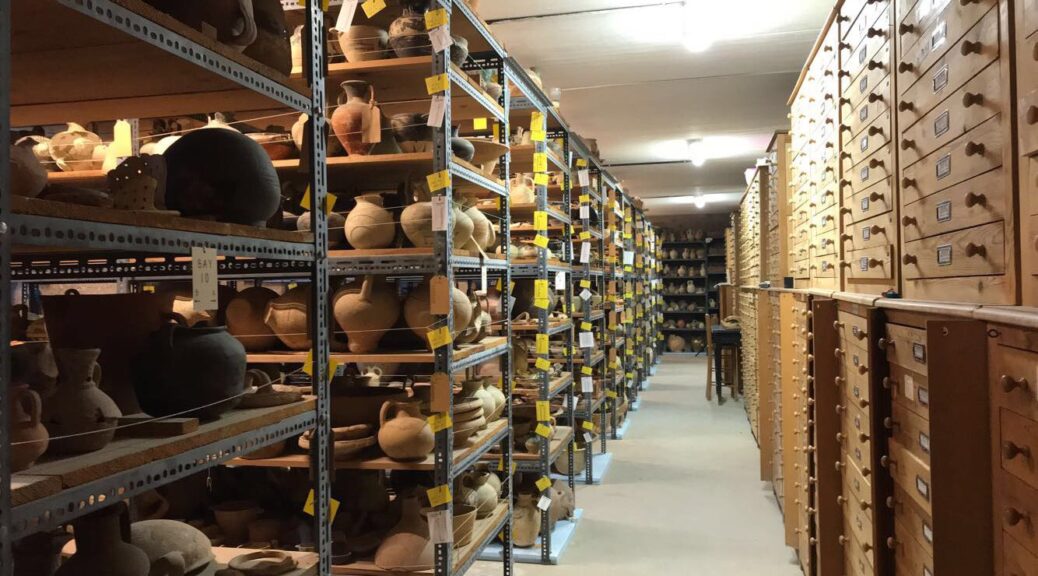
It occurred to me that in my little corner of the Academy, 10k hours is indeed often necessary to research and write a really good dissertation. My wife’s dissertation is based on 4.5 metric tons of pottery from ancient Corinth, which, she estimated for me, probably took her about 10,000 hours to study.
This means that if you work 10 hours a day, every day (and she worked much harder than that!), it will take you 2.74 years to write your dissertation. That seems about right; the PhD in Archaeology at UCL, for example, is a three-year degree. But this is a research degree. In North America, we require more than just a Ph.D. from our Mediterranean archaeologists and historians in Ph.D. programs: we require them to be expert at both Greek and Latin language (or at least one of the two), literature, history, and culture.
How long does it take to become an expert in the ancient languages? (We’ll set aside all the other material we require students to master, like history and literary analysis). A long time. The average undergraduate course in Greek/Latin will consume at least 180 hours of “deliberate practice” (15 week semester * (3 hours of class per week + 9 hours of work outside of class per week)) and it is wonderful if students applying to Ph.D. programs in Classics have four years of each language. So, by the time a student gets to graduate school, s/he will have logged about 1500 hours in Greek and another 1500 hours in Latin. Once in graduate school, s/he’ll need to refine her skills and increase her reading speed to get through the reading lists that are required for all Ph.D. programs. I’d guess that a good graduate student spends about 1000 hours per year on each language (25 hours per language a week * 40 weeks per year), normally for 3 years. That means that after three years of graduate school, our hypothetical student will have 4,500 hours of practice in each ancient language.
Adding those together gets us pretty close to our (wholly arbitrary) 10,000 hours, and we’re working graduate students at the languages alone 50 hours a week! Then, once they’ve passed their exams proving that they’ve read, understood, read about, and thought about these texts, we ask them to write a brilliant dissertation, which may (depending on the project, of course) require another 10,000 hours of work to become expert. (Reading Homer doesn’t help you to identify pottery, after all!)
This is why I am skeptical when I read about proposals to shorten time to degree at humanities Ph.D. programs. The “time to degree” issue has gotten a lot of press, including this 2007 piece in the New York Times (featuring, I’d add, a Classicist who planned to finish his Ph.D. at Princeton in 2008, which would have been a time-to-degree of 5 years; he actually finished in 2010, so seven years, and now he’s a lawyer). The MLA released a report in May of last year suggesting that
Departments should design programs that can be completed in five years from entry into a doctoral program with a bachelor’s degree as the highest degree attained. If departments change the structure of the curriculum and examinations, articulate and monitor a reasonable scope and time frame for the dissertation project, design a careful mentoring process, and provide sufficient financial support to allow students to progress appropriately, a five-year doctorate ought to be achievable.
Unfortunately (or perhaps fortunately) they didn’t tell anyone how to achieve this goal.
I have a hard time seeing many departments in my area improving this situation, since I don’t see the number of expertises we expect from our students decreasing over time. Archaeology is increasingly requiring less and less of the languages in research (but graduate students need to be able to teach the languages if they want to have access to the widest pool of jobs once they graduate). On the other hand, archaeology requires more from graduate students in respect to non-Classics skills: GIS, database management, working with techniques for digital imaging, understanding (and/or making use of) archaeological science, and so on.
It took me eight years to get the Ph.D.: two years doing the M.A. and another six doing the Ph.D. One of those Ph.D. years was spent doing the regular program at the American School of Classical Studies at Athens. My year in Athens was formative, personally, professionally, and intellectually, but it slowed down my time to degree. I took a long time to actually write the Ph.D.: about three years. Again, that time was well-spent, I suspect. It meant, among other things, that I could publish articles out of the dissertation while I was swamped with the work of teaching full-time for the first time at a series of one-year positions (an increasingly common experience for most Ph.D.s) while applying for tenure-track jobs.
The 10,000 hour “rule” isn’t a rule, of course. But it does point at something meaningful. How can we expect to reduce time to degree without reducing the expertise of the students who graduate on the other end? I see no substitute for spending lots and lots of time reading Greek and Latin, learning GIS and other software programs that are increasingly necessary for graduate students to learn, and sorting through 4.5 metric tons of pottery. Not if we plan to produce students that are well-trained Classicists and have done the requisite work to make an original contribution to knowledge about the ancient world.