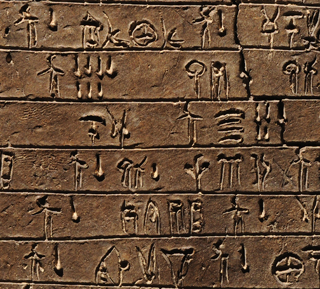
This is the first post of a series of translations of Linear B tablets. I’m asked every so often where to find good translations of Linear B tablets online, and the answer is, there isn’t such a place. I complain every so often (and on this very blog) about the lack of outreach on the part of the subdiscipline of Linear B studies, so maybe I should do something about it… so I’m going to try to regularly post transcriptions and translations of Linear B tablets here. Because it’s the start of the semester and I don’t have loads of time, I’ll start with one I’ve already translated:
The “header” of the text announces the purpose of the document: the community officials will fatten fatted pigs, presumably in order for them to be delivered to a location (or locations) for their sacrifice and consumption in a state-sponsored feast (on the Linear B evidence for these feasts, see this article by Tom Palaima).
jo-a-se-so-si = /hō asēsonsi/, “thus will they fatten” (cf. ἆσαι)
si-a2-ro = accusative plural of /sihalos/, “fatted pig” cf. σία^λος
o-pi-da-mi-jo = nominative plural of /opidāmios/, a compound of opi (cf. Greek επί) and dāmos(cf. Greek δῆμος , Doric δᾶμος)
The ideogram SUS+SI is a ligature of the standard ideogram for pig (normally transliterated with the Latin SUS in small caps) and the syllabogram for si, presumably used here as an abbrevation for si-a2-ro, “fatted pig.”
Because the verb is in the future, and the palace was destroyed probably not long after this text was written (the tablet was found in Room 7; on the findspots in Rooms 7 and 8 of the Palace, see this article by Kevin Pluta), it’s probable that these pigs were never fattened.
The “community officials” are referred to as o-pi-da-mi-jo, presumably /opidāmioi/, so those people “in charge of the dāmos“. This term has been interpreted in different ways, but this seems to me the most probable.
Piswā, Metapā, Pethnos, Sphagiānes, Aphus, Agrēwā, Elatos, Kharadroi, and Rhion are all place-names in the “Hither Province” of the Pylian kingdom, located west of the mountain range that separates western Messenia from the Pamisos valley. On the two provinces of Pylos, see these articles online by John Chadwick, John Killen, and the directors of the Pylos Regional Archaeological Project (PRAP)
This presumably means that each of these places had, or constituted, a dāmos. This is interesting because the later Greek word δῆμος , Doric δᾶμος means “district, country, land” as well as the “people, inhabitants” of such a district (I’m quoting the lexicon of Liddell and Scott here). The Mycenaean dāmos seems to have been an important, semi-independent institution that appears in the Linear B texts as an organization that deals with agricultural activities, like fattening pigs, or allocating plots of land.
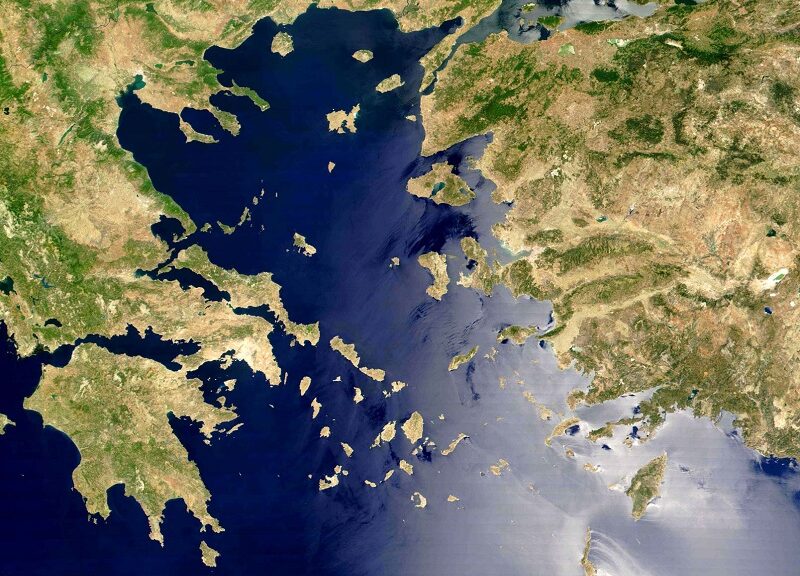
I just got back to Athens from the 3rd International Symposium on the Periphery of the Mycenaean World. It was an exciting and demanding conference: there were 60 talks over three days. Most days started at 9 am and didn’t finish before 8 pm. So today I’m exhausted and sleep-deprived, and my head is spinning with new information and new ideas. My observations on the whole event are:
Lamia is an incredibly welcoming place. The symposium was co-hosted by the archaeological ephorate of Phthiotis and Evrytania and the Demos of Lamia, and both were amazing hosts. The δήμαρχος was present – and not in the usual way. He didn’t just speak at the start of the conference and disappear; he sat in on a lot of sessions and personally thanked many of the speakers. The director of the ephorate and everyone associated with it were also super hospitable; at the end of the conference we got great tours of the castle of Lamia and the archaeological site of Kynos.
Who runs the world (of Greek archaeology)? Women. More than two thirds of the speakers at the symposium are women (41 out of 60 by my count), and that doesn’t take into account that eight of the male speakers aren’t Greek or don’t have positions in Greece. It is a noticeable difference if you are used to archaeological traditions in which men are dominant (numerically and otherwise). Of course it’s the archaeologists in the Greek Ministry of Culture that are overwhelmingly female (rather than, say, University professors), but they are the ones supervising and doing almost all of the archaeology in Greece.
The Greek archaeological service is chock full of talent. The archaeologists of the service work under extremely difficult conditions, to be sure. Their intellectual ability, work ethic, and dedication to archaeology is unmatched. I don’t know enough to compare the archaeologists of Greece to other countries, but it’s hard to imagine that Greece is second to any other country in terms of talent and devotion.
The “periphery” is so ’90s. By the end of the conference, it seemed clear that most participants were dissatisfied with the title of the conference and especially the use of the term “periphery.” It came up in a bunch of the talks (including mine) and in the concluding remarks too.
The “periphery” is where it’s at. There’s so much coming out of the ground in these “peripheral” areas that it’s dizzying. I came out of the conference feeling like an ignorant fool for not keeping apace of these developments.
I really need to improve my Greek.
Here’s the text of the paper that I delivered:
«άγνωστος λησμονημένος απ’όλους»? Why the “periphery” should be central to Mycenaean studies
Dimitri Nakassis, University of Colorado Boulder
From the very beginning of its study, it has been traditional to understand the Mycenaean world as a homogeneous culture. Christos Tsountas had concluded already at the end of the nineteenth century that the Mycenaeans constituted “a distinct and homogeneous civilization” («πολιτισμός…ομογενής») whose “central hearth” was the site of Mycenae (η πόλη των Μυκηνών «παρουσιάζεται σήμερον ως η κυριωτέρα εστία του πολιτισμού εκείνου») and whose northern frontier lay at Thessaly. In my paper today, I’d like to suggest that this view, venerable as it may be, presents us with a number of problems that affect the study of the “core” regions of the Mycenaean world as well as its so-called “periphery.” After briefly reviewing these problems, I will very briefly suggest some solutions, which point to the importance of the periphery for the study of the Mycenaean world.
I should say from the start that my paper will be intentionally challenging and unorthodox. I want to destabilize established ideas about “cores” and “peripheries” in the Mycenaean world. My discussion is premised on two arguments: one, that Mycenaean archaeology radically overestimates the importance of the palaces, and two, that heterogeneity across time and space has too often been overlooked. The homogeneity of the Mycenaean world is closely linked to the presumed centrality of the palaces, so much so that it is difficult to separate them conceptually.
To begin: the notion of a Mycenaean “core” is both temporal and spatial, for it is normal to define the “core” with respect to the establishment of the palaces.
For example, traditional definitions of “Mycenaean” typically invoke, as Jim Wright does here, a temporal scheme in which the “high point” – or in this case, the “fullest expression” – of the Mycenaean world is located temporally in the 14th and 13th centuries BC, and specifically in the material culture associated with the palaces.
By “Mycenaean” I mean the assemblage of artifacts that constitutes the characteristic archaeological culture that originates on the mainland of Greece in the late Middle Bronze Age, finds its fullest expression in the palaces during the Late Helladic (LH) IIIA-B, and can be traced through the postpalatial LH IIIC period.
Put another way, our internal periodization of the Mycenaean world revolves entirely around the establishment and destruction of the palaces. There are, no doubt, good reasons to organize the material this way, but this mode of organization nevertheless creates problems, both empirical and theoretical.
For example, what do we do with regions that never developed palaces? Does Arkadia have a “palatial” period if there is no Arkadian palace? The answer to this question is usually “no.” Thus, for instance, Cynthia Shelmerdine and John Bennet suggest that
regions such as Achaea and Laconia apparently never developed a monumental center like Mycenae or Pylos. These areas may have continued to operate at the level of the Early Mycenaean village-centered societies, outside the control of any particular center.
(Shelmerdine and Bennet are obviously writing prior to the discovery of Ayios Vasilios in Lakonia).
Likewise, Emiliano Arena suggests that “chiefdoms characteristic of the Early Mycenaean era probably survived alongside Mycenaean palatial states” in Achaia and other non-palatial parts of the Mycenaean world. That is to say, it is usual for scholars to assume that non-palatial parts of the Mycenaean world do not participate fully in the palatial period. Indeed, they effectively remain – socially, politically, and economically – in the pre-palatial Early Mycenaean period.
We can see, therefore, that time and space are connected in this schema. The core isn’t just more central spatially, but it is more advanced temporally. It experiences a palatial period, whereas the periphery remains stuck in the prior pre-palatial period. The schema is reminiscent of the remark of Thucydides (1.5) that καὶ μέχρι τοῦδε πολλὰ τῆς Ἑλλάδος τῷ παλαιῷ τρόπῳ νέμεται (“up to the present much of Greece lives in the old manner”): so the Ozolian Lokrians, Aitolians and Akarnanians continue to carry weapons ἀπὸ τῆς παλαιᾶς λῃστείας (“from the piracy of old”).
This situation is unsatisfactory for many reasons. It is obviously teleological: the Mycenaean world’s end goal is a monolithic and rigid palatial system. But for the purposes of my talk today, I want to highlight two other problems with this scheme. First, it does a poor job of understanding the operation of the palaces; and second, it underestimates the capacity for complexity in non-palatial regions. It is frankly depressing that it seems so logical to us that a place as dynamic and as interesting as western Achaia (for example) can be understood as essentially “pre-palatial” – that is, it is depressing that we don’t have better models with which to come to grips with such regions, and that we assume that the Mycenaean world is capable of only one form of complexity.
I would also argue that our conception of the palaces as highly rigid and hierarchical structures is an impediment. I have argued that this image isn’t consistent with the internal evidence of the Linear B tablets. At Pylos and other sites, it seems clear that the palatial system depends on the participation of a large number of individuals who appear in the texts identified by personal name. Almost all of the most important systems of production, from the manufacture of textiles to metallurgy, are premised not on palatial systems per se, but on what we might anachronistically call “private enterprise” harnessed to serve palatial interests. Just as there are no large palatial estates (as Julien Zurbach has recently argued at some length), so too are other areas split up into small pieces for which named individuals are responsible.
Even interregional exchange seems to have been transacted through the agency of elite intermediaries. Although the evidence is slim – Linear B famously tells us very little about trade – the evidence that we do have is consistent with this picture. Here, for example, we have one of two tablets from Pylos (An 35) that refers to the palace “purchasing” alum, an astringent and mordant, from a named individual probably named Aithalos (“Smoky”, Καπνώδης), who is also a smith (appropriately, given his name) elsewhere in the tablets. Because alum isn’t available in the Peloponnese, it must have been imported, perhaps by Aithalos himself as it was by another smith (named Kyprios) mentioned elsewhere as a palatial alum supplier.
This research matters, I think, because in conjunction with new discussions about how the palatial economy operates, it gives us a different view of the palaces. Rather than being monolithic institutions that are separate from society at large, the palaces function by interfacing with complex economies that either pre-existed these palatial systems or emerged in tandem with them. That is to say, the palatial system was both deeply rooted in, and densely entangled with, broader socioeconomic practices and processes.
This observation, in turn, allows us to explore a second area of concern: internal heterogeneity. If the palaces emerged through dynamic processes that responded to local conditions, as recent research has suggested, then we would expect some heterogeneity within the Mycenaean “core,” and indeed this is exactly what we find. Although many scholars have stressed the homogeneity of the Mycenaean world, in my view this has been over-emphasized. Even burial in chamber tombs, so often understood as an important marker of “Mycenaean-ness”, is practiced in a very uneven way across the Peloponnese. (This map is by now well out of date but it still illustrates the general point). Even where the material culture is superficially similar, the historical developments may differ so much that the same forms clearly have different meanings. So, for example, tholos tombs aren’t used in the same way in Messenia as they are in the Argolid or in Boeotia.
One way to deal with this heterogeneity is to speak of “Mycenaeanization,” which is a useful concept insofar as it points to the fact that Mycenaean culture is itself a process that unfolds through time. On the other hand, Mycenaeanization is vulnerable to all of the problems that have plagued Romanization: the implication that cultural change is unilateral and unilinear, the emphasis on elite culture, the deemphasis on local variation at the expense of uniformity, and so on. As Carl Knappett has perceptively observed, “Mycenaeanization” is also problematic if it imagines a central and unitary core from which “Mycenaean-ness” radiates, especially since such a core is empirically difficult to define, and so (and I quote), “it is easier to entertain the idea that Mycenaeanisation is a set of processes happening across a wide area.” At first glance, Knappett is clearly correct: many of the practices that characterize the Mycenaean world have very different histories. The history of the tholos tomb, for instance, looks nothing like the history of Linear B: neither in terms of their chronologies (that is, neither their timing nor their pace), nor in terms of their geographical origins, nor in terms of their coherence (that is, Linear B is much more homogeneous across the Mycenaean world).
A problem that I have been dancing around but have not yet fully confronted, then, is the issue of the integrity of Mycenaean culture. Many scholars stress its homogeneity; a growing number stress its heterogeneity, following the tendency in affiliated fields like anthropology to stress cultural contradictions and contestations. I think that these positions can be reconciled through the notion of “thin coherence,” as articulated by William Sewell. He points out that while culture is inherently contradictory, loosely integrated, contested, mutable, and highly permeable, it also possesses “a real but thin coherence that is continually put at risk in practice and therefore subject to transformation.”
This notion of ‘thin coherence’ has proved a useful way to think about the historical Greek world in the edited volume by Carol Dougherty and Leslie Kurke, The Cultures within Ancient Greek Culture (2003). As Josh Ober points out in this volume, umbrella terms like “Greek” or “Mycenaean” are analytically meaningful, but they do “offer only very limited purchase” when we ask questions about specific communities.
I think that “thin coherence” does a good job characterizing the patterns that we see in the Mycenaean world. The term “Mycenaean” has validity for a general analysis, but it clearly lacks explanatory value at the regional or sub-regional level. For instance, if we look closely at Mycenaean Arkadia, as Eleni Sallavoura has done, we see that certain standard Mycenaean practices, like burial in chamber tombs and the use of figurines, are rare. On the other and, Sallavoura declares that it is “unfair” to label Arkadia a periphery, since Arkadian burial customs are unexceptionally Mycenaean in character and even the most remote mountain communities use Mycenaean pottery. Calling Arkadia “Mycenaean,” then, doesn’t tell us what the archaeology looks like in specific terms, but it rather points to the fact that the region participates in a number of Mycenaean practices. This is, for me, a good illustration of Mycenaean culture’s “thin coherence.”
Another good illustration is the way that Mycenaean administration works. Here, even in the most homogeneous of Mycenaean practices, there are significant temporal and regional variations, as Cynthia Shelmerdine and others have emphasized. On the one hand, it seems logical that administration is the most homogenized field of practice. As Sewell observes, dominant actors and institutions try to impose coherence on cultural practice through a variety of strategies, and the coherence of administrative practices is plausibly due to such efforts. Yet it is clear that there is no single Mycenaean administrative system. For example, while Pylian administrative practice entails a centralized and centripetal Archive Complex managed by a single master scribe (Hand 1) and a well-organized hierarchical territory, other Mycenaean centers are not so organized. Even if the North Entrance Passage at Knossos represents a central archive, the Knossian administration is not comparable to the Pylian. Because the people who wrote our tablets were administrators, not just scribes, such differences are not just epiphenomenal but cut to the heart of administrative practice and organization. In terms of territoriality, Jan Driessen has convincingly interpreted the Knossian state as territorially discontinuous beyond its administrative core, and I suspect that the same is likely to be true for the Theban polity as well. In this context, as in many others, Pylos appears to be atypical.
Thus far my work has been largely critical, but in my conclusion I want to turn to an approach that I think is more profitable and addresses the second part of my paper’s title, “Why the “periphery” should be central to Mycenaean studies.” If we accept Knappett’s suggestion that “Mycenaeanisation is a set of processes happening across a wide area” and we accept that this area cannot (or need not) be divided into a “core” and a “periphery,” then the obvious job of Mycenaean studies is not to focus on categories such as core/periphery or Mycenaean/non-Mycenaean (especially because our understanding of ethnic identity in the Late Bronze Age is effectively zero). We should instead focus on practices and study how they unfold historically. This approach is preferable because one and the same practice may appear at different times in different places and in different contexts, and it is clear that a single practice can mean radically different things to different communities. This focus on discrete practices allows us to sidestep the problematic notions of Mycenaean unity and identity – and the even more problematic arguments about who or what is really Mycenaean – and to focus our attention instead on the constitutive practices of the Late Bronze Age as they were reproduced in space and time.
From this perspective, which is broadly representative of how archaeologists work anyway, areas traditionally understood as “peripheral” now become central to Mycenaean studies. From the traditional core/periphery perspective, someone like me who works in the “core” of the Mycenaean world – in my case, Messenia and the Argolid – the Mycenaean periphery isn’t strictly necessary, because as interesting as it may be, it is a passive recipient of “Mycenaeanization.” If, on the other hand, the practices that collectively constitute “the Mycenaean” are widely distributed, then the “periphery” becomes central insofar as it contributes as much as the “core” does to our understanding of how Mycenaean practices are organized and how they interface with other practices in different contexts.
For example, Girella and Pavuk (2016) have recently summarized the evidence for weaving activity at Troy in a broad-ranging discussion of the Mycenaeanization of the northeast Aegean, and note that the implements are largely preserved in the vicinity of the lower terraces of the citadel and in the fill of the ditch encircling the Lower Town. They then suggest “some kind of central control over the textile production at Troy during LH IIIA2 and IIIB,” presumably because “it is proved that [in the Mycenaean core] … specific segments of production, such as the textile industry, were controlled by the palatial elites.” Actually the situation is not so simple. Certainly we can conclude on the basis of the Linear B texts that some textile production was administered by the palace, but the palace actually obtained textiles in at least three ways: (1) direct production from attached workshops, (2) taxation, and (3) through direct purchases from specialists.
This last mechanism is attested by this beautiful tablet at Pylos (PY Un 1322), which records a payment to a weaver (or weavers) of a whopping 1,152 liters of grain.
This minor example is illustrative of my critique, and perhaps suggests a way forward. With respect to the former, I want to point out how quick Girella and Pavuk are to assign the entire field of textile production to total palatial control across the entire Mycenaean world in the core and even to central control (however that is imagined) in the periphery. This is a good example of how we have radically overestimated the role of the palaces and the uniformity of Mycenaean practice. But Girella and Pavuk put their finger on something important: the archaeological evidence at major centers on the Greek mainland does not allow us to understand the place of weaving in the Mycenaean economy: recent publications of the evidence at Tiryns and Midea, for example, lament how slender the evidence is. If we want to understand Mycenaean weaving, sites like Troy, where the evidence is more robust, are good places to start exploring this issue, which will undoubtedly be complex, at least as complex as the textual evidence and likely much more than that.
In his poem The King of Asine, Seferis imagines a careful search up and down the rocky hill for the ruler who is “unknown, forgotten by all, even by Homer.”
κι ο βασιλιάς της Ασίνης που τον γυρεύουμε δυο χρόνια τώρα άγνωστος λησμονημένος απ’ όλους κι από τον Όμηρο μόνο μια λέξη στην Ιλιάδα κι εκείνη αβέβαιη ριγμένη εδώ σαν την εντάφια χρυσή προσωπίδα.
Seferis’ search is in vain. So too, I suggest, will our search be in vain if we presuppose simple, binary forms for a highly complex and heterogeneous Mycenaean world. We should embrace the full complexity of the archaeological and textual evidence, especially in areas considered peripheral. These so-called “peripheries” should be central to Mycenaean studies, since it is at the interface of practices that our understanding comes most clearly into focus.
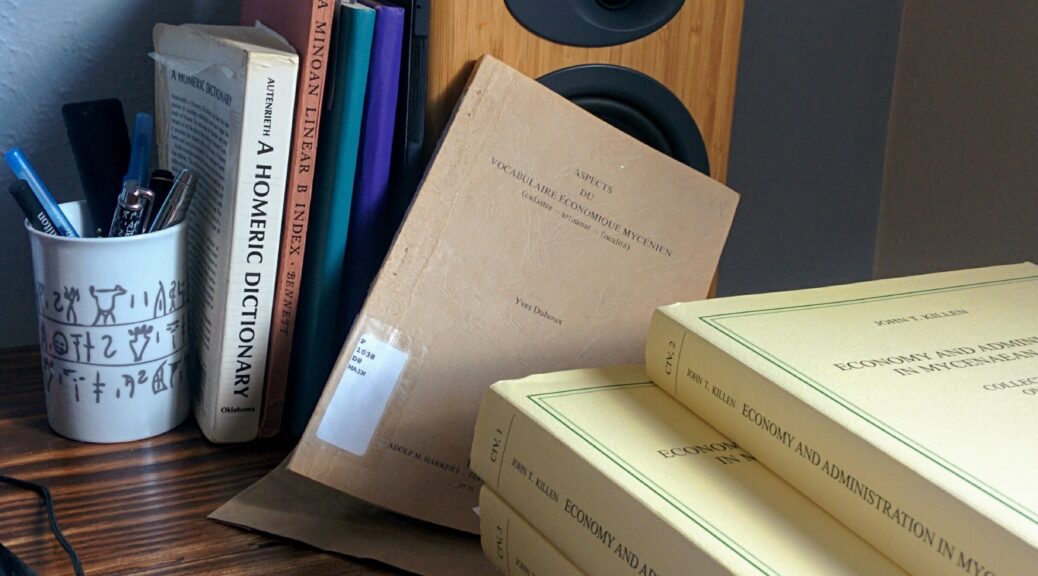
When I started working on Linear B in graduate school (late 90s), there were a handful of books (beyond corpora of texts) that I always kept on my desk for consultation:
What a difference in 2017. I’m working on a paper about Mycenaean “taxation” (really more like extractive regimes) and although I do have my Aura Jorro handy, as well as Docs2, I am leaning on a new set of super useful texts:
Maurizio del Freo’s and Massimo Perna’s Manuale di epigrafia micenea. The only downside to this volume is that it’s in Italian, which is not my strongest language. (Yes, I realize that this is my fault entirely). But it’s very recent (December 2016), authoritative, useful, and cheap: 41.56 euros for 784 pages! It’s got a glossary of Mycenaean words, and although it doesn’t have an index verborum, it does have an index locorum. It’s great to be able to consult Nosch on textiles, Zurbach on the economy, Perna on fiscality, and Garcia Ramon on Mycenaean Greek all in one handy (two-volume) book.
John Killen’s collected papers in three volumes, formally entitled Economy and Administration in Mycenaean Greece, and edited by Maurizio del Freo (2015). Oh man, this thing is the greatest. To be honest, I never really understood the point of collected papers. I had photocopies of pretty much all of these papers, now they live as PDF scans on my hard drive. So what’s to be gained from having all of the papers together physically? Answer: the index. Killen is so productive, so important, and his work so varied, that sometimes it’s hard to remember where any particular discussion is. The great thing about having all of Killen’s papers to hand and indices (verborum and locorum) attached is that you can immediately zoom to the page that you need. It’s really amazing, especially if you’re working on economic or administrative matters in the Linear B texts.
P.S. What do you listen to when you’re working on Mycenaean taxation? If you’re me, it’s Bob Marley and the Wailers pretty much all the time. For some reason I’m especially into the live version of “Punky Reggae Party” on Babylon by Bus.
I just re-read an excellent article by John Bennet, “Now You See It; Now You Don’t! The Disappearance of the Linear A Script on Crete” in a collection of essays about the disappearance of writing systems. Bennet argues that Linear A didn’t disappear, but that it was “killed” in order to create a new script, Linear B, used to write a new language, Greek. He suggests that this was
part of a major cultural realignment among the Knossian ruling elite (including those who used writing), no doubt bilingual, who chose to differentiate themselves through a range of cultural materials and practices drawing on both local and mainland traditions. This realignment included the adaptation of a script that was already at least 300 years old (and so perhaps distanced from spoken forms of its language) to a new written language.
Some background is probably in order here. Linear A was the script that dominated Crete for the first 200 or 300 years (depending on your views on the absolute chronology) of the Late Bronze Age. It disappears somewhat abruptly at the end of the LM IB ceramic phase, ca. 1450 BC. Linear B appears at Knossos in central Crete shortly thereafter, ca. 1400 BC, and clearly owes much to Linear A: some 75-85% of the syllabic Linear B signs have formal parallels in Linear A. But whereas Linear B was used to write an early form of Greek, Linear A is undeciphered. It nevertheless seems clear that Linear A wasn’t used to write an early form of Greek. Among other things, if that were true, we should have deciphered Linear A already.
The traditional interpretation of these facts is cultural-historical: invading Mycenaeans seized Knossos ca. 1450 BC and, establishing themselves as the rulers of Knossos and much of its hinterland, adapted the older administrative system and script to serve their own purposes, which included modifying the script so that it could be used to write their native language of Greek. Another piece of evidence used in service of this argument is mortuary, especially burials that emphasize military status in and around Knossos at the same time.
In the past 15 years or so, however, a new interpretation has emerged: the changes are essentially internal to Crete and especially to the Knossian elite, who constructed a new identity that borrowed some mainland elements. The shift from Linear A to Linear B has been explained in political terms as a strategy for Knossian elite to consolidate political control. As Driessen and Langohr write in Rethinking Mycenaean Palaces II,
Language was the means, not the end. Whoever took control of Knossos may well have deliberately changed the language as part of a political strategy, so that administrative reforms could be made that allowed tighter control.
I’m hesitant to conflate result with intent — in part because I’ve read too many practice theorists who emphasize the unintended consequences of human action — but let’s leave that to the side for the moment. The new, endogenous, model, has a number of strengths. It eschews the cultural-historical explanation in favor of one that explains internal politics on Crete and, importantly, identity politics. The tombs around Knossos, for instance, aren’t easily explained as the tombs of Mycenaean conquerors, but make use of a variety of local Cretan forms and materials.
One thing that has always bothered me about this new model are the names. Some 70% of the personal names in the earliest tablets from Knossos can be understood as Greek. Names, of course, are given for all kinds of reasons, and needn’t be a good indicator of ethnicity or identity (I immediately think of late 18th century Hawaiian chiefs naming their children “King George”). But personal names are almost never mentioned by advocates of the new model. Indeed, if the invention of Linear B was a cynical tool of a broader “power grab” by the Knossian ruling elite to make administration easier to control and centralize, why then did they give their children names like Lawosthios, probably a hypocoristic for Lawosthenes vel sim., which we could somewhat anachronistically translate as “the strength of the people” and Akhilleus, “he who brings pain to the people”? Clearly we must be dealing — no matter which model we use — with issues of identity. Here it’s fairly straightforward. These are martial names for an elite that uses martial themes (or actual martial achievements) as symbols of status. But what about a name like Opilimnios, a compound that should mean “On-the-lake”, or Simos/Simon, “Flat-nose”, or Psakhomenos, “Rubbed down”? These are, I think, somewhat more difficult to explain in the same terms.
I haven’t done a systematic study of the names, at least not yet, but those in the earliest Knossian tablets (from the “Room of the Chariot Tablets”) look to me like regular Greek names, the kind that you see in other Linear B tablets and in later alphabetic Greek. This doesn’t mean that we need to accept the cultural-historical model in which intrusive Greek-speakers from the mainland entered and took control of Knossos. I do think that it suggests, however, that the linguistic changes at Knossos weren’t just a cynical political ploy that only affected writing or administrative practices. The implication (in the Driessen and Langohr article) that the changes at LBA Knossos were (only) power elite strategies seems to me not only overly voluntarist (that is, society and identity as creations of calculating individuals) but also to underestimate the importance and the depth of the historical processes at work.
My sub-sub-specialty is Linear B, the script of the Greek mainland and Crete during the second half of the Late Bronze Age, roughly 1400-1200 BC. It’s an important little area for a couple of reasons. It’s the earliest evidence we have for the Greek language and some of the best evidence we have about the states that used the script. Among other things, it informs us about the prehistory of Greek language, religion, administration, economy, and society. It therefore has some broad appeal. But the community of scholars who work on Linear B is small and specialized, and most Classicists and archaeologists aren’t taught much of anything about the script.
So, as you might imagine, it’s a bit of a problem when scholars without specialized training want to dip their toes into the textual evidence. This is of course not a problem that’s unique to Linear B — the same problems present themselves when any scholar moves outside of his or her comfort zone and into a discipline or sub-discipline with which s/he is less familiar. But it’s especially true of Linear B because the number of specialized practitioners is few. And it’s exacerbated by the fact that the “bible” of Linear B studies, Documents in Mycenaean Greek (commonly abbreviated Docs),was published in 1956 — only four years after the script was deciphered! — with a second edition in 1973 (Docs2). This second edition, however, isn’t really a second edition. It’s a reprint of the 1st edition with ca. 140 pages of additional commentary written by Chadwick alone (Ventris died in 1956) appended to the end of the text of the 1st edition.
For whatever reason, many scholars outside the sub-field continue to rely more or less exclusively on Docs2. A new third edition is in the works but it’s unclear when it will be published — it’s been “in the making” for at least six years. The main dictionary of Linear B is written in Spanish as part of the Diccionario Griego-Españoland isn’t commonly used (unfortunately; it is a scholarly masterpiece) and the authoritative Companion to Linear B, now running to three volumes, is also seldom used by non-specialists. Many of my non-specialist friends confess that they find the scholarly literature impenetrable, and that’s confirmed by the many mistakes contained in virtually every book that includes some discussion of Linear B written by a non-specialist.
For someone like me, this is a depressing situation. I don’t want to spend all my time complaining in book reviews about little mistakes, and I want to see the material I work on get the (positive) attention that it deserves. The field of Linear B studies, like so many academic sub-specializations, is largely turned in on itself and is focused on internal concerns. The first circular of the 14th Mycenological Colloquium (the main conference for specialists in Linear B and other Aegean scripts, held every 5 years or so in a different location) states that “priority will be given to papers that present new inscriptions or new editions” of texts: not exactly a central concern to the average Aegean prehistorian or Greek historian that constitutes the broader audience for our scholarly output.
What’s the solution? Honestly I’m not sure. This post has been more a venting of frustration than anything else. Maybe this isn’t a problem but something that is just endemic to modern scholarly and disciplinary boundaries. I can’t help but feel that scholars of the Aegean scripts haven’t done a good job of communicating what’s interesting and important about their research to a broader audience. Nobody’s written a book like John Chadwick’s The Mycenaean World — a Linear B-focused account of the Late Bronze Age aimed at a general audience — since it was written in 1976. That, more than anything else, is limiting the appeal and interest of our sub-discipline.
Kevin Pluta and I submitted an abstract to present a 20-minute paper at the upcoming annual meeting of the Archaeological Institute of America in Chicago (January 2-5, 2013) and we’ve just been notified that it’s been accepted. Here’s the abstract we submitted:
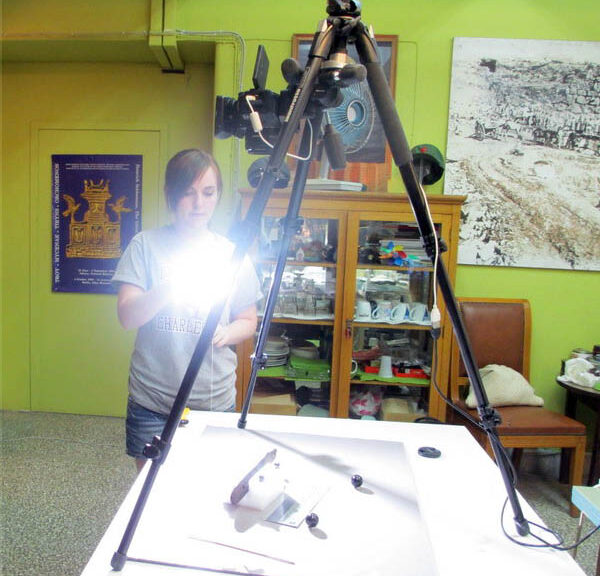
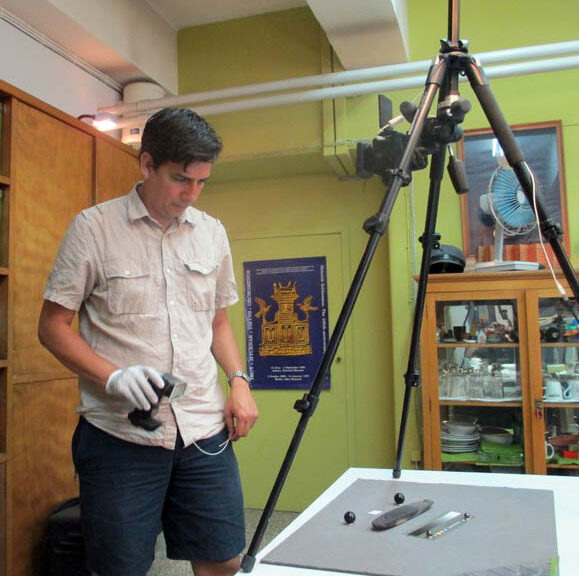
Digital imaging of the Linear B tablets from the “Palace of Nestor”
This paper presents a new project, whose goal is to create a print and digital edition of the administrative texts from the “Palace of Nestor” using advanced imaging techniques. Initiated in the summer of 2013, it is part of the official publication of the “Palace of Nestor” at Pylos excavated by the University of Cincinnati under the auspices of the American School of Classical Studies at Athens. We argue that digital editions such as ours have the potential to transform the study of the Aegean Bronze Age by allowing researchers to interact with artifacts at a level of detail and verisimilitude that approaches that of autopsy.
We employ two imaging techniques. The first of these is Reflectance Transformation Imaging (RTI), a method that involves taking multiple photographs of the same artifact under variable lighting conditions. These photographs are stitched together into an image file that stores the color of each pixel in addition to how it reacts to light, allowing the user to re-light the artifact in an interactive virtual environment. RTI therefore affords the opportunity to select the best lighting angle or angles for clearest presentation of the inscriptions. Our second imaging technique is structured light three-dimensional scanning, which has the ability to record accurate, low-interference surface data with minimal clean up. The technique is particularly useful as it collects color data that permit realistic renditions of the artifacts being recorded. In combination, these two techniques will provide the user with highly accurate renditions of the color, shape, topography, and texture of each and every administrative document from Pylos.
There are two closely-related advantages that we see to this digital imaging. First, we anticipate an improvement in the conservation and archiving of the physical artifacts, since the availability of high-resolution images in two and three dimensions will reduce the need for their study and handling. Second, a digital edition provides users with the ability to work interactively with the administrative documents in a digital environment. The resolution of the imaging is such that it even permits users to propose new readings and joins. This allocation of high-quality primary data to scholarly experts represents an exciting development. Far from being merely an enhancement of standard methods of illustration, these imaging techniques have the potential to transform the field by distributing control of the primary data to all qualified experts.
Also accepted was a submission for a poster, entitled “The use of structured light scanning for the study of the Linear B deposits from Pylos, Messenia, Greece,” and co-authored by the 2013 team: Ben Rennison, Jami Baxley, James Newhard, Kevin Pluta, and myself.
The ever-useful academia.edu (which now keeps asking me if I am interested in Roman Archaeology) brought to my attention an article by Jorrit Kelder entitled “Ahhiyawa and the World of the Great Kings: A Re-evaluation of Mycenaean Political Structures” (Talanta XLIV[2012]). The author argues in this paper that the Mycenaean world was unified into a single state ruled by a single king (the wanax) at Mycenae, while the other Mycenaean palaces were subsidiary administrative centers, each ruled by a local king (the lawagetas).
The spur for this argument, which runs totally against the grain of all Mycenaean scholarship, is the fact that in Hittite diplomatic texts, the region called Ahhiyawa (now located by Hittite scholars in the Aegean) is ruled by a “great king.” It is indeed interesting that our usual understanding of the Mycenaean world, i.e. that it is a patchwork of independent peer polities, is so different from the picture we get from the Hittite texts, and Kelder is right to identify this as an important question that needs resolution. His solution, however, is to accept the historical reality of the Hittite texts and then see whether he can fit the Mycenaean evidence into this picture.
In some ways, of course, that’s what we all do. We work from the evidence we know best to solve problems that they impinge upon, or we temporarily ignore a complex reality so that we can focus our attention on a particular problem (what Giddens calls “methodological bracketing”). The difference is the way that we go about treating the material we don’t know well but which is important to our argument.
In this case, the problem is the way that Kelder treats the Mycenaean material. For instance, we read that
The point that various large-scale infrastructural works (most notably the drainage of the Kopais basin in Boeotia, and the evidence for a well-developed network of roads in, especially, the Argolid) are difficult to reconcile with the modest amounts of resources and manpower that, according to the Linear B texts, would have been available to the individual palaces is usually ignored…
This is all we are told (no citations are given). It is not an unimportant statement, for together with the cultural and administrative homogeneity of the Mycenaean world, it allows that author to conclude in the following paragraph that “The argument for a politically fragmented political landscape during the Late Bronze Age thus seems to be based on assumptions, rather than facts.” It thus shoulders a great deal of argumentative weight.
Passing aside the administrative homogeneity of the Mycenaean world, which seems to me to ignore the context in which writing took place in LBA Greece (on which, see Kevin Pluta’s dissertation), this argument doesn’t hold. The author assumes that what is written on Linear B texts is congruent with (“according to the Linear B texts”), or at least indicative of, the total resources commanded by individual palaces. This is to misunderstand the nature of the Linear B texts and the processes whereby we have received them. The amount of labor recorded on the Linear B texts is indeed not very large, but it would be a mistake to conclude from this that the palace could not command large quantities of labor. As many scholars have pointed out, the Linear B texts heavily bias regular transactions, probably because those texts were less often recycled and reused. Thus we are much more likely to have evidence of annual or monthly transactions than ad hoc transactions. A good example of this is the fact that we have much more evidence for dependent groups of women and children at Pylos who are allocated monthly supplies of foodstuffs for their support than evidence for other short-term allocations of foodstuffs. Second, there is some good evidence that the palaces used multiple systems to recruit labor, including the use of intermediaries who were allocated large quantities of staples to recruit various laborers for palatial projects. So what we have in the Linear B texts are fragments of information about the labor that was certainly available to the palace, but in no way can we use this information to determine that the palaces didn’t have enough labor to, say, drain the Kopais or build a road 100 miles long, especially when neither has been adequately quantified.
Kelder makes the important point, and it is a correct one, I think, that it is a mistake to equate administrative borders with political borders (p. 4, bottom). On the other hand, he misrepresents what we know about the two main officials of the Mycenaean state, the wanax and the lawagetas. Although the contexts in which they are appear are similar, it is not true to say that (p. 5, top):
The numerous (and as far as I can see, unconvincing) attempts to make a clear distinction between the two officials, other than the size of their respective temenoi (at Pylos, the wanax’s is thrice the size of that of the lawagetas), clearly illustrate that there is no real consensus on the exact position and status of either of them.
Actually, there is a clear distinction between the two, which is demonstrated by a number of the secondary sources cited in this article. The adjective formed from wanax is wanakteros, which makes use of a Greek suffix (-teros) that indicates binary opposition (like Greek ἕτερος, “the other [of two]”), while the adjective formed from lawagetas is lawagesios, a regular adjectival ending. Thus it seems possible that the wanax is an important structural concept in Mycenaean Greek (at least among the administrators). There are other differences. The wanax appoints the damokoros, a regional official who administers one of the two main provinces of Pylos. He is thus directly involved in regional administration.
This much is consistent with Kelder’s argument that the wanax is the real king, whereas the lawagetas is a sub-king. But where is the evidence that the lawagetas is a “ruler-like figure”? This is crucial because the presence of two “ruler-like figures” is what Kelder finds so problematic about traditional interpretations of the Mycenaean political order. The answer is that there is no such evidence. The lawagetas appears in a number of important contexts, as does the wanax, but there is no evidence that he is a ruler-like figure. Why couldn’t he be something like the grand vizier, for example? This possibility is never entertained.
Also strange is Kelder’s reference to “two throne-rooms.” Here he elides the important difference between a throne-room and a megaron. The former is an interpretation of the function of a space; the latter is a designation of a particular architectural configuration. It is true that the rooms that we consider throne-rooms are megara, but it hardly follows that all megara are throne-rooms. In fact at Pylos, the lawagetas is not thought to hold court in the smaller megaron (room 23), but in Halls 64-65. It’s not certain what the other megara at Mycenaean palaces are for, but nowhere are the possibilities (except the one favored by the author) entertained.
Kelder’s put his finger on an important question, but although he concludes his article with the statement that “the growing body of circumstantial evidence for a unified Mycenaean state now seems overwhelming,” I am afraid that we are no closer to solving this thorny problem. That will require close, sustained engagement with the Hittite and the Mycenaean evidence.
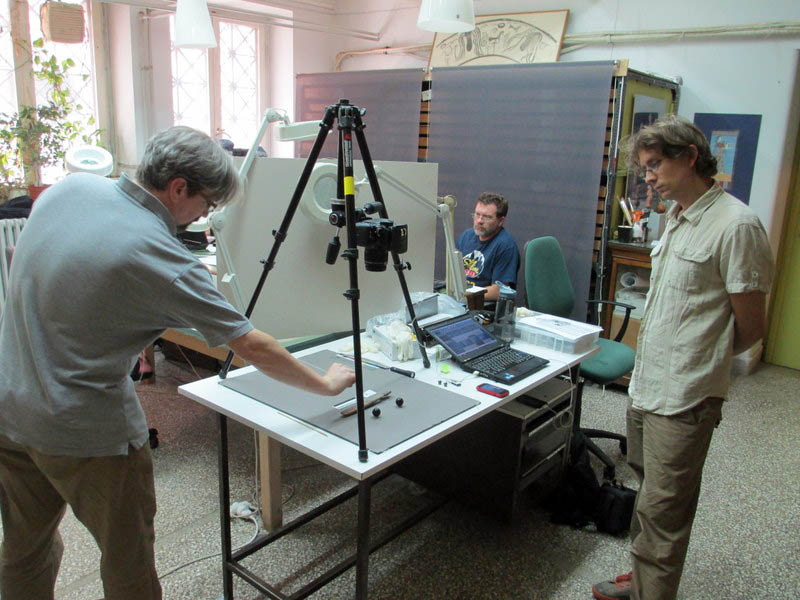
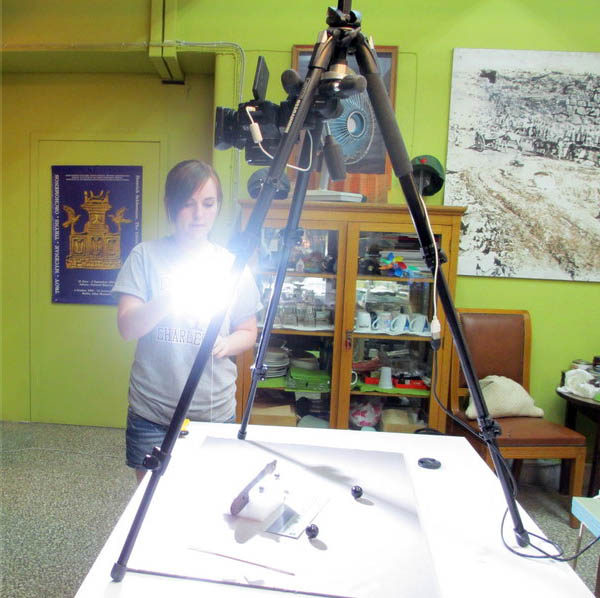
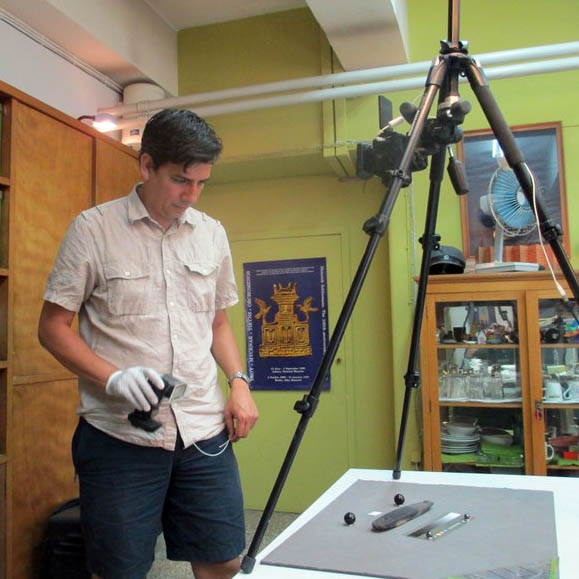
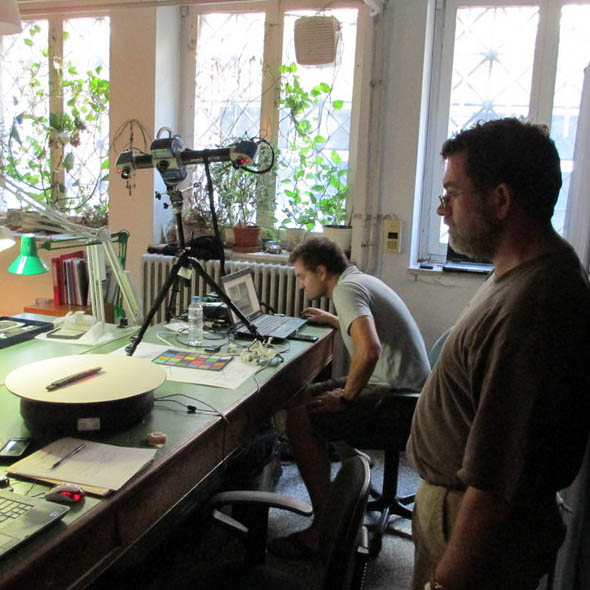
This summer I co-directed (with Kevin Pluta) a project in which we began advanced imaging (RTI and 3D scanning) of the Linear B tablets from the “Palace of Nestor” at Pylos (modern Ano Englianos). These tablets are now housed in the National Archaeological Museum in Athens. I’ve written a couple of blog posts elsewhere about the project: one for the website of the American School of Classical Studies at Athens (ASCSA), through which we applied for our permit, and another for the Archaeological Computing Research Group (ACRG) at the University of Southampton, a member of whom, Hembo Pagi, trained us in RTI. The posts say the same thing, more or less, to slightly different audiences. You can read the stories here (ASCSA) and here (ACRG).
RTI with Kevin Pluta (left) and Hembo Pagi (right)RTI with Jami BaxleyRTI with Dimitri Nakassis 3D scanning with Jim Newhard and Ben Rennison
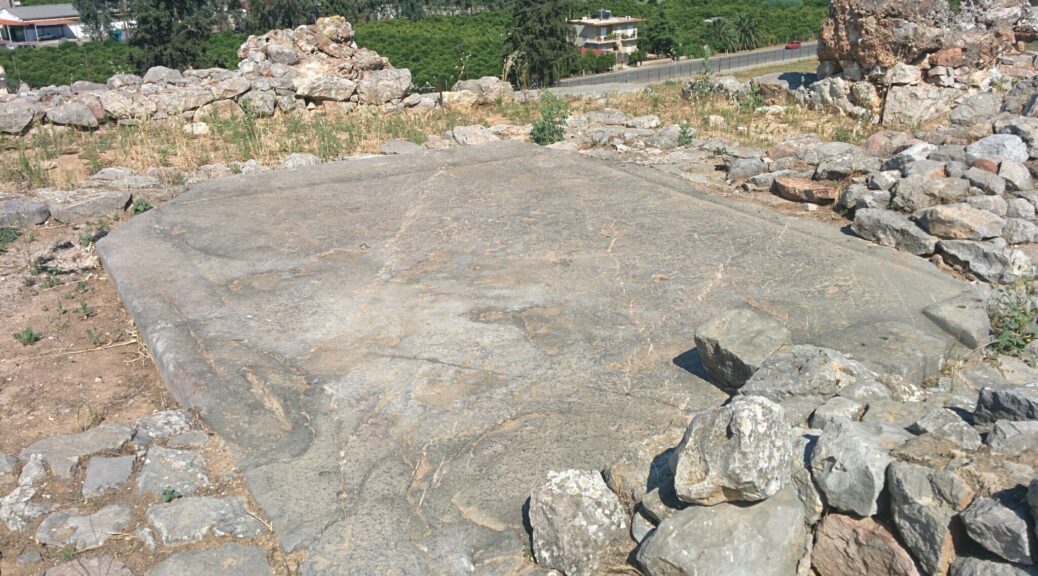
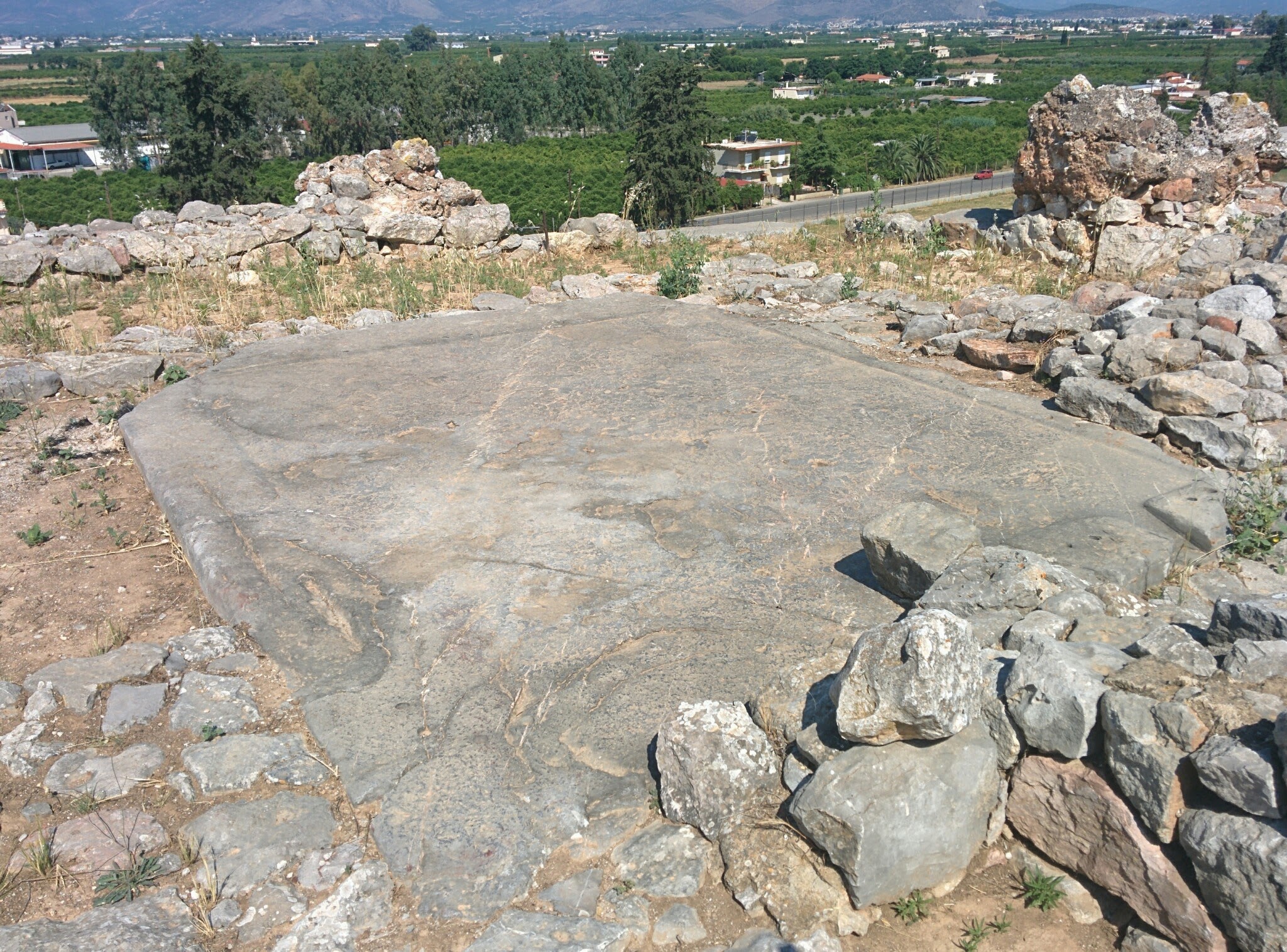
One of the features I like best about Bill Caraher’s blog are his discussions of journal articles. This is, it seems to me, something that’s extraordinarily useful and easy to do in a blog, but doesn’t find easy expression in other media. Recently I read Joe Shaw’s “Bathing at the Mycenaean Palace of Tiryns” in the American Journal of Archaeology (2012). In the article, Shaw reconstructs the room with the “bathing slab” in the Mycenaean palace at Tiryns, shown here:
Shaw shows that the drilled sockets anchored a wooden bench with wooden panels underneath that slotted into wooden vertical supports. He reconstructs the bath complex (see below) and he then goes on to review evidence for bathing more broadly in the Aegean Bronze Age.
In some ways, this paper is pretty regular. By this I mean that it probably won’t show up in popular media (like, say, the BBC News), and it doesn’t represent an enormous methodological or theoretical breakthrough. But it’s remarkable nevertheless. First, it is a real model of how arguments should be made. Shaw weaves together past interpretations, architectural parallels from other sites on the Greek mainland and the island of Crete, and real common sense to make his argument in only 15 pages of text. Every sentence in his article is necessary, every sentence packs punch. As a reader, I felt incredibly well taken care of, in the hands of someone who has thought hard and carefully. In fact, I’m sure that this is true. But this feeling is notable because this isn’t something I often encounter. More often, the text feels like an impediment to understanding rather than a guide. Second, it is a great example of an article that requires real mastery of Aegean architecture. It’s not the kind of article that just any Aegean prehistorian could have written. It requires a seasoned eye, one that’s been trained to look for details, and a mind that can rifle through a database of relevant parallels, and to bring them together to come up with a plausible and persuasive reconstruction.
This article has also forced me to reflect more broadly on bathing in the Greek Bronze Age. As Shaw points out, the more one thinks about bathing, the more important it does seem to be to Mycenaean elites. In this, Shaw shows, it is distinctive to the mainland: bathing is apparently not as important on the islands. There are large, well-appointed rooms for bathing at two (at least) mainland Mycenaean palaces: Pylos and Tiryns. Linear B tablets at Pylos record workers that concern themselves with bathing: there are 66 bath-workers (re-wo-to-ro-ko-wo, lewotrokhowoi, cf. Homeric λοετροχόος, on Aa 783, Ab 553; Ad 676 records their sons). The tablets also carefully record palatially-managed production of perfumed olive oil. Whether or not this oil was used in bathing ceremonies — as Shaw shows, it probably was — it is also concerned with care for the body. Shelmerdine (1985) has also suggested that perfumed oil was used to anoint textiles.
Much of the literature on bathing and the Aegean Bronze Age has focused on ritual aspects, such as ritual lustration. Shaw also draws attention to what we might call more practical concerns: care of guests and strangers who entered the palace, hot and dusty from the road, perhaps (Shaw, 555: “journey-worn guests”). But regardless of its ritual import, or its practical functions, it does seem possible that bathing and care for the body was a particular concern of the Mycenaean elite. It may have been strategy whereby some members of the elite distinguished themselves from others. (It’s impossible for me to write this without thinking of that scene in “Monty Python and the Holy Grail.”) Those resident in the palaces would have been particularly well-placed to bathe themselves more regularly and to anoint themselves with fragrant oils produced in palatial workshops. They probably wore special textiles, perhaps those produced by palatial workshops, like the texts at Knossos described as “of hekwetas type” (e-qe-si-jo), and other objects, like jewelry. Thus, Shaw’s article encourages us to see bathing as part of a larger suite of activities by which mainland elites in the Bronze Age arranged their bodily appearance, perhaps as a mode of distinction from those who could not afford to do so. Bathing, however, appears to be a particular concern of Mycenaean elites on the mainland, which suggests that such modes of bodily display were not homogeneous across the Aegean or throughout its history.