Category Archives: dimitri

My sabbatical: part one

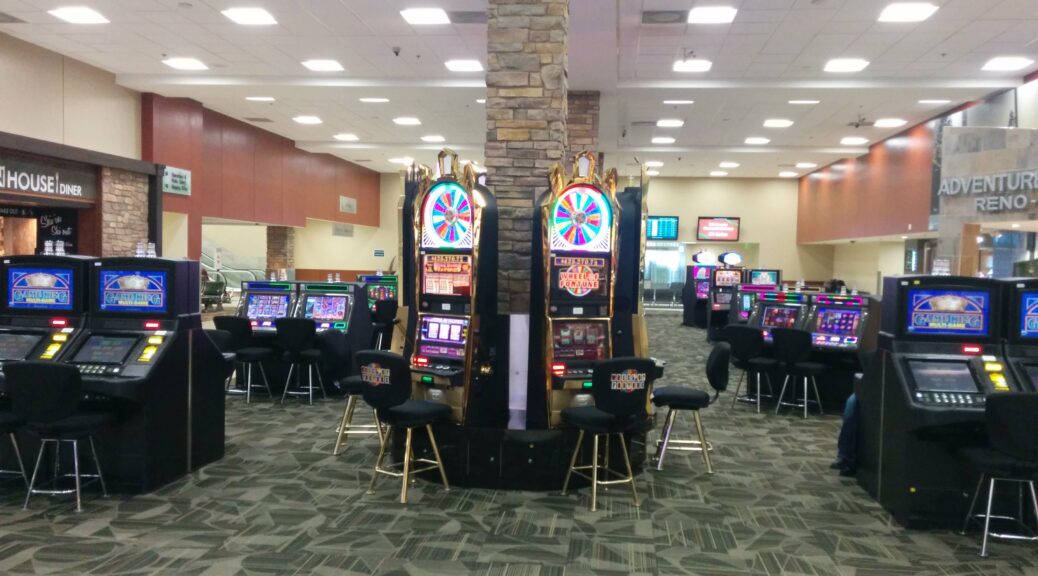
I wasn’t planning to blog about my sabbatical, but my friend Bill suggested that I do so, and because my airline was so kind as to cancel my 1 pm flight to San Francisco (where I’m going to attend the annual meetings of the AIA) and rebook me on a 6 pm flight, I’m now sitting with a coffee in the Reno airport. I have some options: work on my AIA papers, gamble (I keep hearing “WHEEL! OF! FORTUNE!” from a nearby machine), listen to some podcasts, read Marshall Sahlins’ Apologies to Thucydides (2004), etc., but I figure now is a good time to write and reflect a bit.

This academic year has been the first real research leave/sabbatical that I’ve had. One semester, I think the spring of 2010, I had a course reduction from two courses to one, but otherwise I’ve always taught a 2/2 or a 3/3 teaching load, since the fall of 2006. So I was excited to go on sabbatical for the first time (as much fun as it was to tell people that only slackers went on sabbatical) and I had grand hopes of accomplishing a lot in the first half of my time off.

(1) Reading. I wanted to read a lot over the fall. I read all of Evi Karouzou’s excellent Les jardins de la Mediterrannée (2014), Antonia Foias’ Ancient Maya Political Dynamics (2013), Adam Smith’s The Political Machine (2015) and a parts of other books and articles that I can’t quite recall right now, but I can’t say that I read a lot, and I don’t really feel up to date in any of the fields that I claim to know well. It’s a frustrating fact of modern academia — or so I tell myself — that it’s rarely the case that anyone can really stay up to date across multiple academic sub-specialities. Maybe I can use the excuse of the diminishing returns in reading modern scholarship on any given subject (I’m ripping off Robin Osborne here).

(2) Writing. I absolutely needed to finish two small writing projects for edited companions in the fall: a chapter on the Greek economy from 1400-700 BC for a Blackwell companion edited by Irene Lemos and Antonis Kotsonas, and a chapter on Homeric geography for a Cambridge encyclopedia on Homer edited by Corinne Pache. I had planned to knock these out quickly (in September) so that I could start work on my book, which I planned (and still plan) to write about Mycenaean politics. I finished the chapters, but much later than I expected, and so I’ve hardly written anything on the book: about half of a detailed proposal and a handful of pages of the introduction. I’m well behind, so I really need to get cracking on the book this winter. I’ll be in Athens working at the American School’s fantastic Blegen Library, so I’m hopeful that it will be a good environment for getting lots and lots of work done. Much of the reading that I did in the fall also helped me to prepare for the theoretical sections of the book, so with any luck I’ll be able to write quickly, although generally speaking I’m a very slow writer.

(3) ‘Rithmatic. Nope.

(4) Moving around. I did a fair amount of travelling over the fall: I went to the Mycenological colloquium in Copenhagen in early September (which reminds me that Kevin Pluta and I need to write up our contribution to the proceedings this month) and did a little AIA public lecture tour to western Illinois (where I got to stay with friends) and Ann Arbor (at my alma mater, the University of Michigan) at the end of September. That was fun. But I got sick on the tail end of both trips, which was not fun, and it deprived me of a second trip to the Ny Carlsberg Gyptoteket and a first visit to the National Museum of Denmark in addition to the time I lost getting better.

All in all, I’d give myself a C. I didn’t accomplish what I planned to, so maybe I deserve a D, but I usually don’t accomplish what I plan to do. I also have a bunch of excuses. I got sick. I had to do a fair amount of writing for the survey project I co-direct. I was also named a MacArthur fellow, which was great, but it also distracted me a lot — mostly I spent a lot of time convincing myself that it was not an elaborate hoax and/or trying not to feel like an impostor. On the other hand, I did do what I needed to. So a C feels about right.

Also, isn’t sabbatical supposed to be a bit relaxing? This blog post doesn’t make it seem so. Am I not supposed to take it a little easy, catch up on sleep, and watch all the football games and footie matches that I can? On the other hand, the sabbaticals of archaeologists are abbreviated; we don’t get the summer to ourselves, but instead we’re running around in the field falling over and getting fleas. So I’d better get serious this winter… or start thinking of some more excuses.
Podcasting

Over the past couple of weeks I’ve appeared as a guest on two podcasts. The first is Historically thinking, a podcast maintained by Al Zambone, a historian of the colonial American South and professor in the history department of Augustana College. I was visiting the fair quad cities on a short AIA lecture tour. You can see the talk I gave at Augustana here.

The second is Caraheard, the podcast of my friends and fellow EKAS alumni, Bill Caraher and Richard Rothaus. I’ve embedded the Caraheard podcast but make sure to check out the show notes for many explanatory notes and references.

Thinking digital archaeology

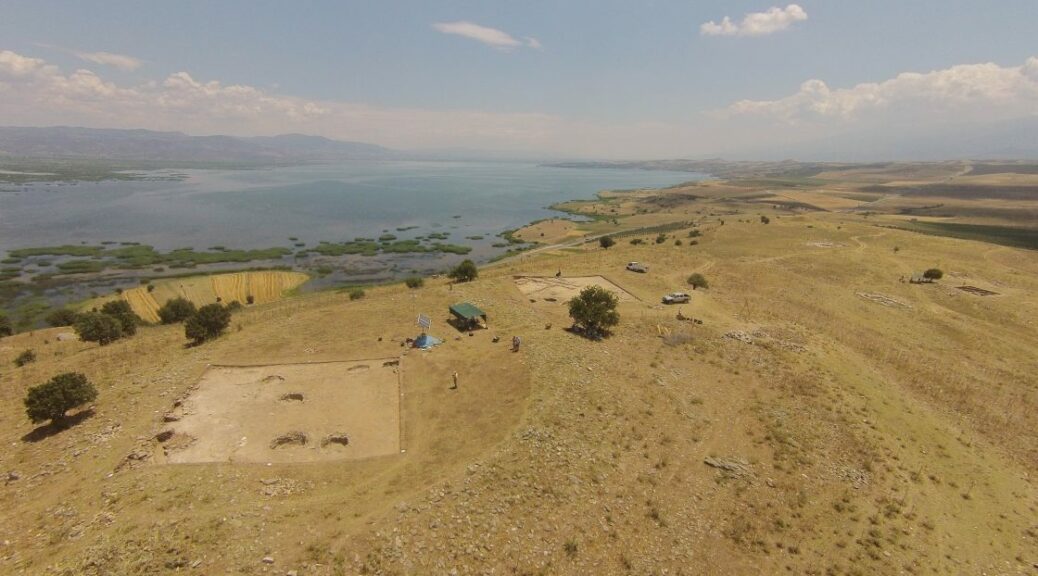
This post is prompted by a recent (and freely available) article in the Journal of Field Archaeology, “Excavation is Destruction Digitization: Advances in Archaeological Practice” by Chris Roosevelt, Peter Cobb, Emanual Moss. Brandon Olson, and Sinan Ünlüsoy. Let me begin by saying that the article is really great. What the project is doing is innovative, cutting-edge, and thoughtful. But like Bill Caraher, I worry about some of the implications of the article, a couple of issues that caused me to frown and think.

Data and interpretation

The authors of the article make the important point that archaeological data are produced by decisions (and interpretations) made by archaeologists in the field, such that full digital documentation is not of the pristine archaeological record but rather of the excavators’ interactions with that record. Yet this point, once made, is not repeated, and the authors focus on improvements to accuracy and efficiency — for good reason, and persuasively so. Accuracy and efficiency are excellent goals, but once achieved, so what?

The proof of the pudding is in the eating. And in archaeology, what we want (I think, but I’m pretty jetlagged right now) are better understandings of the ancient world. And it seems to me that the authors haven’t made a particularly cogent argument connecting their methods and this ultimate goal. To be fair to them, this is not the main point of their article, but they do address the issue. First, we are told,

…we are, in effect, increasing efficiency and thereby providing greater opportunity for in-the-field reflection about depositional and post-depositional processes and the human behavioral and natural conditions that drive them.

Second, we are told that

Data sharing allows for the sort of broadbrush,inter-site comparisons that can increase understanding of some of the greatest concerns of humanity more so than can single datasets: climate change, social inequality, and urbanism, for example. If archaeologists argue that their work provides such public benefits, they must be willing to provide full access to their complete and original data as well as to their analytical results (Gestrich 2011). A significant goal for archaeology, then, is the free and open accessibility of such datasets. The most efficient way to reach this goal is to generate publishable or near-publishable quality data at the time and place of collection, so that additional data preparation—sure to slow publication—becomes unnecessary.

So, more efficiency is good because it means more time to think, and more (digital, standardized) data are good because they promote most efficiently large-scale comparison and querying. With regard to the first claim, when has increased efficiency in data collection ever yielded more time for contemplation? In my experience, it tends to produce the opposite: a stronger push to collect more. That’s been my experience working on my own digitization project, at any rate: I interact with the digitization and data capture, counting on the fact that the data I produce will bail me out down the line when I need to get to analysis. I’m somewhat less skeptical of the second claim, but it relies on the promise of future gains of comparison between field projects that, even if they use the same systems, are fundamentally dissimilar in all other kinds of ways. After all, as the authors point out in the first page of the article, digitization doesn’t actually record some archaeological truth, but rather the archaeological process of discovery. So publishing raw data, while laudable, doesn’t help us to understand urbanism (say) without an intimate knowledge of the archaeological processes that produced those data.

In sum, then, I suggest that while gains in efficiency and accuracy are great, it remains to be demonstrated that they get us something important. For instance, the authors present us with the example of a granary and their documentation of their excavation of it. It is impressive. But does it help us interpret the granary any better? It hasn’t seemed to thus far.

Skilling and deskilling

Another objection (or potential objection) that the authors confront is de-skilling:

others might fret that such developments are potentially ‘‘de-skilling’’ (W. R. Caraher, personal communication 2014), or at least that they diminish the reflexive value of mechanical or analog archaeological methods. On the contrary, we argue that skills are not lost, but only shifted from analog to digital.

Part of the problem here is that deskilling has a more specific meaning than loss of (some) skills. As Wikipedia, the font of all truth, helpfully informs us,

Deskilling is the process by which skilled labor within an industry or economy is eliminated by the introduction of technologies operated by semiskilled or unskilled workers. This results in cost savings due to lower investment in human capital, and reduces barriers to entry, weakening the bargaining power of the human capital.

It seems to me that this meaning of deskilling is what is at stake, and the argument therefore misunderstands the perceived objection. And this brings us back to my core concern about archaeological interpretation. Does this shift away from analog to digital skills help us as archaeologists to understand the ancient past? A deskilling argument would suggest that in this shift, we lose quality and skill in favor of efficiency. Think, for instance, of handmade goods made by craftsmen (e.g., a fine wooden rocking chair handmade by Ron Swanson) as compared to their modern counterparts made by unskilled and cheap factory workers.

Maybe? Probably? Probably maybe? I’m not sure. I do know that I’d prefer a rocking chair handmade by a craftsman than an efficiently-made, super-standardized rocking chair made in a factory. And I’d prefer a site excavated expertly and documented with paper notebooks than a site excavated reasonably well but with full digital documentation.

I suppose one could argue that this doesn’t mean that we shouldn’t digitize, because we can still innovate and improve. I agree. Yet it seems to me that what archaeological projects really need is lots of expertise at the edge of discovery. The Kaymakçı Archaeological Project (KAP), on which the authors work, clearly has that. But that expertise, in my view, will be much more decisive in their analytical success than their digital methods. And if this is true (or even partly true), then much more decisive for the field than the development of new digital methods will be the training of good archaeologists.

Carl Blegen: Personal and archaeological narratives

A series of flights across North America (Denver to LaGuardia to Toronto) gave me the opportunity to finally read a volume I picked up in New Orleans edited by Natalia Vogeikoff-Brogan, Jack Davis, and Vasiliki Florou about the life and work of Carl Blegen, the excavator of Pylos (among many other sites).

My friend Bill Caraher already wrote some thoughts about the volume, and, like Bill, rather than write a review of the book, I just wanted to add a couple of thoughts that the various papers elicited.

Archaeological teamwork

Davis and Vogeikoff-Brogan emphasize that Blegen thought of archaeology as a “team enterprise” (11), and Blegen also came up with my new favorite quote about a successful excavation (192):

On a dig, you have to live as a family lives… and if you have to live as a family, it’s better to be a happy family.

But if the excavation team was a family, it seems that Blegen was very much the paterfamilias. John Camp is quoted in the volume as commenting that

Among those who didn’t know him, Mr. Blegen was thought to be gentle; and he was. But among those who worked with him, he had a fuller reputation as a man who was somewhat hard to work for. Once he had stated an opinion, it was to be regarded as fact; one did not argue with Mr. Blegen, his word was law. … In short, his gentle manner was real, but it hid a forceful stubborn personality.

That’s interesting, especially because that the model of excavation when Blegen began his research emphasized not the archaeological team, but the singular excavator, a model that Bill Caraher has described as “heroic archaeology.” Blegen’s way of thinking seems to have departed somewhat from the “heroic archaeology” model: it is the model of a family-like or patrimonial structure, with the director playing the role of the traditional strict father, whose opinion is fact and whose word is law. Nevertheless Blegen was, if I understand things correctly, progressive for his day. By contrast, the projects that I were trained on didn’t resemble this patrimonial model. Instead they rather resembled a modern graduate seminar, with “skeptical graduate students” (SGSs) — people like me — engaging in a lively debate with the project directors, the “real Mesoamerican Mediterranean archaeologists” (RMAs) and the “great synthesizers” (GSs). In fact, I felt so comfortable working in this environment that as an SGS I felt comfortable working with and publishing project data, without feeling the need to worry too much about whether the RMAs and GSs would disagree with my interpretations and get angry. Thinking about it a little bit, that’s actually quite remarkable. In any case, this model seems to have emerged in the post-war period, after Blegen’s training was already complete. But it was embraced by those students he trained. In this sense, Blegen’s model of a successful excavation straddles the true “heroic archaeology” of the early 20th century and the more team-oriented model that characterizes late 20th century and early 21st century American archaeology.

I should emphasize that this is not a hidden criticism of Blegen, who by all account was extremely generous and kind, but a comment on the changing nature of archaeological knowledge production. If anything, Blegen was far ahead of his time, both with respect to the way he treated his archaeological family and in the way that he worked together with his colleagues in the Greek archaeological service (the latter point is emphasized especially by Davis’s chapter in the Blegen volume).

Insiders and outsiders

Blegen was sometimes an insider, sometimes an outsider. He was director of the American School of Classical Studies at Athens, but only after he had first been (somewhat voluntarily) banished from it by Edward Capps, then the chair of the American School’s managing committee. In “the most dramatic episode” in the School’s history (5), Bert Hodge Hill was forced out of the directorship of the School by Capps, and with Blegen he retreated from the School to found a salon at 9 Ploutarchou.

I’m not particularly interested in assigning blame for this episode (I don’t know nearly enough about it, although I am inclined to favor Hill and Blegen over Capps), but it is astonishing to think that Blegen — probably the most important American archaeologist in Greece over the last 100 years — was ever on the outs at the American School, an institution at which he is now revered. It’s a vivid illustration not only of the vicissitudes of archaeological fortune (i.e., today’s outsider is tomorrow’s superstar and eventual legend) but also of the wastefulness (that’s not quite the right word) of the political wrangling of archaeological heavyweights. Capps seems to have blocked Blegen from working at Pylos using “political pressure, bribery, and blackmail” (214). One of the things that I like least about archaeology is the way in which established scholars can use their influence to block access to others, and the way that research material becomes territory to be defended at all costs. I was drawn to archaeology because I had the real sense that we archaeologists are all in this together, that our data and interpretations, when combined and recontextualized and reinterpreted, are moving us closer to a better understanding of the past. That’s naive, admittedly, but I still believe it. We all benefit the more transparent and open we are with our evidence and our interpretations, and we all suffer when those doors are closed. Here too, Blegen was ahead of his time, a scholar who seems to have encouraged and enabled others. He was, after all, a man who held an open hour at his home in his retirement for anyone who wanted to talk to him (133-134). Perhaps it was the experience of having the door shut to him by Capps that encouraged him to be so open and welcoming to others.

Why I like archaeological survey

Over the past several months, a couple of different people have asked me why I like survey. My initial response is always intellectual. I talk about the importance of understand the countryside, about the urban bias of our texts and excavations, the approach of books like The Corrupting Sea, and so on. In both cases, that wasn’t the answer that the questioner wanted. What they wanted to know was, why did I like getting up before dawn to wander around the Greek countryside for six hours or more over six+ weeks?

Strangely, that’s a more complicated answer. As a student, I wasn’t immediately drawn to archaeological survey, although I was of course exposed to it as an undergraduate at the University of Michigan, especially in the classes that I took from Sue Alcock and John Cherry. I first got seriously interested in survey because of the senior thesis that I wrote on settlement and state formation in Minoan Crete. I knew that I was interested in state formation (thanks to classes with John Cherry and Kent Flannery) and I knew that it was too big a topic for an undergraduate thesis. So I had spent the summer reading Colin Renfrew’s The Emergence of Civlisation (1972) — a book, incidentally, that convinced me that I wanted to be an Aegean prehistorian — and went into John Cherry’s office with a list of areas that interested me. One of them was settlement, and that sealed my fate: I ended up writing my thesis on published survey data from Crete from the Bronze Age, with a focus on the relationship between settlement data and state formation.

So my initial interest in survey was based on thinking, not doing. I had done survey for two weeks in Tunisia on the Leptiminus project back in 1995, and I liked it, but it wasn’t immediately my passion. But my intellectual interest in landscape and settlement led to me working on survey projects as I entered graduate school, both on the Iklaina Archaeological Project and especially the Eastern Korinthia Archaeological Survey.

So that’s part of the story… but the way that I’ve told it might suggest that I like survey as an intellectual and analytical activity but not in practice. That’s not the case. So when I’ve been asked why I like to get up before dawn and wander around the Greek countryside, I tend to talk about a couple of different things:

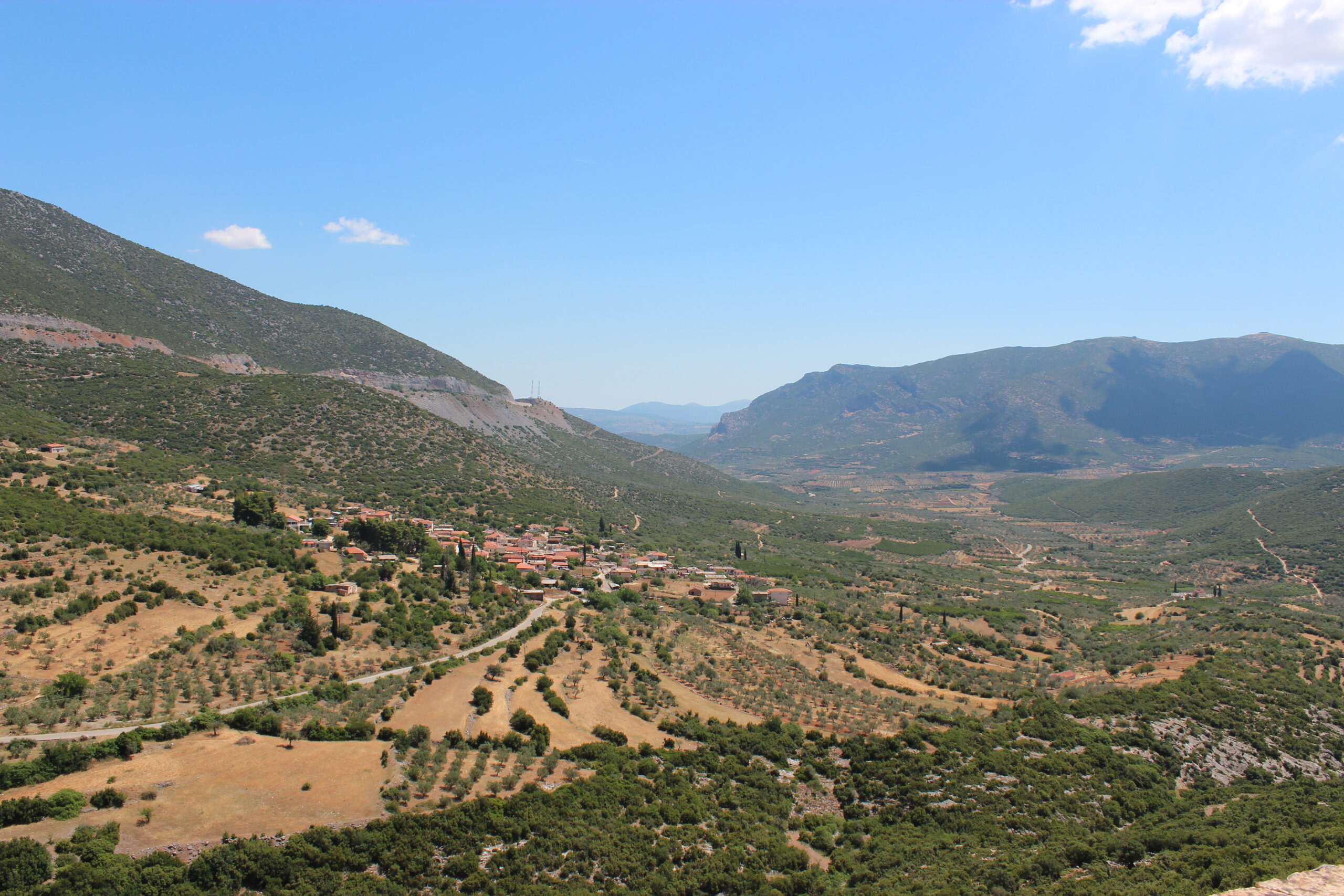
(1) The Greek landscape is really beautiful. I won’t ever get tired of looking at this:

Kaparelli

And this isn’t even the most iconic form of the Greek landscape (the deep blue Aegean up against the painted white houses of the Cyclades), but it’s still wonderful and variegated. Some of my favorite moments in Greece have been driving around a corner to be greeted to a wide and beautiful vista (the road to Kato Zakros in Crete is one of the best).

(2) The Greek landscape is endlessly surprising. This is true both generally — there are so many beautiful little valleys and harbors in Greece that you could spend your whole life visiting them — and in particular — walking through a familiar landscape will yield all kinds of little surprises.

(3) I love to explore and to hike. Loving survey is about embracing that spirit of exploration: of wanting to hike the trail that you haven’t yet hiked, not knowing where it goes. It sounds cheesy, and it is, but to love survey I do think you need to want to hike up to that hill in the distance to see what’s there.

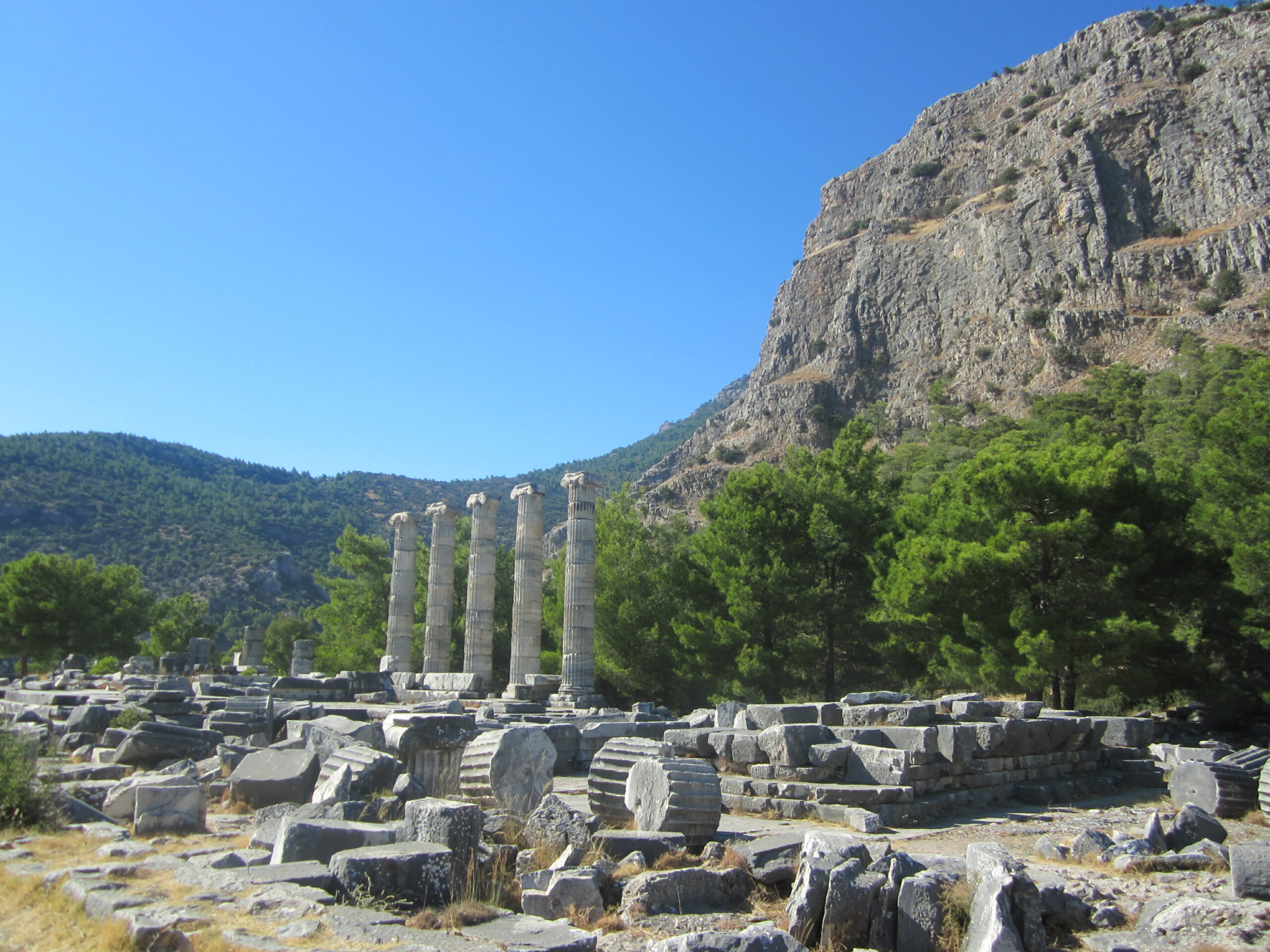
This will sound familiar to veterans of the American School’s regular program, which involves a lot of hiking up to hills to see what’s there. When I went to Priene on the Ionia trip led by John Camp, my first thought and first question to John was, “Can I hike up to the acropolis?”

After being asked why I liked survey and giving these three responses, I started to wonder where (3) came from. Why do I have this strange desire to hike up to hills and mountains to see what’s up there? Was it drilled into me at the American School? Or does it come from somewhere else?

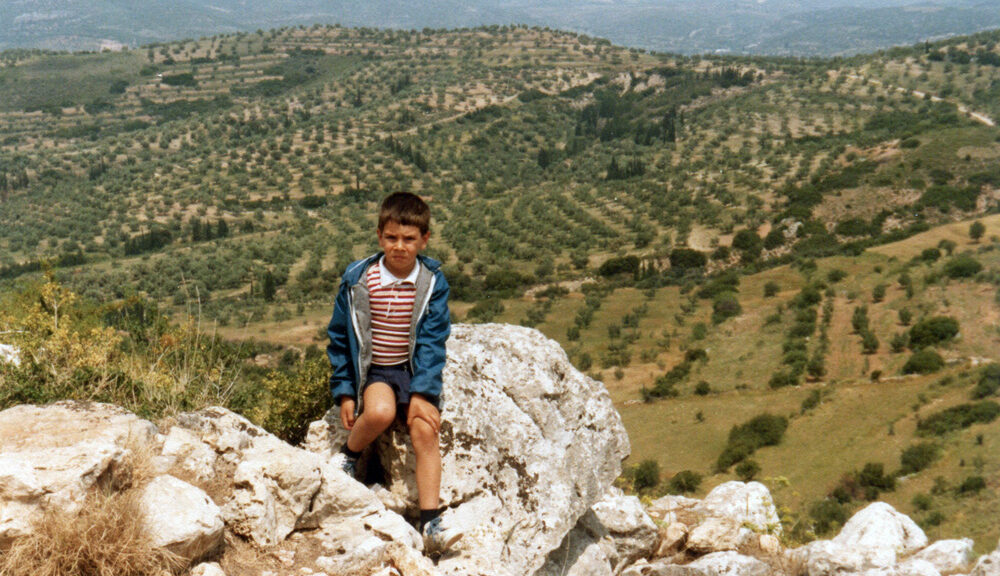
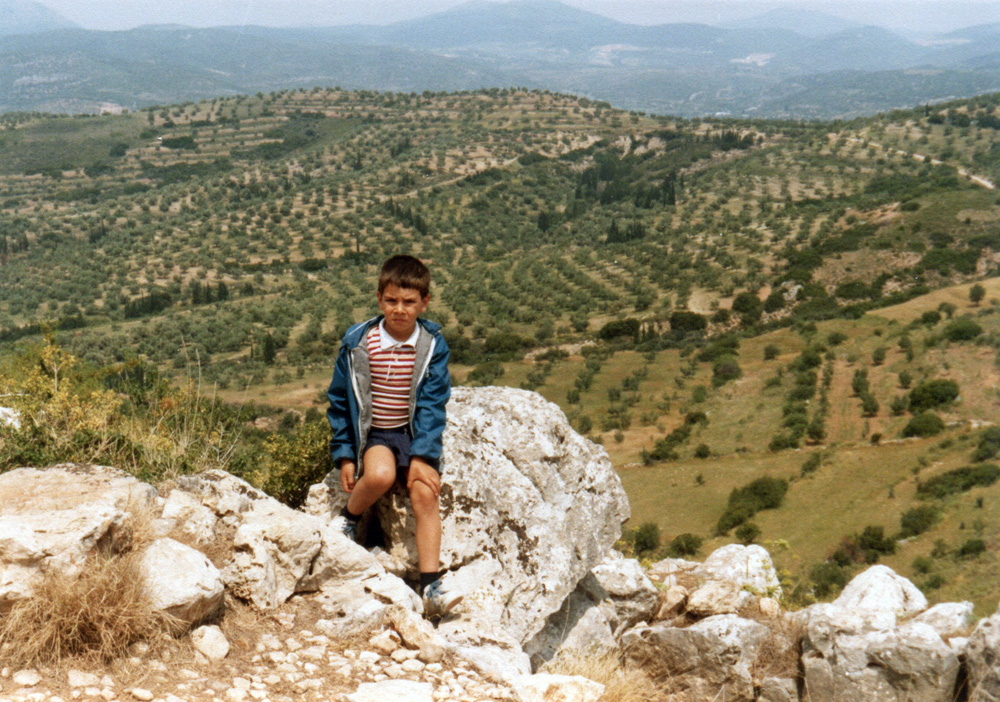
Thinking back on it, I spent an awful lot of my childhood hiking up hills in Greece. Most of my father’s family never left Greece, and so my summer vacations as a child involved going to Greece to visit my uncle, my cousin, and my grandparents. And Nakassis family vacations basically involved eating, swimming, and wandering up to hills.

Doesn’t it look like I’m having a great time? We wandered up hills like this one, with world-famous, UNESCO World Heritage archaeological sites on them, but we also hiked up to castles (like the Frankish castle above Voidokoilia beach, which we did without bringing any water with us!) and also up mountains with nothing on them at all, like when we were on vacation on Kos and Lesvos.

I do think that there’s something to this idea, that I like survey not only for intellectual reasons that emerged from my undergraduate education and my exposure to professors who were and are passionate about the ability of survey to shed light on the ancient world, but also because it involves a bodily practice and a bodily engagement with the Greek landscape that is almost literally hard wired in me from years of childhood vacations with my family. I managed to turn vacation activities into serious research. I’m not too upset about that.

Knossos, elite strategies, and the invention of Linear B

I just re-read an excellent article by John Bennet, “Now You See It; Now You Don’t! The Disappearance of the Linear A Script on Crete” in a collection of essays about the disappearance of writing systems. Bennet argues that Linear A didn’t disappear, but that it was “killed” in order to create a new script, Linear B, used to write a new language, Greek. He suggests that this was

part of a major cultural realignment among the Knossian ruling elite (including those who used writing), no doubt bilingual, who chose to differentiate themselves through a range of cultural materials and practices drawing on both local and mainland traditions. This realignment included the adaptation of a script that was already at least 300 years old (and
so perhaps distanced from spoken forms of its language) to a new written language.

Some background is probably in order here. Linear A was the script that dominated Crete for the first 200 or 300 years (depending on your views on the absolute chronology) of the Late Bronze Age. It disappears somewhat abruptly at the end of the LM IB ceramic phase, ca. 1450 BC. Linear B appears at Knossos in central Crete shortly thereafter, ca. 1400 BC, and clearly owes much to Linear A: some 75-85% of the syllabic Linear B signs have formal parallels in Linear A. But whereas Linear B was used to write an early form of Greek, Linear A is undeciphered. It nevertheless seems clear that Linear A wasn’t used to write an early form of Greek. Among other things, if that were true, we should have deciphered Linear A already.

The traditional interpretation of these facts is cultural-historical: invading Mycenaeans seized Knossos ca. 1450 BC and, establishing themselves as the rulers of Knossos and much of its hinterland, adapted the older administrative system and script to serve their own purposes, which included modifying the script so that it could be used to write their native language of Greek. Another piece of evidence used in service of this argument is mortuary, especially burials that emphasize military status in and around Knossos at the same time.

In the past 15 years or so, however, a new interpretation has emerged: the changes are essentially internal to Crete and especially to the Knossian elite, who constructed a new identity that borrowed some mainland elements. The shift from Linear A to Linear B has been explained in political terms as a strategy for Knossian elite to consolidate political control. As Driessen and Langohr write in Rethinking Mycenaean Palaces II,

Language was the means, not the end. Whoever took control of Knossos may well have deliberately changed the language as part of a political strategy, so that administrative reforms could be made that allowed tighter control.

I’m hesitant to conflate result with intent — in part because I’ve read too many practice theorists who emphasize the unintended consequences of human action — but let’s leave that to the side for the moment. The new, endogenous, model, has a number of strengths. It eschews the cultural-historical explanation in favor of one that explains internal politics on Crete and, importantly, identity politics. The tombs around Knossos, for instance, aren’t easily explained as the tombs of Mycenaean conquerors, but make use of a variety of local Cretan forms and materials.

One thing that has always bothered me about this new model are the names. Some 70% of the personal names in the earliest tablets from Knossos can be understood as Greek. Names, of course, are given for all kinds of reasons, and needn’t be a good indicator of ethnicity or identity (I immediately think of late 18th century Hawaiian chiefs naming their children “King George”). But personal names are almost never mentioned by advocates of the new model. Indeed, if the invention of Linear B was a cynical tool of a broader “power grab” by the Knossian ruling elite to make administration easier to control and centralize, why then did they give their children names like Lawosthios, probably a hypocoristic for Lawosthenes vel sim., which we could somewhat anachronistically translate as “the strength of the people” and Akhilleus, “he who brings pain to the people”? Clearly we must be dealing — no matter which model we use — with issues of identity. Here it’s fairly straightforward. These are martial names for an elite that uses martial themes (or actual martial achievements) as symbols of status. But what about a name like Opilimnios, a compound that should mean “On-the-lake”, or Simos/Simon, “Flat-nose”, or Psakhomenos, “Rubbed down”? These are, I think, somewhat more difficult to explain in the same terms.

I haven’t done a systematic study of the names, at least not yet, but those in the earliest Knossian tablets (from the “Room of the Chariot Tablets”) look to me like regular Greek names, the kind that you see in other Linear B tablets and in later alphabetic Greek. This doesn’t mean that we need to accept the cultural-historical model in which intrusive Greek-speakers from the mainland entered and took control of Knossos. I do think that it suggests, however, that the linguistic changes at Knossos weren’t just a cynical political ploy that only affected writing or administrative practices. The implication (in the Driessen and Langohr article) that the changes at LBA Knossos were (only) power elite strategies seems to me not only overly voluntarist (that is, society and identity as creations of calculating individuals) but also to underestimate the importance and the depth of the historical processes at work.

Bringing Linear B to the masses

My sub-sub-specialty is Linear B, the script of the Greek mainland and Crete during the second half of the Late Bronze Age, roughly 1400-1200 BC. It’s an important little area for a couple of reasons. It’s the earliest evidence we have for the Greek language and some of the best evidence we have about the states that used the script. Among other things, it informs us about the prehistory of Greek language, religion, administration, economy, and society. It therefore has some broad appeal. But the community of scholars who work on Linear B is small and specialized, and most Classicists and archaeologists aren’t taught much of anything about the script.

So, as you might imagine, it’s a bit of a problem when scholars without specialized training want to dip their toes into the textual evidence. This is of course not a problem that’s unique to Linear B — the same problems present themselves when any scholar moves outside of his or her comfort zone and into a discipline or sub-discipline with which s/he is less familiar. But it’s especially true of Linear B because the number of specialized practitioners is few. And it’s exacerbated by the fact that the “bible” of Linear B studies, Documents in Mycenaean Greek (commonly abbreviated Docs), was published in 1956 — only four years after the script was deciphered! — with a second edition in 1973 (Docs2). This second edition, however, isn’t really a second edition. It’s a reprint of the 1st edition with ca. 140 pages of additional commentary written by Chadwick alone (Ventris died in 1956) appended to the end of the text of the 1st edition.

For whatever reason, many scholars outside the sub-field continue to rely more or less exclusively on Docs2. A new third edition is in the works but it’s unclear when it will be published — it’s been “in the making” for at least six years. The main dictionary of Linear B is written in Spanish as part of the Diccionario Griego-Español and isn’t commonly used (unfortunately; it is a scholarly masterpiece) and the authoritative Companion to Linear B, now running to three volumes, is also seldom used by non-specialists. Many of my non-specialist friends confess that they find the scholarly literature impenetrable, and that’s confirmed by the many mistakes contained in virtually every book that includes some discussion of Linear B written by a non-specialist.

For someone like me, this is a depressing situation. I don’t want to spend all my time complaining in book reviews about little mistakes, and I want to see the material I work on get the (positive) attention that it deserves. The field of Linear B studies, like so many academic sub-specializations, is largely turned in on itself and is focused on internal concerns. The first circular of the 14th Mycenological Colloquium (the main conference for specialists in Linear B and other Aegean scripts, held every 5 years or so in a different location) states that “priority will be given to papers that present new inscriptions or new editions” of texts: not exactly a central concern to the average Aegean prehistorian or Greek historian that constitutes the broader audience for our scholarly output.

What’s the solution? Honestly I’m not sure. This post has been more a venting of frustration than anything else. Maybe this isn’t a problem but something that is just endemic to modern scholarly and disciplinary boundaries. I can’t help but feel that scholars of the Aegean scripts haven’t done a good job of communicating what’s interesting and important about their research to a broader audience. Nobody’s written a book like John Chadwick’s The Mycenaean World — a Linear B-focused account of the Late Bronze Age aimed at a general audience — since it was written in 1976. That, more than anything else, is limiting the appeal and interest of our sub-discipline.

Time to degree and the 10,000 hour “rule”

This morning over coffee I was describing the enormous amount of work that went into a mutual friend’s dissertation that I happened to be reading for professional reasons, and it reminded me of the 10,000 hour “rule” that originates from research written by Anders Ericsson and popularized by Malcolm Gladwell. Gladwell summarizes the rule as follows:

…  excellence at performing a complex task requires a critical minimum level of practice … In fact, researchers have settled on what they believe is the magic number for true expertise: 10,000 hours.

Of course, Gladwell’s summary is simply not true. Ericsson made a much more limited claim:

Our research on expert music performance focused on objectively measurable performance and claimed that this type [of] performance is improved gradually by deliberate practice (defined as the engagement with full concentration in a training activity designed to improve a particular aspect of performance with immediate feedback, opportunities for gradual refinement by repetition and problem solving) and by maturation (responsible for increases in height and body size). …

Our main point was that the best group of violinists had spent significantly more hours practising than the two groups of less accomplished groups of expert violinists, and vastly more time than amateur musicians. There is nothing magical about exactly 10 000 h.

It occurred to me that in my little corner of the Academy, 10k hours is indeed often necessary to research and write a really good dissertation. My wife’s dissertation is based on 4.5 metric tons of pottery from ancient Corinth, which, she estimated for me, probably took her about 10,000 hours to study.

This means that if you work 10 hours a day, every day (and she worked much harder than that!), it will take you 2.74 years to write your dissertation. That seems about right; the PhD in Archaeology at UCL, for example, is a three-year degree. But this is a research degree. In North America, we require more than just a Ph.D. from our Mediterranean archaeologists and historians in Ph.D. programs: we require them to be expert at both Greek and Latin language (or at least one of the two), literature, history, and culture.

How long does it take to become an expert in the ancient languages? (We’ll set aside all the other material we require students to master, like history and literary analysis). A long time. The average undergraduate course in Greek/Latin will consume at least 180 hours of “deliberate practice” (15 week semester * (3 hours of class per week + 9 hours of work outside of class per week)) and it is wonderful if students applying to Ph.D. programs in Classics have four years of each language. So, by the time a student gets to graduate school, s/he will have logged about 1500 hours in Greek and another 1500 hours in Latin. Once in graduate school, s/he’ll need to refine her skills and increase her reading speed to get through the reading lists that are required for all Ph.D. programs. I’d guess that a good graduate student spends about 1000 hours per year on each language (25 hours per language a week * 40 weeks per year), normally for 3 years. That means that after three years of graduate school, our hypothetical student will have 4,500 hours of practice in each ancient language.

Adding those together gets us pretty close to our (wholly arbitrary) 10,000 hours, and we’re working graduate students at the languages alone 50 hours a week! Then, once they’ve passed their exams proving that they’ve read, understood, read about, and thought about these texts, we ask them to write a brilliant dissertation, which may (depending on the project, of course) require another 10,000 hours of work to become expert. (Reading Homer doesn’t help you to identify pottery, after all!)

This is why I am skeptical when I read about proposals to shorten time to degree at humanities Ph.D. programs. The “time to degree” issue has gotten a lot of press, including this 2007 piece in the New York Times (featuring, I’d add, a Classicist who planned to finish his Ph.D. at Princeton in 2008, which would have been a time-to-degree of 5 years; he actually finished in 2010, so seven years, and now he’s a lawyer). The MLA released a report in May of last year suggesting that

Departments should design programs that can be completed in five years from entry into a doctoral program with a bachelor’s degree as the highest degree attained.  If departments change the structure of the curriculum and examinations, articulate and monitor a reasonable scope and time frame for the dissertation project, design a careful mentoring process, and provide sufficient financial support to allow students to progress appropriately, a five-year doctorate ought to be achievable.

Unfortunately (or perhaps fortunately) they didn’t tell anyone how to achieve this goal.

I have a hard time seeing many departments in my area improving this situation, since I don’t see the number of expertises we expect from our students decreasing over time. Archaeology is increasingly requiring less and less of the languages in research (but graduate students need to be able to teach the languages if they want to have access to the widest pool of jobs once they graduate). On the other hand, archaeology requires more from graduate students in respect to non-Classics skills: GIS, database management, working with techniques for digital imaging, understanding (and/or making use of) archaeological science, and so on.

It took me eight years to get the Ph.D.: two years doing the M.A. and another six doing the Ph.D. One of those Ph.D. years was spent doing the regular program at the American School of Classical Studies at Athens. My year in Athens was formative, personally, professionally, and intellectually, but it slowed down my time to degree. I took a long time to actually write the Ph.D.: about three years. Again, that time was well-spent, I suspect. It meant, among other things, that I could publish articles out of the dissertation while I was swamped with the work of teaching full-time for the first time at a series of one-year positions (an increasingly common experience for most Ph.D.s) while applying for tenure-track jobs.

The 10,000 hour “rule” isn’t a rule, of course. But it does point at something meaningful. How can we expect to reduce time to degree without reducing the expertise of the students who graduate on the other end? I see no substitute for spending lots and lots of time reading Greek and Latin, learning GIS and other software programs that are increasingly necessary for graduate students to learn, and sorting through 4.5 metric tons of pottery. Not if we plan to produce students that are well-trained Classicists and have done the requisite work to make an original contribution to knowledge about the ancient world.

Gender disparities in archaeology

The blog Doug’s Archaeology recently had a great post about the disparities in NSF archaeology grants between men and women. Briefly, he showed that about 70% of all applications for NSF grants in archaeology are held by men. But this figure is even less than the proportion of all applications for NSF grants in archaeology that are made by men (75%). So there is a gender disparity between the proportion of applicants, but not in acceptance rates.

A separate issue is the composition of panels at conferences. One study of the annual meetings of the American Society for Microbiology found that the number of women invited to speak at organized panels correlated with the number of women involved in the organization of those panels. Thus, panels organized by men invited mostly male speakers (75%), whereas the representation of women increased (from 25% to 43%) on panels whose organizers included at least one woman.

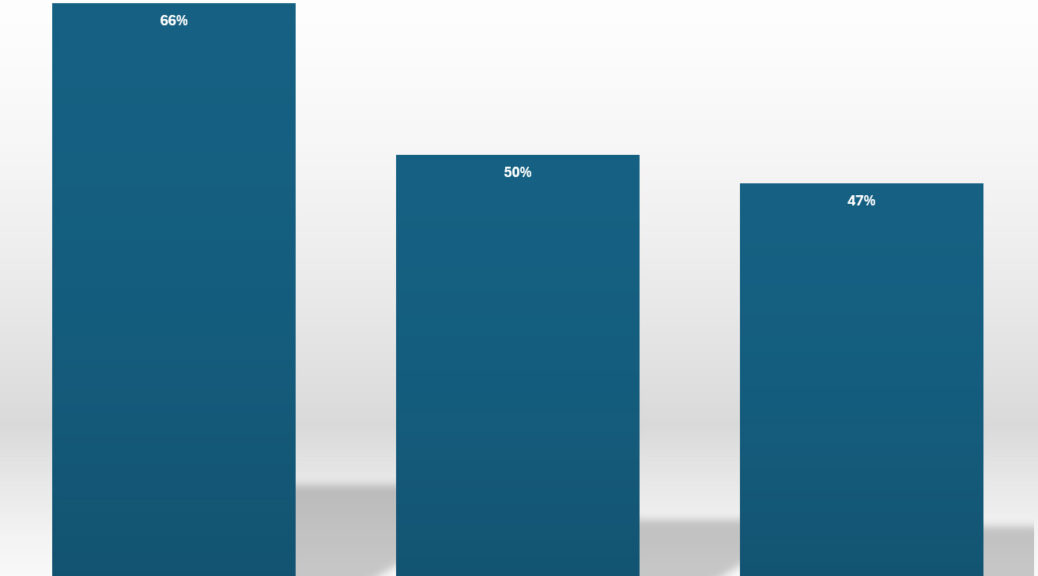
Curious, I ran a quick analysis of the last annual meetings of my professional association, the Archaeological Institute of America (AIA). I found that in panels organized by one or more men (and no women), 66% of the speakers were male; in panels organized by one man and one woman, the speakers were 50% male; and in panels organized by one or more women, 47% of the speakers were male. [Disclosure: I organized a panel at the 2014 annual meeting of the AIA with two other men; we invited two women and three men to present papers.]

Most panel organizers were men (24, compared to 14 women) and most invited speakers were men (69, compared to 53) women, so that in sum, 57% of all invited speakers at the AIA were men. (Unfortunately I didn’t have the time to run the numbers on the open panels, to see what proportion of speakers are male and female.)

Of course, my “study” hardly qualifies as such, since it only included one annual meeting and I didn’t control for anything at all. Even so, it seems plausible that we have a problem similar to the NSF: more organizers are male, resulting in gender disparities among speakers. Likewise, in the NSF study, it seems that more men are PIs of projects, resulting in many more applications by men. I have no solutions to this problem, although I can think of at least one potential solution that I’m entirely opposed to.

Papyrus, clay, and the market

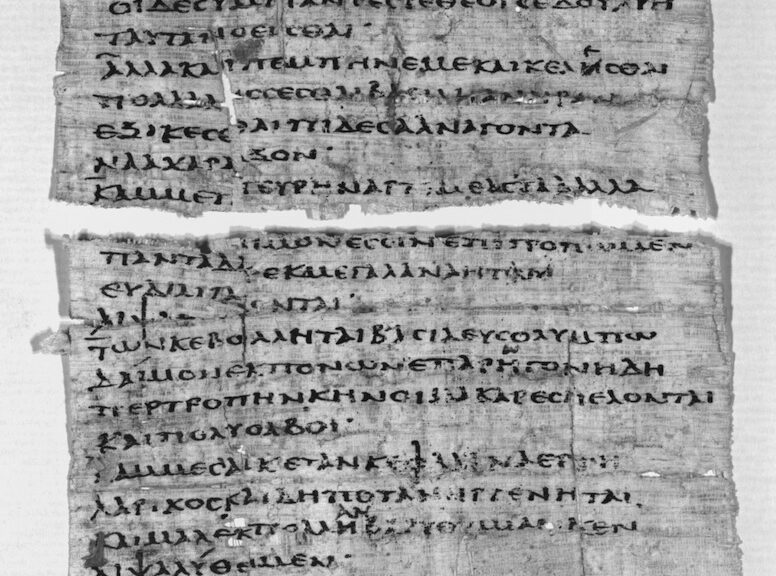
Two articles about the publication of ancient texts of unknown provenance have got me thinking about the ethical issues of publication. The first is Doug Boin’s op-ed in the New York Times about the forthcoming publication of two new fragments of Sappho, the second is Jerry Cooper’s argument on the ASOR blog for publishing cuneiform tablets that do not have a provenance.

Let’s begin with the Sappho. The announcement that two new poems of Sappho had been found and that publication was imminent created a sensation both in Classics circles and in the popular press, but some people (including myself) were worried that in the preliminary draft of the publication (posted online but now taken down), we were just told that the papyrus was “now in a private collection” of an anonymous person in London. As Boin points out in his op-ed:

Looting has become particularly catastrophic in Egypt in recent years. Sites have been pillaged, including those in military zones, and museums have not been spared. In 2011, the Egyptian Museum near Tahrir Square suffered at the hands of rioters. Half of the nearly 50 objects stolen have been recovered, but the situation was deemed so grave that in February 2012 the International Council of Museums launched an Emergency Red List of Egyptian objects at risk of theft. Items to look out for? Mummies, mummy casings, and papyrus fragments.

Given that fact, it might seem a bit odd that more information about the provenance of the papyrus wasn’t provided. But actually, it’s not too surprising when you realize that most people just don’t care. Even if the papyrus were illegal, does anyone really believe that scholars would uniformly, or even as a majority, refuse to publish two new fragments of Sappho?

This is not to accuse papyrologists of being unethical. They’re not. But there is, it seems to me, a sense that different rules apply to texts. Why?

Here we can turn to Jerry Cooper’s thoughtful piece on the ASOR blog. The argument is twofold: First, unlike archaeological artifacts, textual documents contain within them contextual information. Second, unlike many archaeological artifacts, it is unknown whether publications of cuneiform texts “help create a market for cuneiform tablets and thus encourage looting and site destruction.” Cooper honestly isn’t sure what to think about this:

 I have seen no well-founded answer to this question [whether publication encourages looting], and I can’t pretend to know what motivates the small number of serious collectors of these rectangular bits of inscribed mud. I personally find working with dealers to identify and market looted tablets reprehensible. In any case, nearly all the unprovenanced tablets being published today are off the market, in large public collections, where they are well cared for. It makes no sense to ignore them, or to stigmatise scholars who have saved them from oblivion.

Cooper then goes on to say:

It is quite possible that the number of tablets illicitly excavated since the first Gulf War in 1991 is as large as the number of all the tablets that came to light in the century and a half before 1991- perhaps 200,000. Can a scholar willfully ignore half of the evidence bearing on his subject? I can’t.

Here, it seems to me, is the crux of the issue. Cooper doesn’t know whether publishing encourages looting, but it seems that he really doesn’t want to know, because first of all, it’s awful — “no cuneiformist could be unmoved by the moonscape images of looted sites” — but even if there were a direct and demonstrable link between publication, the market, and looting, he couldn’t bear to ignore half of the evidence that bears on his subject anyway. That hardly seems like a defensible position to me. It’s a rationalization of an established practice, which is to publish texts that don’t have good archaeological provenience.

(Parenthetically, it seems insane to me to write an argument in defense of publishing texts of unknown origin while claiming ignorance about whether there’s a relationship between publication and looting — not because I think that such a relationship is self-evident — but because it’s illogical. Doesn’t one need to have an answer to such a question?)

It seems to me likely that something similar is going on with the Sappho fragment. It’s too spectacular, too important, to ignore. And the omission of the provenance of the fragment wasn’t, it seems to me, intentional, but reflects the priorities of scholarly practice… unfortunately, in my view,