
Tag Archives: archaeological ethics

Field archaeology & sexual harassment

Field archaeology has a sexual harassment problem. Everybody knows this, at least anecdotally; we’ve all seen, experienced, and/or heard about it. It’s especially problematic in a field that is numerically dominated by women but where many of the directorial staff are men. It’s scandalous that this is the case, and it’s scandalous that our institutions seem to be doing nothing about it.

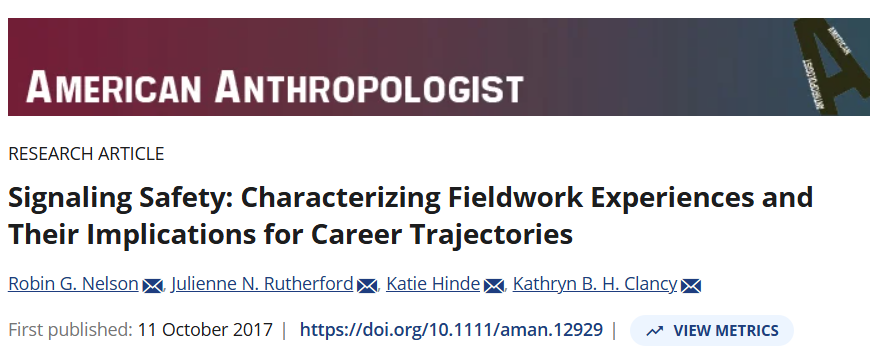
A recent article in American Anthropologist about this problem, “Signaling Safety: Characterizing Fieldwork Experiences and Their Implications for Career Trajectories,” suggests some ways forward. They find that sexual harassment and assault are systemic problems in fieldwork (not specifically, but including, archaeological fieldwork) and that these behaviors hurt women in a variety of ways, including their careers. That’s not surprising. What is useful is their finding that clear rules and consequences are clearly associated with healthier projects. That is to say, on such projects

field directors and researchers participated in explicit conversations, training, or meetings to establish site-specific policies. Senior researchers engaged in implicit modeling of these rules to other field researchers and often made themselves available for discussion. There was also evidence that the rules at these sites were enforced with observable consequences. In one specific example, the sexual harassment of a peer resulted in the perpetrator being asked to leave the fieldsite.

The other major, related, finding was that good projects

were fair and/or egalitarian in execution, living and working conditions were intentional and safe, and directors anticipated problems and created avenues for conversations or reporting. Respondents who described these experiences highlighted the importance of having women in leadership roles at their sites, particularly if the rest of the site leadership valued those women’s roles.

My own experiences tally with these findings, especially when it comes to the project that I co-direct. I wish that this article had come out before we started our project, because it would have changed the way I did some things – I would have been much more explicit about our policies on sexual harassment, for instance – but most of them were things that we did on our project. The negative findings also tally with my experiences and what I’ve heard about bad projects.

The big problem here, from my perspective, is that projects are not held to account by the institutions that regulate archaeological field work. The Archaeological Institute of America’s Code of Professional Standards says that archaeologists shouldn’t harass or discriminate, but that has no teeth. The American School of Classical Studies at Athens requires an application for a field permit to include statements about research questions, methods and techniques, site conservation, a budget, etc. but nowhere is anything said about policies to enforce issues arising from discrimination and harassment. The same is true for the Canadian Institute in Greece. Searches for “harass” and “harassment” on their websites yield nothing about policies about sexual harassment.

This is unsatisfactory, because as many of us know, the worst offenders can be the project directors themselves. It doesn’t help that although women are probably the majority of all field projects, they are severely underrepresented among directorial staff. (And this criticism is true of my own project: men outnumber women on the directorial staff, but virtually all of our supervisors are women and most of our students were).

I don’t think that we can claim, in the face of all the evidence, that this is simply a question of a few bad eggs. This is a systemic problem and it requires a systemic solution.

My suggestion would be that applications for field permits in Greece should be required to include policies that govern discrimination and harassment. If they refuse to include such policies, their request should be denied. Participants need to be made aware of these policies, and that they may report violations to the Director of the American School or the Canadian Institute (and to the relevant fieldwork committees), since we know what happens when such problems are dealt with internally. This is a serious problem, and we need to deal with it seriously.
Papyrus, clay, and the market

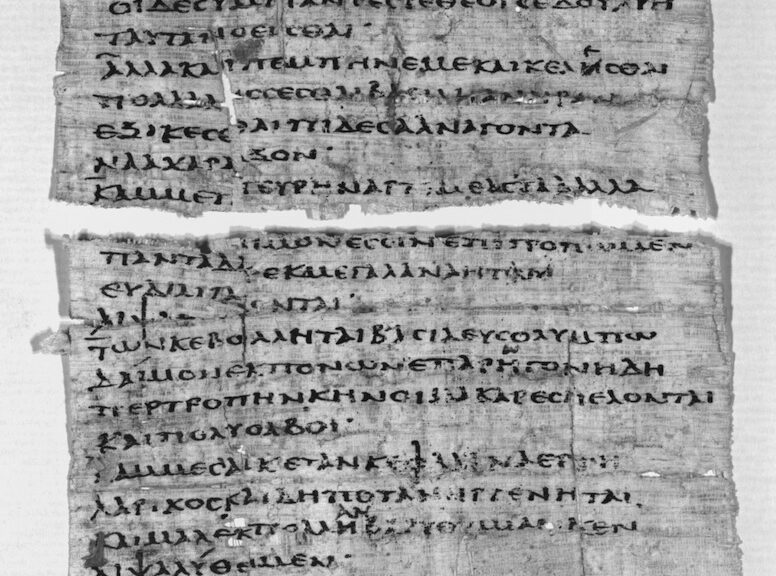
Two articles about the publication of ancient texts of unknown provenance have got me thinking about the ethical issues of publication. The first is Doug Boin’s op-ed in the New York Times about the forthcoming publication of two new fragments of Sappho, the second is Jerry Cooper’s argument on the ASOR blog for publishing cuneiform tablets that do not have a provenance.

Let’s begin with the Sappho. The announcement that two new poems of Sappho had been found and that publication was imminent created a sensation both in Classics circles and in the popular press, but some people (including myself) were worried that in the preliminary draft of the publication (posted online but now taken down), we were just told that the papyrus was “now in a private collection” of an anonymous person in London. As Boin points out in his op-ed:

Looting has become particularly catastrophic in Egypt in recent years. Sites have been pillaged, including those in military zones, and museums have not been spared. In 2011, the Egyptian Museum near Tahrir Square suffered at the hands of rioters. Half of the nearly 50 objects stolen have been recovered, but the situation was deemed so grave that in February 2012 the International Council of Museums launched an Emergency Red List of Egyptian objects at risk of theft. Items to look out for? Mummies, mummy casings, and papyrus fragments.

Given that fact, it might seem a bit odd that more information about the provenance of the papyrus wasn’t provided. But actually, it’s not too surprising when you realize that most people just don’t care. Even if the papyrus were illegal, does anyone really believe that scholars would uniformly, or even as a majority, refuse to publish two new fragments of Sappho?

This is not to accuse papyrologists of being unethical. They’re not. But there is, it seems to me, a sense that different rules apply to texts. Why?

Here we can turn to Jerry Cooper’s thoughtful piece on the ASOR blog. The argument is twofold: First, unlike archaeological artifacts, textual documents contain within them contextual information. Second, unlike many archaeological artifacts, it is unknown whether publications of cuneiform texts “help create a market for cuneiform tablets and thus encourage looting and site destruction.” Cooper honestly isn’t sure what to think about this:

 I have seen no well-founded answer to this question [whether publication encourages looting], and I can’t pretend to know what motivates the small number of serious collectors of these rectangular bits of inscribed mud. I personally find working with dealers to identify and market looted tablets reprehensible. In any case, nearly all the unprovenanced tablets being published today are off the market, in large public collections, where they are well cared for. It makes no sense to ignore them, or to stigmatise scholars who have saved them from oblivion.

Cooper then goes on to say:

It is quite possible that the number of tablets illicitly excavated since the first Gulf War in 1991 is as large as the number of all the tablets that came to light in the century and a half before 1991- perhaps 200,000. Can a scholar willfully ignore half of the evidence bearing on his subject? I can’t.

Here, it seems to me, is the crux of the issue. Cooper doesn’t know whether publishing encourages looting, but it seems that he really doesn’t want to know, because first of all, it’s awful — “no cuneiformist could be unmoved by the moonscape images of looted sites” — but even if there were a direct and demonstrable link between publication, the market, and looting, he couldn’t bear to ignore half of the evidence that bears on his subject anyway. That hardly seems like a defensible position to me. It’s a rationalization of an established practice, which is to publish texts that don’t have good archaeological provenience.

(Parenthetically, it seems insane to me to write an argument in defense of publishing texts of unknown origin while claiming ignorance about whether there’s a relationship between publication and looting — not because I think that such a relationship is self-evident — but because it’s illogical. Doesn’t one need to have an answer to such a question?)

It seems to me likely that something similar is going on with the Sappho fragment. It’s too spectacular, too important, to ignore. And the omission of the provenance of the fragment wasn’t, it seems to me, intentional, but reflects the priorities of scholarly practice… unfortunately, in my view,