All posts by Dimitri

Geography and a Greek “culture of freedom”?

I recently had the opportunity to begin reading Christian Meier’s “A Culture of Freedom: Ancient Greece & the Origins of Europe” (Oxford University Press 2011), a translation of the first two parts of his seven-part history of Europe. Several reviews of the book have already come out in academic journals (CJ, CP) and in the popular press (THES, WSJ). The book seeks to answer “how the Greeks came about… how they developed into a culture that was so different from all the other magnificent high cultures that emerged before and beside them in world history.” (286) The answer, not surprising given the title, is freedom: “With the Greeks, the motor [of culture] was freedom, specifically, a broad circle of free men in many cities, who saw themselves challenged to secure and expand their free way of life against all encroachments.” (286)

I have to say that so far I find the book deeply problematic. For the moment, I’ll leave aside the politics, which I would characterize as triumphant Occidentalism. Meier is writing to a broad audience, and he is covering a massive topic, so a certain amount of oversimplification is probably inevitable. But when an author talks over and over again about “the Greeks,” it’s hard not to think about bad undergraduate essays in introductory classes. For instance (14):

The Greeks’ defining characteristics were that they were first and foremost human beings, and not emperors, consuls, or senators; that they refused to be constrained by the rules of a class-segmented society…

I really don’t understand this. Was Augustus an emperor first and a human being second, whereas Perikles was a human being first and a general second? How could we know? Similar problems occur when Meier tries to explain the big events in Greek history. Thus, when discussing the 8th century “renaissance” and the rise of the polis, he writes (65):

In fact, it was probably only their intense contact with the Orient that allowed Greeks to jump immediately, almost without any transition, up to the next rung of the ladder of civilization without drastically changing their original nature.

What can this possibly mean? The “rung of the ladder of civilization” seems to appeal to some notion of unlineal evolution, a theory jettisoned already by the beginning of the 20th century. And how can Meier know what the “original nature” of the Greeks was, given that all of our literary evidence begins precisely during this early period?

The result of this extremely broad and diffuse level of discourse is that Meier is forced to manipulate the evidence so that it fits his schema. I doubt that this is intentional; he is simply not a master of all the material he discusses. But when this material is the end of the Greek Late Bronze Age, I think it is legitimate to take him to task. Here I want to focus on Meier’s discussion of geography and politics.

In his chapter on the “new beginning” in Greece after the destruction of Mycenaean palatial culture, Meier points out that the early city-states of the 8th century were typically small, and he points out that “landscape and climate encouraged the formation of small communities” (53). He then goes on to say that (53-54)

But geography alone cannot explain why Boeotia contained ten independent, only loosely associated poleis, or Rhodes three. Already in the Mycenaean period, topography had not proved a serious obstacle to the formation of larger political units. In that era, however, neighbouring territorial powers — Minoan Crete as well as the Hittite Empire in Asia Minor — seem to have provided the impetus for the formation of larger centrally ruled kingdoms. This may be part of the solution to the puzzle: in this sort of landscape, external impulses were necessary to stimulate the development of larger political units. In the centuries after 1200 BC and the collapse of the Hittite Empire, however, no Oriental power took an interest in the Aegean region.

It seems odd to characterize Mycenaean kingdoms are large political units. Were they really so anomalously large? Pyos, the kingdom whose political geography we know best, occupied about 2000 sq km, comparable to the territory of the polis of Athens. And in fact, the Classical polis that later occupied the same land was in fact larger than its Mycenaean predecessor — by over three times. As Meier himself points out, after the conquest of Messenia, Sparta controlled a territory of 7400 sq km.

We understand the political geography of other Mycenaean kingdoms less well, but they are not gargantuan in size. Knossos maximally controlled a territory of some 6400 sq km — which is still smaller than Classical Sparta. But Jan Driessen (2001) has argued that in fact the evidence from the Linear B texts suggests that Knossos “was not so much a territorial state as an economic enterprise” (99) that focused on particular types of activities in particular places. He suggests that the Knossian kingdom “monitored only one-third or one-fourth of the island” — that is, 2100-2800 sq km, about the same amount of territory at Pylos. The political geography of the Argolid is difficult to assess, but it is worth noting that there are a large number of Mycenaean centres in and around the Argive plain. The modern municipality of Argos covers only some 1000 sq km, although it does seem likely that the kingdom of Mycenae extended north and east into the Corinthia and the Epidauria. Thebes may have controlled a very large territory, although a note of caution has been sounded by Tom Palaima (2011) and Dakouri-Hild, who imagine a Theban polity in the 1000 sq km range, with influence extending to Amarynthos and Karystos. And I’d add, as a coda, that neither were the Neopalatial (“Minoan”) predecessors of the Mycenaean states very large: John Bennet (1990) has estimated that their territories were about 1000 sq km, with the largest being 1500 sq km.

In sum, then, Minoan and Mycenaean polities were not particularly large. They were probably larger on average that Classical poleis: for instance, according to Bennet, Classical and Hellenistic poleis on Crete had on average territories ca. 500 sq km, compared to the Minoan polities with territories twice as large on average. But it is also the case that there may have been many independent Mycenaean polities — say, for example, Aidonia — that skews our data towards the larger, better-known, and better-studied, Mycenaean polities.

So why does Meier insist on the large size of Mycenaean polities? Why doesn’t he cite Colin Renfrew’s (1975) Early State Module, which suggested that in many early civilizations, we find many small (ca 1500 sq km) polities? Perhaps its simple ignorance, but if so it is willful. Meier needs to differentiate Mycenaean culture from Greek culture (49):

As far as we can tell from the numerous and often grandiose remains, Mycenaean culture was monarchic in both organization and character. It was a palace culture, and Mycenaean kings seem to have ruled over large territories. These are two of the major differences between Mycenaean and post-Mycenaean Greek culture.

There is no road that leads from Mycenaean to polis-based culture. All the fundamentally new aspects of this latter culture, which turned world history on its head, could not have arisen easily, had the foundations, forms (and limitations) of the preceding epoch not been destroyed, and, notwithstanding a small and on the whole insignificant number of continuities, had the post-Mycenaean Greeks not had the chance to begin again from scratch.

So, Mycenaean polities are large because that makes them fundamentally different from Greek poleis, and it makes them fundamentally similar to other contemporary eastern kingdoms. Hence Meier mentions the large size of the Minoan palaces (which actually aren’t very large) and the Hittite Empire. But to compare the fairly small Aegean polities to the Hittites is absurd. For some reason, I can’t find any estimates of the size of the Hittite empire, but even if it was on quarter the size of modern Turkey, it covered 196,000 sq km. Meier seems to imagine that the Hittites influenced the Mycenaeans and stimulated the development of larger kingdoms, but how would this have actually worked? It’s entirely unclear.

I think it’s more likely that Meier sees the Mycenaeans are fundamentally non-Greek. After all, they did not create a culture “for freedom’s sake” (14), a phrase that recurs throughout the work. So the Mycenaeans weren’t really Greek, not in their politics (monarchy, not oligarchy or democracy), not in their political geography (big territorial states, not small independent poleis). So Meier needs to assert that Mycenaean polities were big territorial states, even when they’re not. By cutting the Mycenaeans out of Greek history, Meier can begin his history of Europe with the emergence of the polis. This is Europe’s elusive “zero hour.”

Maybe some people won’t mind that Meier stretches the truth a bit to capture a complex reality. To me, however, this is less history than European myth-making.
Place and memory

I’m currently reading Janice Kulyk Keefer’s fantastic memoir, Honey and Ashes. It’s a memoir of an immigrant family in Toronto, full of stories from the Old World, stories that revolve around her grandparents, her mother and her aunt, in the western Ukraine. Those stories were about a world that felt in some ways far more real to her than the Toronto in which she grew up. Her book reminds me of my own relationship to my grandparents and their stories. On the one hand, I wish that I had paid more attention to their stories so that I could recall them with Keefer’s vividness. On the other, the yawning chasm between Keefer and the Ukraine is different from my experience — my paternal grandparents never left Greece, I and my family went back often, almost every summer of my life, although of course my experience of Greece was very different from theirs. My grandmother was from a mountain village in the least populated part of Greece, after all, and my grandfather was one of the refugees who were forcibly moved from their homes in Turkey to Greece in the population exchanges of the early 1920s. When they were married they were strangers, my grandmother always used to say. The Greece I knew as a child was a radically urban Athens and its suburbs (especially Glyfada) in the 1980s and onwards.

The other dimension of Keefer’s work that interests me is the extent to which her stories about her grandparents’ village are bound up in place, and how important place becomes when she travels back to the Ukraine as an adult to explore the remnants of ‘home.’ Places anchor these stories, prove their authenticity, bring them alive. In this respect, one of the stories I was told by my grandparents — although it barely qualifies as a story — has profoundly influenced me. One night I went out to dinner with a prehistorian friend in the Athenian neighborhood of Kaisariani. When I told my grandmother where I had been the night before, she nodded and quietly said that many people had died there during the war. Almost word for word, her youngest sister Elli independently repeated the same to me later that morning. I didn’t ask for any more details. 200 communists were executed there on May 1, 1944, and this is now commemorated by a memorial.

I was struck then by the way in which traumatic memories were so stronly associated with particular places, such that my grandmother and her sister immediately responded in exactly the same way, and I don’t think that it’s a coincidence that more than 10 years later, I wrote an article in GRBS in which I argued that traditions and memories associated with the Athenian Acropolis — in particular the slaughter of the followers of Kylon circa 632 BC — exerted a powerful effect on Athenians in the Archaic and Classical periods, so strong that it influenced the performance of an annual ritual on the Acropolis known as the Dipolieia and the Bouphonia. Memories and family traditions reside in places, they haunt them and define them, no less I would argue then than they do now.

Bathing in the Bronze Age

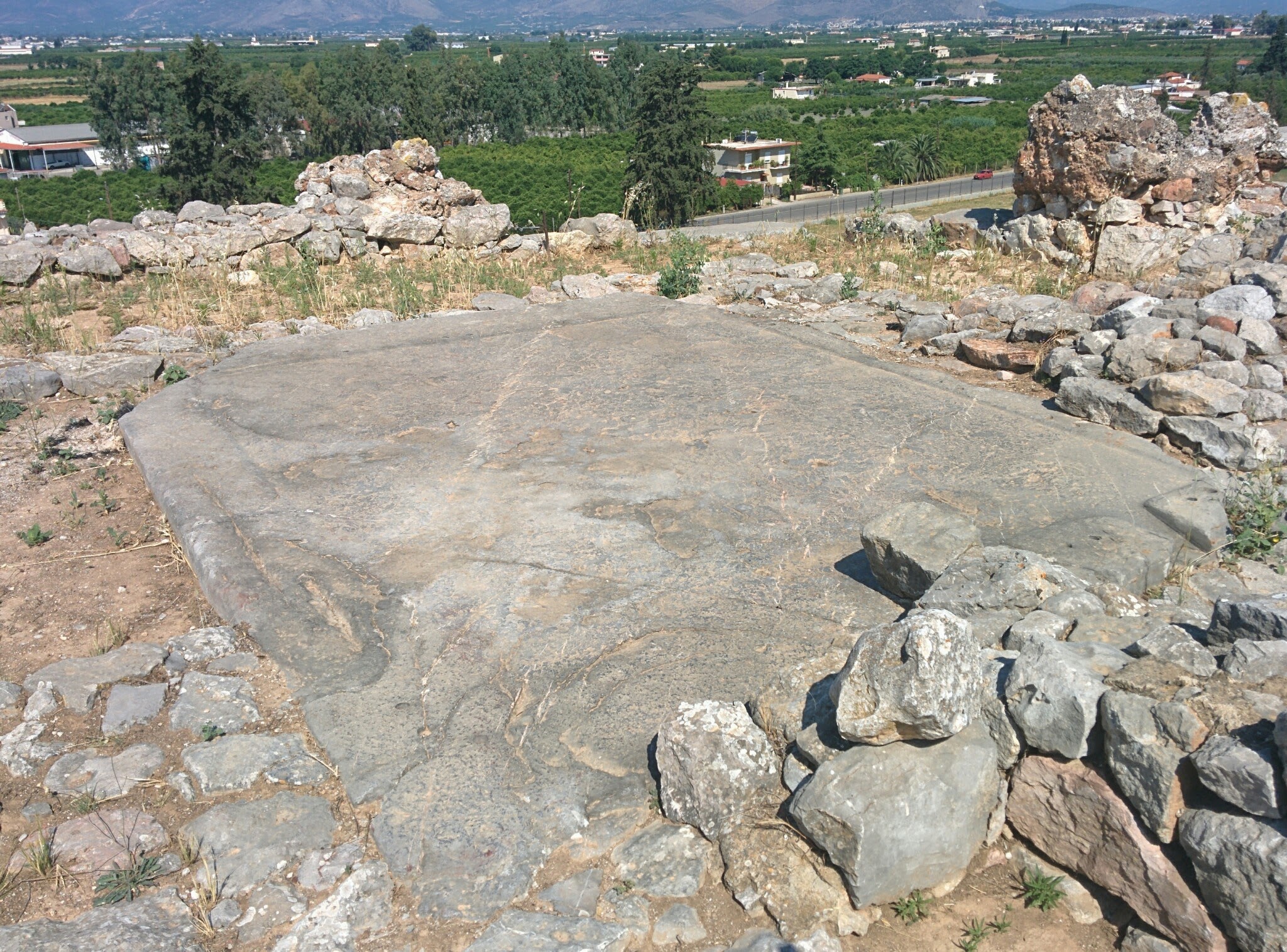
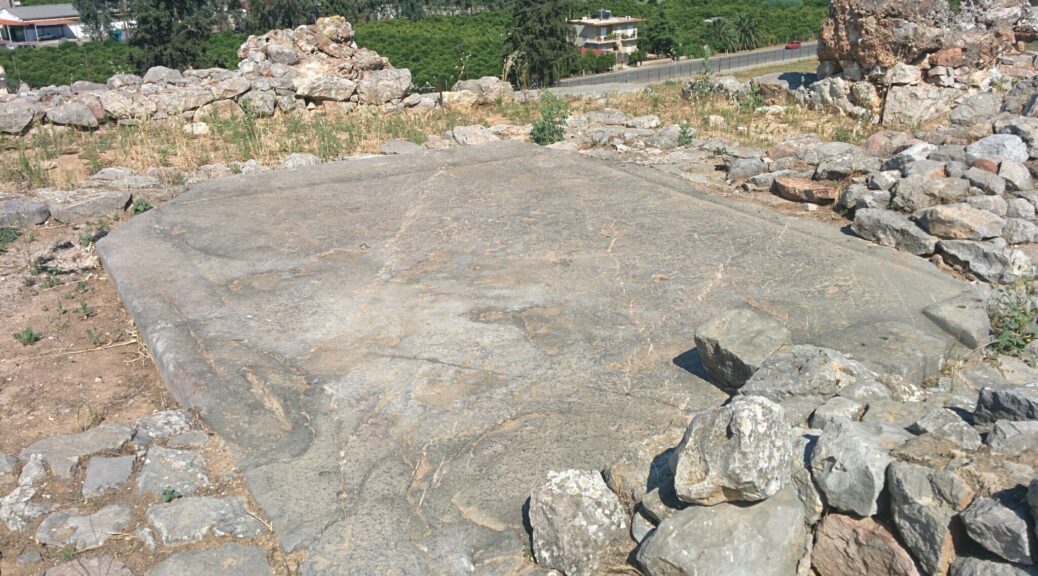
One of the features I like best about Bill Caraher’s blog are his discussions of journal articles. This is, it seems to me, something that’s extraordinarily useful and easy to do in a blog, but doesn’t find easy expression in other media. Recently I read Joe Shaw’s “Bathing at the Mycenaean Palace of Tiryns” in the American Journal of Archaeology (2012). In the article, Shaw reconstructs the room with the “bathing slab” in the Mycenaean palace at Tiryns, shown here:

Shaw shows that the drilled sockets anchored a wooden bench with wooden panels underneath that slotted into wooden vertical supports. He reconstructs the bath complex (see below) and he then goes on to review evidence for bathing more broadly in the Aegean Bronze Age.

tiryns_bath_reconstruction

In some ways, this paper is pretty regular. By this I mean that it probably won’t show up in popular media (like, say, the BBC News), and it doesn’t represent an enormous methodological or theoretical breakthrough. But it’s remarkable nevertheless. First, it is a real model of how arguments should be made. Shaw weaves together past interpretations, architectural parallels from other sites on the Greek mainland and the island of Crete, and real common sense to make his argument in only 15 pages of text. Every sentence in his article is necessary, every sentence packs  punch. As a reader, I felt incredibly well taken care of, in the hands of someone who has thought hard and carefully. In fact, I’m sure that this is true. But this feeling is notable because this isn’t something I often encounter. More often, the text feels like an impediment to understanding rather than a guide. Second, it is a great example of an article that requires real mastery of Aegean architecture. It’s not the kind of article that just any Aegean prehistorian could have written. It requires a seasoned eye, one that’s been trained to look for details, and a mind that can rifle through a database of relevant parallels, and to bring them together to come up with a plausible and persuasive reconstruction.

This article has also forced me to reflect more broadly on bathing in the Greek Bronze Age. As Shaw points out, the more one thinks about bathing, the more important it does seem to be to Mycenaean elites. In this, Shaw shows, it is distinctive to the mainland: bathing is apparently not as important on the islands. There are large, well-appointed rooms for bathing at two (at least) mainland Mycenaean palaces: Pylos and Tiryns. Linear B tablets at Pylos record workers that concern themselves with bathing: there are 66 bath-workers (re-wo-to-ro-ko-wo, lewotrokhowoi, cf. Homeric λοετροχόος, on Aa 783, Ab 553; Ad 676 records their sons). The tablets also carefully record palatially-managed production of perfumed olive oil. Whether or not this oil was used in bathing ceremonies — as Shaw shows, it probably was — it is also concerned with care for the body. Shelmerdine (1985) has also suggested that perfumed oil was used to anoint textiles.

Much of the literature on bathing and the Aegean Bronze Age has focused on ritual aspects, such as ritual lustration. Shaw also draws attention to what we might call more practical concerns: care of guests and strangers who entered the palace, hot and dusty from the road, perhaps (Shaw, 555: “journey-worn guests”). But regardless of its ritual import, or its practical functions, it does seem possible that bathing and care for the body was a particular concern of the Mycenaean elite. It may have been strategy whereby some members of the elite distinguished themselves from others. (It’s impossible for me to write this without thinking of that scene in “Monty Python and the Holy Grail.”) Those resident in the palaces would have been particularly well-placed to bathe themselves more regularly and to anoint themselves with fragrant oils produced in palatial workshops. They probably wore special textiles, perhaps those produced by palatial workshops, like the texts at Knossos described as “of hekwetas type” (e-qe-si-jo), and other objects, like jewelry. Thus, Shaw’s article encourages us to see bathing as part of a larger suite of activities by which mainland elites in the Bronze Age arranged their bodily appearance, perhaps as a mode of distinction from those who could not afford to do so. Bathing, however, appears to be a particular concern of Mycenaean elites on the mainland, which suggests that such modes of bodily display were not homogeneous across the Aegean or throughout its history.

[Originally posted to englianos.wordpress.com]

Farm fragmentation in modern Greece

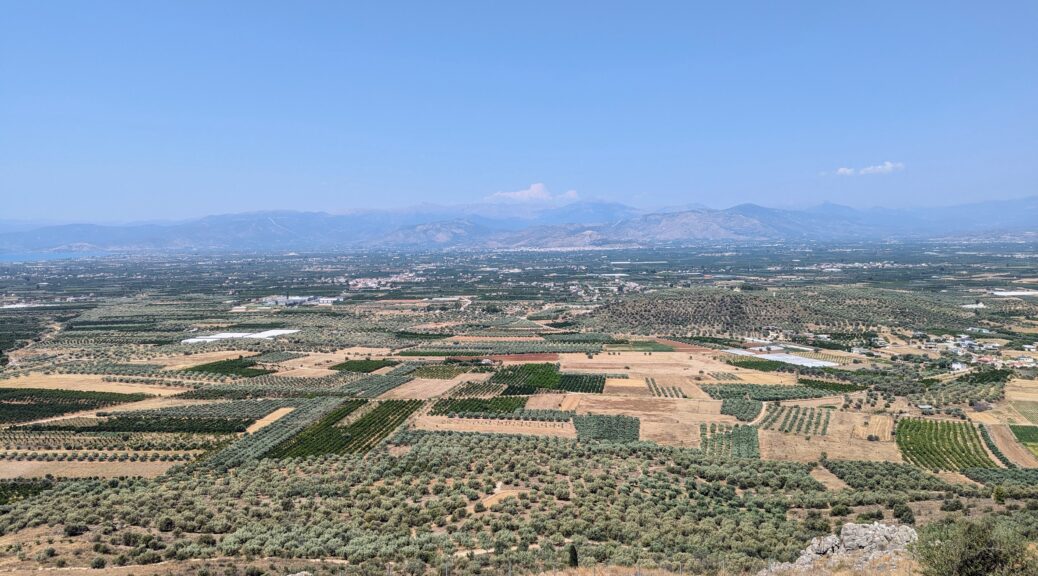
Viewed from a vantage point, and in the clarity of its celebrated light, the Greek landscape contains much to charm and interest the observer. But in the mundane aspects of its agriculture, many imperfections may be detected including such features as primitive farming techniques, meager crop stands, insufficient fencing, and neglect of the principles of soil conservation. Most striking, perhaps, is the fact that the arable land generally presents the aspect of an intricate mosaic of tiny fields set in a matrix of roads, paths, and field divisions.

More careful study of the landscape reveals a grossly anomalous pattern of proprietorship since the minuscule, awkwardly-shaped fields (perhaps better termed plots) are rarely in contiguous ownership. Usually a single farm consists of a number, even 30 or more, of widely separated, tiny plots. The dismemberment of land has gone so far that a plot of 20 stremmata (about 5 acres) is now considered a large piece of property. Truly, the fabric of Greek agriculture has been cut to pieces.

Thus begins Kenneth Thompson’s classic Farm Fragmentation in Greece (1963, 1). The fragmentation of the landscape into small plots was a nightmare for Thompson, who wrote his study for the monograph series of the Greek Center of Economic Research (the preface is written by Andreas Papandreou!). Thompson clearly didn’t understand, and couldn’t understand, the fragmented Greek systems of land holding. Most archaeologists and historians now interpret farm fragmentation positively, as a sensible, risk-averse economic strategy (e.g., Gallant 1991).

In any case, I had occasion to look at Thompson and the other literature of farm fragmentation for different purposes. My forthcoming monograph is a prosopographical study of Late Bronze Age Pylos. I argue that in many cases, we can plausibly show that when a personal name appears in multiple Linear B texts, it represents a single historical individual who was active in multiple areas under palatial administration. One obstacle to these prosopographical identifications is geography. Although in some cases the same name appears at the same place-name, in others the same name is listed against different places. Now, sometimes we know where these places are, sometimes we don’t. But if we do know where these places are, when it is reasonable to say that they are TOO far apart? Clearly if the places are 1 or 2 km apart, it’s not impossible to believe that a single person could have been active at both places. After all, according to Google Maps my office is a 1.4 km walk from my home, a short distance that isn’t very troublesome, even in the coldest depths of a Toronto winter. But what about 10 km? 20 km?

The farm fragmentation studies were one way for me to approach an answer this question. Like most Greek archaeologists, I was familiar with Greek farm fragmentation and the fact that Greek farmers were generally willing to travel great distances (or what seemed to me like great distances) to work their land, but I hadn’t looked at the primary data. Thompson is the most comprehensive study, but there is also information about Melos (from Renfrew and Wagstaff 1982), Methana (from Clark 1988) and Messenia itself (from McDonald and Rapp 1972). On Melos, the travel time to the most distant landholding  ranged from 5 minutes to 6 hours, with a mean of 2 hours. Here is the breakdown based on the 97 farmers interviewed for the Melian study:

melos_travel-time

The Melian results are basically compatible with those from Methana and the survey of Thompson, which covered several different parts of Greece. Thompson found that the average distance to the furthest landholding was 7 km, or a walk of about 1.4 hours. Clark (1988, 58-59) reports that most fields on Methana are 5 minutes to 1 hour’s walk from the village, although some were as far as 3 hours away, Some Methanites owned land on the plain near the village Τροιζήνα and travelled there by mule, a journey of 5-8 hours (Clark 1988, 92). Unfortunately the Minnesota Messenia Expedition did not report distances to the furthest landholding. Instead, they report that “the average travel distance between the farmer’s home and his fields is about 1.3 km…” (van Wersch 1972, 178). This is significantly less than the average of 2.2 km for the Peloponnese reported by Thompson (1963, 32). For my purposes, the furthest landholding is the most useful statistic. But in any case, we can concluded that farmers in mid-20th century Greece were generally willing to travel 1-2 hours to their furthest landholding, although in some cases they would be willing to travel 5-8 hours. The average field, however, was closer to the farmer’s home, on average about 20-30 minutes away.

If the modern farmers are anything to go by, then, distances of 10 km should be no major obstacle to prosopographical identification. That is, it is not difficult to imagine a Bronze Age Messenian walking 2 hours from this place of residence to a plot of land, or the location of some other part-time work. Indeed, it might even be possible to see 20 km distances as no great obstacle, if we assume that the individual in question lived midway between the two locations recorded in the Linear B documentation (although I don’t operate on this assumption in my book).

In any case, I’m not sure that geography is all that significant in prosopographical identification. After all, many (if not all) of the individuals identified by name in the Linear B tablets were likely to be individuals of some standing, who could have had holdings and interests that were taken care of by kin or dependents. But in some cases, it’s possible to show that a name listed against two different toponyms can reflect one person who, although not itinerant, does regularly move across significant distances in the landscape. Many Linear B scholars, when confronted with the same name at two toponyms, concluded that two individuals with the same name were being referred to. A closer look, however, suggests the opposite conclusion: that in many cases we’re looking at references to the same person who moved around the Messenian countryside.

[Originally posted to englianos.wordpress.com 19 Jan 2013]

Debt, patriarchy, and Hesiod

Thanks to the guys over at Savage Minds, I picked up and started reading David Graeber’s Debt: The First 5,000 Years, and increasingly, talking about it to anyone who will listen. Graeber’s book is really good, very interesting and thought-provoking, and it’s given me lots of ideas.

Today, while waiting in line for a burger, I came across a section in the book where Graeber makes an argument for the origins of patriarchy. He argues that anxieties about the sexual propriety of women emerge when human economies become increasingly commercial. A human economy is one where money is “used to arrange marriages and settle affairs of honor” (177) but not to purchase commodities. Such economies primarily arrange relationships between people. But these human economies can be transformed into something else, economies where slavery exists and humans can be bought and sold. Graeber is particularly concerned with debt and debt-bondage. (That is, when an individual took out a loan and used members of his household as sureties on that loan, and if he then defaulted on the loan, then these household members could be put into various forms of servile relationships with the creditor). As Graeber argues,

for much of the rural poor, debt dependency was institutionalized, with the daughters of poor debtors, predictably, often dispatched to brothels or to the kitchens or laundries of the rich. In either case, between the push of commoditization, which fell disproportionally on daughters, and the pull of those trying to reassert patriarchal rights to “protect” women from any suggestion that they might be commoditized, women’s formal and practical freedoms appear to have been gradually but increasingly restricted and effaced. As a result, notions of honor changed too, becoming a kind of protest against the implications of the market… (186)

Graeber then proceeds to discuss the ancient Greek evidence (186-188), without, however, mentioning Hesiod. It immediately seemed to me clear that Hesiodic poetry works very well with Graeber’s larger master narrative. You have in Hesiod on the one hand an anxiety about economic hard work and self-reliance, the importance of passing on to one’s son or sons (although ideally one should have only one son) a large farm, and the avoidance of risky economic enterprises. Hesiod also places his poetic persona in opposition to the elites of the city and their violent, hubristic activity. On the other hand, there is an anxiety about control over female sexuality, an anxiety expressed in the succession myth in the Theogony but also in the Works and Days (trans. Evelyn-White 1914):

(320-341) Wealth should not be seized: god-given wealth is much better; for it a man take great wealth violently and perforce, or if he steal it through his tongue, as often happens when gain deceives men’s sense and dishonour tramples down honour, the gods soon blot him out and make that man’s house low, and wealth attends him only for a little time. Alike with him who does wrong to a suppliant or a guest, or who goes up to his brother’s bed and commits unnatural sin in lying with his wife, or who infatuately offends against fatherless children, or who abuses his old father at the cheerless threshold of old age and attacks him with harsh words, truly Zeus himself is angry, and at the last lays on him a heavy requittal for his evil doing. But do you turn your foolish heart altogether away from these things, and, as far as you are able, sacrifice to the deathless gods purely and cleanly, and burn rich meats also, and at other times propitiate them with libations and incense, both when you go to bed and when the holy light has come back, that they may be gracious to you in heart and spirit, and so you may buy another’s holding and not another yours.

(342-351) Call your friend to a feast; but leave your enemy alone; and especially call him who lives near you: for if any mischief happen in the place, neighbours come ungirt, but kinsmen stay to gird themselves. A bad neighbour is as great a plague as a good one is a great blessing; he who enjoys a good neighbour has a precious possession. Not even an ox would die but for a bad neighbour. Take fair measure from your neighbour and pay him back fairly with the same measure, or better, if you can; so that if you are in need afterwards, you may find him sure.

(352-369) Do not get base gain: base gain is as bad as ruin. Be friends with the friendly, and visit him who visits you. Give to one who gives, but do not give to one who does not give. A man gives to the free-handed, but no one gives to the close- fisted. Give is a good girl, but Take is bad and she brings death. For the man who gives willingly, even though he gives a great thing, rejoices in his gift and is glad in heart; but whoever gives way to shamelessness and takes something himself, even though it be a small thing, it freezes his heart. He who adds to what he has, will keep off bright-eyed hunger; for it you add only a little to a little and do this often, soon that little will become great. What a man has by him at home does not trouble him: it is better to have your stuff at home, for whatever is abroad may mean loss. It is a good thing to draw on what you have; but it grieves your heart to need something and not to have it, and I bid you mark this. Take your fill when the cask is first opened and when it is nearly spent, but midways be sparing: it is poor saving when you come to the lees.

(370-372) Let the wage promised to a friend be fixed; even with your brother smile — and get a witness; for trust and mistrust, alike ruin men.

(373-375) Do not let a flaunting woman coax and cozen and deceive you: she is after your barn. The man who trusts womankind trust deceivers.

(376-380) There should be an only son, to feed his father’s house, for so wealth will increase in the home; but if you leave a second son you should die old. Yet Zeus can easily give great wealth to a greater number. More hands mean more work and more increase.

(381-382) If your heart within you desires wealth, do these things and work with work upon work.

(383-404) When the Pleiades, daughters of Atlas, are rising, begin your harvest, and your ploughing when they are going to set. Forty nights and days they are hidden and appear again as the year moves round, when first you sharpen your sickle. This is the law of the plains, and of those who live near the sea, and who inhabit rich country, the glens and dingles far from the tossing sea, — strip to sow and strip to plough and strip to reap, if you wish to get in all Demeter’s fruits in due season, and that each kind may grow in its season. Else, afterwards, you may chance to be in want, and go begging to other men’s houses, but without avail; as you have already come to me. But I will give you no more nor give you further measure. Foolish Perses! Work the work which the gods ordained for men, lest in bitter anguish of spirit you with your wife and children seek your livelihood amongst your neighbours, and they do not heed you. Two or three times, may be, you will succeed, but if you trouble them further, it will not avail you, and all your talk will be in vain, and your word-play unprofitable. Nay, I bid you find a way to pay your debts and avoid hunger.

To be clear, I am not arguing that Hesiod’s Works and Days is a poem that is “really” about debt-bondage. Hesiod doesn’t mention it directly, although he does urge Perses to free himself from debt. Nor does Hesiod express any anxiety over losing members of his household to debt. As Ian Morris put it in Burial and Ancient Society (1987, 201):

Ed. Will assumed that Hesiod’s grumblings about the basileis were those of a proto-revolutionary railing about exclusion from power, and tried to see a situation of mounting discontent and debt bondage in seventh-century Boeotia (1957; followed by Detienne (1963, 15-27)). But as many historians have commented, there is nothing to suggest that either Hesiod or Perses was in debt to the basileis, and indeed the words for debt occur only rarely in the Works and Days.

On the other hand, there is no reason that Hesiod’s anxieties could not have been shaped by broad economic structures and processes,well known to all Greek historians, in which farmers across Greece, especially poor farmers or those with many children who thereby inherited increasingly small parcels of land, ran the risk of falling into relationships of debt with their richer neighbors and losing their autonomy to them. Indeed, Hesiod anxieties over the economic autonomy of the nuclear family and the family’s control over women are hardly unique to him. But it may not be coincidental that these axes of ancient Greek culture emerged in a period when not only debt-bondage, but the more extreme debt-slavery, was a recurring problem for Greek communities. As Ed Harris has recently argued (Harris 2002), Solon in early 6th century BC Athens outlawed the latter (debt-slavery) but not the former (debt-bondage), which continued to be practiced in Athens and indeed in most parts of Greece.

[Originally posted on englianos.wordpress.com 27 Dec 2012]

Blegen’s notebooks from Korakou

This is the first post of a blog dedicated to my research interests, which center on the archaeology and scripts of the Aegean Bronze Age. The name of the site, Englianos, is the modern toponym where Carl Blegen excavated the “Palace of Nestor.” This site, which was called Pylos in the Late Bronze Age, is the source for some 1000 inscribed clay documents whose study formed the basis for my doctoral dissertation.

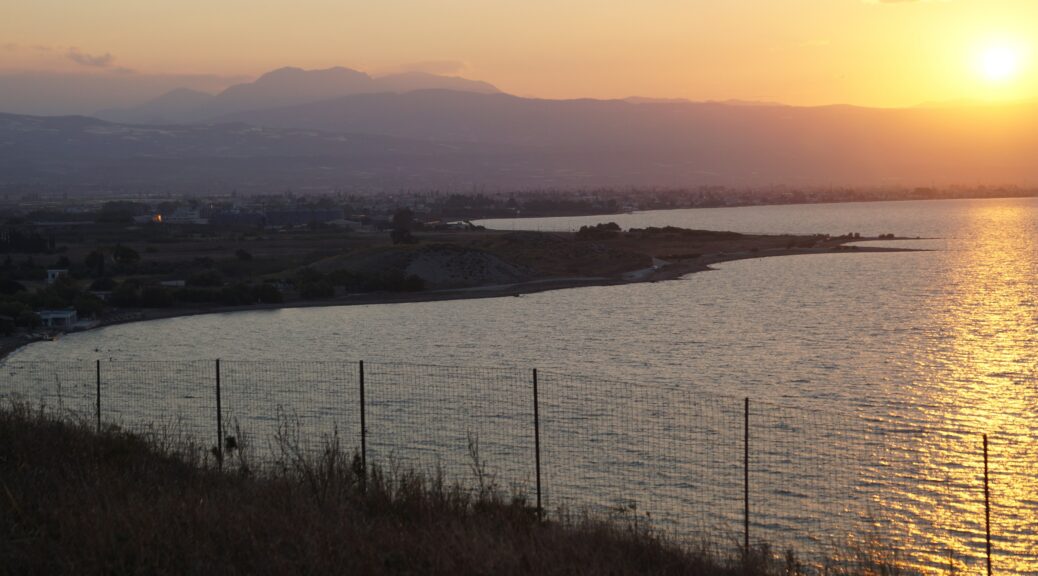
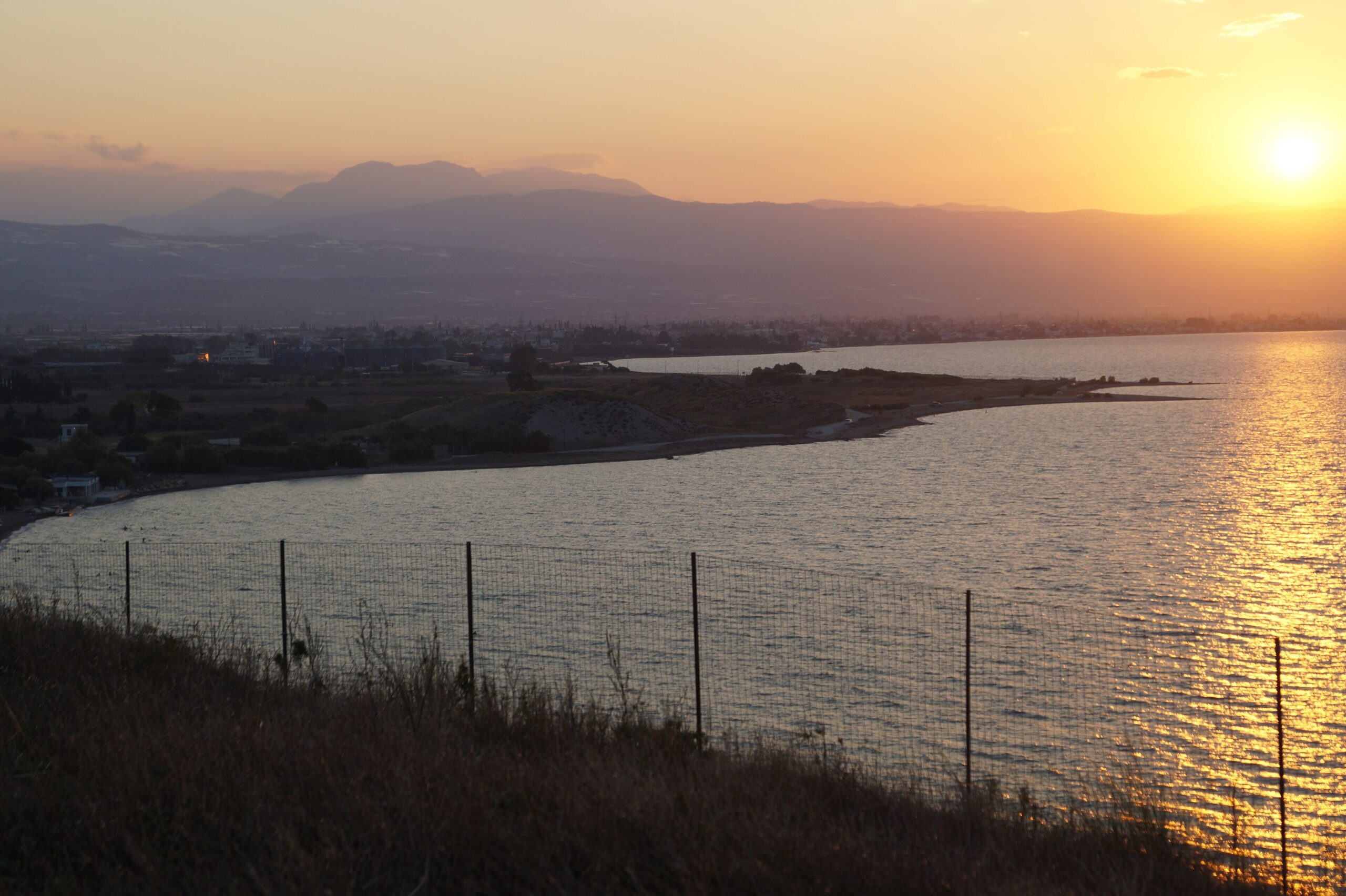
Corinth, Greece: View from the archaeological site of Korakou to the west on the archaeological site of Lechaeon

Prior to excavating LBA Pylos, Blegen excavated at a number of other prehistoric sites in the Peloponnese, one of which is Korakou. This site, located on the bluffs overlooking the Corinthian Gulf at the outskirts of modern Corinth, was excavated in 1915 and 1916, and formed the basis for Blegen and Wace’s ceramic chronology of the Greek mainland for the Greek Bronze Age.

Blegen’s excavation notebooks have been scanned and made publicly available by the American School of Classical Studies at Athens and the Corinth Excavations (among other things). As my colleague Bill Caraher pointed out in his blog (about two years ago!), these are a fantastic resource, but they are static. There is no opportunity for scholars to add metadata to the digital scans. As Bill put it,

as I thought about this I began to imagine a parallel site where scholars could upload their transcriptions of notebook pages. These would be keyed to the stable urls provided by the American School and presented in a wiki which would allow for and track revisions. I am sure that some notebooks are useful enough and commonly investigated enough to warrant this.

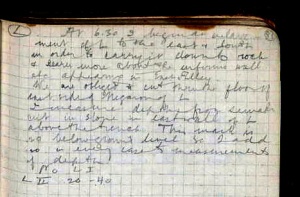
I think that Bill is right, and I wanted to provide here a small example of the kind of thing that he envisioned, using Blegen’s Korakou notebooks as an example. As Bill noted, Blegen’s handwriting can be difficult to read. Transcriptions of all the Korakou notebooks were made in 2005 by myself and Sarah James, and could provide a valuable resource to scholars working on Korakou. We are not the only scholars who have made transcriptions of the Korakou notebooks, however. Others who have worked with the Korakou material have also transcribed sections for their own work, and in some cases there are discrepancies between their readings and ours. In Notebook 84, p. 81, Blegen writes (on my reading, based on autopsy):

I measure depth from semadi cut in stone on east wall of L above the trench. This mark is .20 below ground level so I add .20 in every case to measurements of depth.

This differs from the reading of Jerry Rutter (also based on autopsy, published in his 1974 dissertation, p. 108):

I measure depth from [?……?] cut in slope in east wall of L above the trench.  This mark is .20 below ground level so I add .20 in every case to measurements of depth.

Below is the image of the passage in question. I’ve increased the contrast so that the writing is more clear, but you can see the original scan here.

NB84_p81

This difference in readings is somewhat significant for how we understand the archaeology of Korakou and indeed Blegen’s methods in the field. Rutter goes on to argue, based on his reading of this passage, that (Rutter 1974: 108-109)

Not too much credence should be given to Blegen’s depth measurements…since the ground level to which these measurements refer no longer existed and had to be estimated at 0.20 above some obscure “cut”. It is quite possible that Blegen began his…sounding at ca 0.40-0.50 below ground level, the level of the earlier floor which he had uncovered on 19 June.  In this case, the uppermost wall in the sounding would have appeared not at 0.60 below ground level, but at 0.80-0.90, roughly the level of the bottom of the LH IIIB 1 fill on which House L was built.

If, on the other hand, we use my reading of Blegen’s notebook, then the measurements were taken from a mark (semadi is a transliteration of the Greek σημάδι) cut into a stone. This stone belongs to a wall of House L, and the tops of these walls are, as Blegen notes, 20-30 cm below ground level (Corinth NB 81, p. 220). Thus his measurements are reliable. And this potentially changes Rutter’s interpretation of this area, as Sarah James and I noted in an unpublished report that we submitted to Corinth Excavations in the summer of 2005:

Rutter suggests that Blegen’s enlargement of [Trench] L began at ca. 0.40 m below ground level, where he exposed an earlier floor. However, Blegen only exposed this floor “in the southern part of the Megaron,” and his enlargement of the pit in L is “to the east and south.”  It is likely that the southern part of the Megaron is roughly equal to the area south of the pit in L, which cuts diagonally across the northern half of the main room of House L (the Megaron).  However, the enlargement of the pit in L extended to the south and east, and to the east of pit L Blegen apparently had not dug down to 0.40.  Thus, L II probably represents an operation taking the enlargement down to 0.40, and then L III included both the eastern and southern parts of the enlargement.  As the eastern part of the enlargement is directly west of the eastern wall of House L, it makes good sense for Blegen to use the wall as a benchmark from which to measure depths.

In short, this means that Blegen does reveal a wall (with L III, NB 84, p. 127) whose top is only 0.60 m below ground level.  This is problematic for Rutter’s reconstruction of this area, specifically his argument that the “habitation level” revealed at a depth of 0.80 in the East Alley, and the “floor of hard earth” at a depth of 0.80 in Trench L (NB 81, p. 375), represent a terracing line for a fill of LH IIIB:1 date upon which House L was built.  Perhaps the “habitation level” at 0.80 is actually a floor associated with the construction of a building (represented by a wall whose socle rises 0.20 above its floor), which was then covered by the same LH IIIB:1 fill.

My primary interest here is not the interpretation of the area around House L at Korakou. Rather, it is that while static publications of excavation notebooks are invaluable, they do not (as they might) capture the scholarly arguments that build on these notebooks. What the American School has done — making a vast quantity of scholarly materials publicly available on the web — is laudable, but the next logical step is to turn these static materials into a dynamic scholarly space. A parallel wiki on the Corinth notebooks such as Bill and I are suggesting would allow scholars to add value to the static scans in a way that would benefit students and scholars of Greek archaeology for years to come.

[Originally posted to englianos.wordpress.com on 26 December 2012]