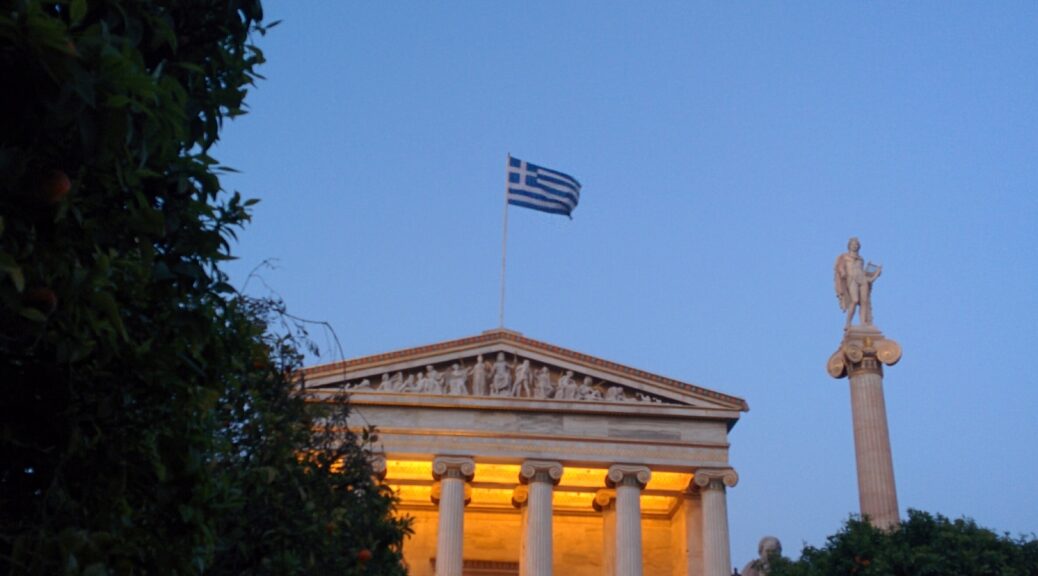
Athens is an amazing place of contrasts. It’s a real center of intellectual activity and talent from all over the world. I’ve never attended talks packed with as much academic firepower as I have in Athens (which is a terrifying thought; I’ve given two talks here in the past couple of months!) and there’s no place in the world with this density of archaeological institutions: all the foreign schools, the University of Athens, the Archaeological Society, the National Museum, and so on. There are multiple talks, every. Single. Night. Besides the foreign schools, there are seminars devoted to every single chronological and thematic region: the Palaeolithic Seminar, the Minoan Seminar, the Cycladic Seminar, the Mycenaean Seminar, etc. When I was a student at the School (2003-4), I didn’t take advantage of hardly any of this. Indeed, I was only marginally aware of it. Maybe it wasn’t as intense back then? I doubt it.
This intellectual activity is taking place in a radically different context from 2003-4. Then, Greece was a booming economy (GDP growth was 5.8% in 2003!); now, not so much. Athens is chugging along, but for those of us who have known the city for years, the signs of economic downturn are there. And of course everyone’s talking about the refugee crisis. My friends are volunteering at centers who need people to sort and deal with donations. The foreign schools are all collecting materials (canned goods, medical supplies) that they’re donating to refugee aid centers, a practice with deep historical roots. There are announcements before lectures start, reminding everyone to do their part. Meanwhile we keep hearing news about borders being shut, the horrible conditions in the camp at the border, and the rise of anti-immigrant parties and sentiment in Europe. This in a Greece where the local population is suffering economically, where pensions are set to be cut by 1% of GDP, and whose government can hardly afford additional expenses. After the past five years of crisis, it seems clear that the political class of Europe has been a colossal failure.
But I’m an archaeologist, not a policy wonk. I read Paul Krugman and nod, donate money to humanitarian organizations, and draw comfort from the history of the modern Greek economy, which is a story of setback and recovery. I am also amazed at the reaction here in Greece, which is incredibly noble and generous.
And through all of this, Athens is as amazing as it ever has been. I know many of my archaeologist friends don’t like Athens. I like to tell them that if you don’t like Athens, you don’t like Greece. Greece is a nation of many regions, each of them different: Crete is not like Messenia, which is not like the Argolid, which is not like the Corinthia, which is not like Thessaly, and so on. And the only place where people from all parts of Greece live together and break bread together is: Athens.
But besides that, Athens is a city of intellectual might, with plenty of grit and frenetic energy. There’s not a drop of Disneyfication here. I’ve barely scraped the surface of her depths and can’t imagine a better place to spend my sabbatical.
Since the new year, my sabbatical has changed gears significantly. I’m currently based in the most old skool of old schools: the American School of Classical Studies at Athens. My daily routine now revolves around the Blegen Library and Loring Hall in a way that it’s only done in 2003-4, my regular member year. Regular membership is something that was considered de rigeur in my graduate program at the University of Texas at Austin and my regular year was a formative experience for my professional career and personal life.
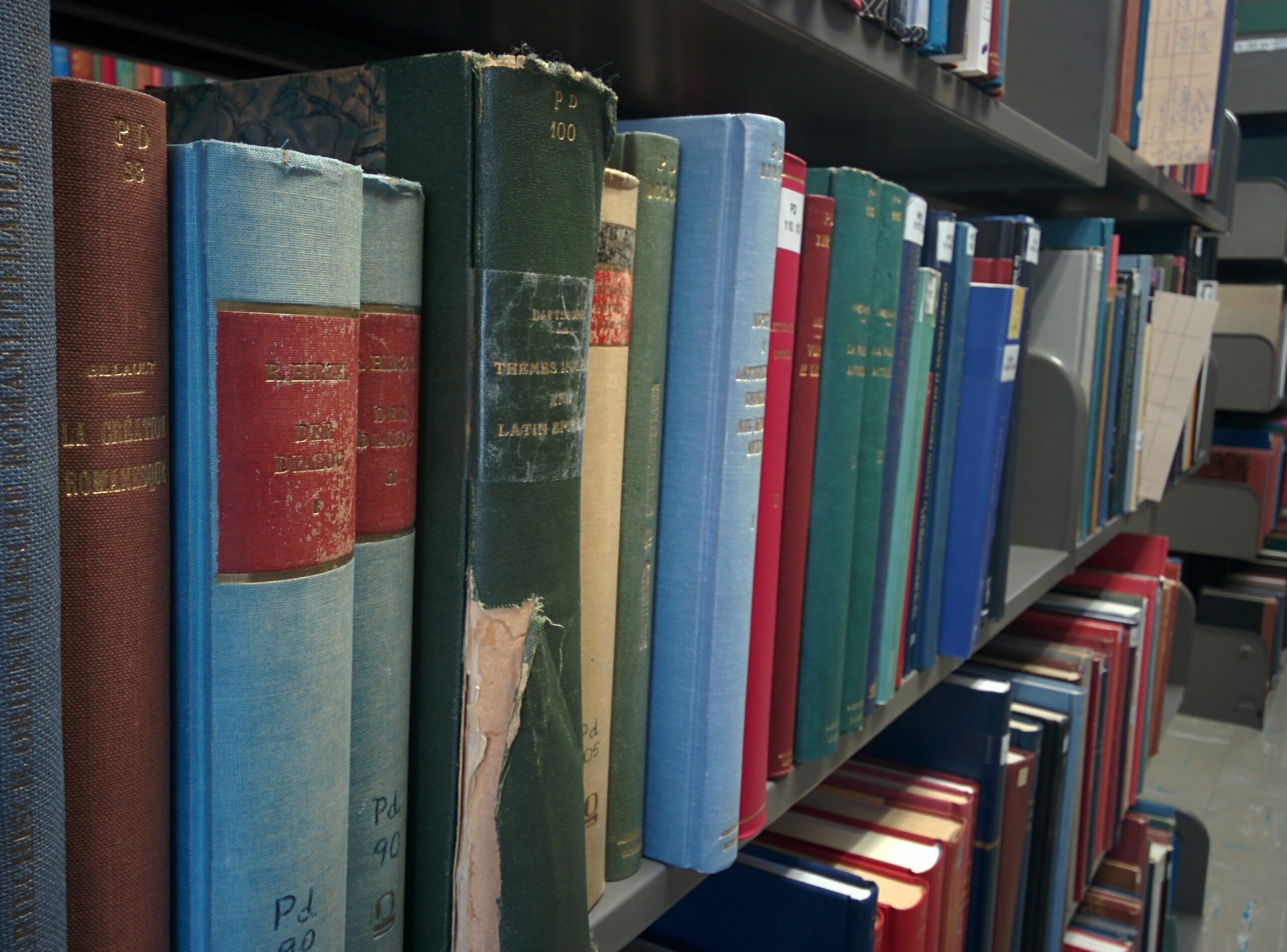
I’ve found it really fun and productive to work in a carrel in a non-circulating library, surrounded by (almost) all of the books that I could want for my various projects.
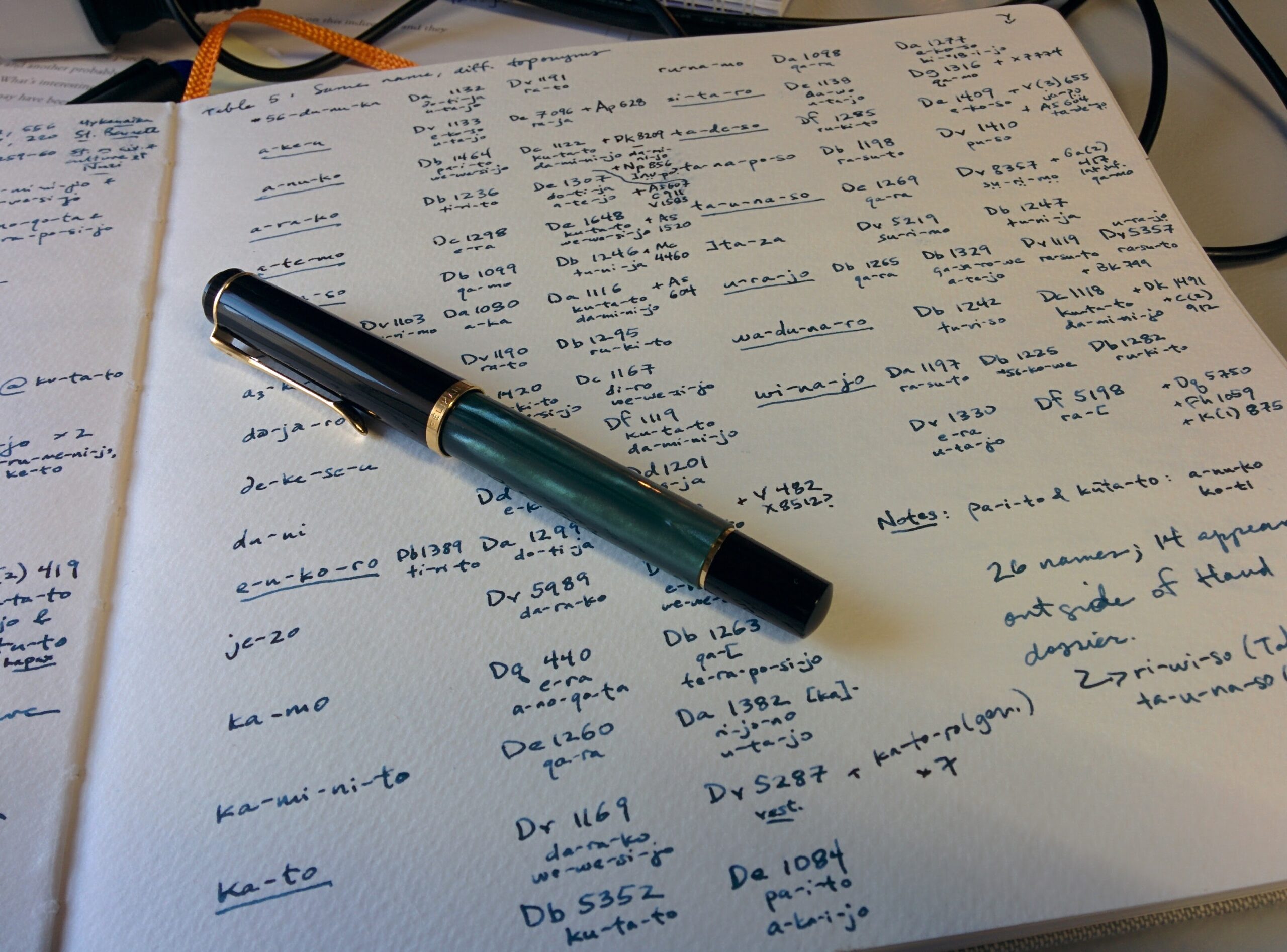
What else? I’ve also started keeping many of my notes in a notebook with high-quality thick paper to absorb the ink from my Pelikan fountain pen:
This isn’t some weird affectation or rejection of technology – it’s actually allowing me to make better use of my computer. My laptop, with only a 13″ screen, is perfect for travel and working on the go, two things that I do plenty of, but it means that it’s hard to have more than one or two things open at a time. When you’re working with Linear B texts, lexica, prosopographies, etc. all at once while writing a paper that you’re rapidly realizing isn’t close enough to done even though you’re leaving town in less than a week, it’s useful to have pen and paper handy in order to multitask. (And I do really love the way my fountain pen writes; it’s a really good pen. I’m not trying to be weird). It still feels awfully old-fashioned, but I’ve filled up this notebook faster than almost any other.
Being back at the American School has been weirdly nostalgic, but it’s also been an amazing place to work. It’s given me a boost in productivity when I’ve needed it most (I’ve given three papers in Athens, London, and Cambridge in the past month, with a fourth at the BSA in less than a week), it’s given me the opportunity to hang out with old friends and make some new ones. The American School and Athens can really feel like the center of the world, as well as a wonderful place to hole up in the library and read, read, and write. Once I’ve given my talk this Monday I’ll have a bit more unstructured time to do some things in Athens outside of the familiar walls of the School.
This is the first post of a blog dedicated to my research interests, which center on the archaeology and scripts of the Aegean Bronze Age. The name of the site, Englianos, is the modern toponym where Carl Blegen excavated the “Palace of Nestor.” This site, which was called Pylos in the Late Bronze Age, is the source for some 1000 inscribed clay documents whose study formed the basis for my doctoral dissertation.
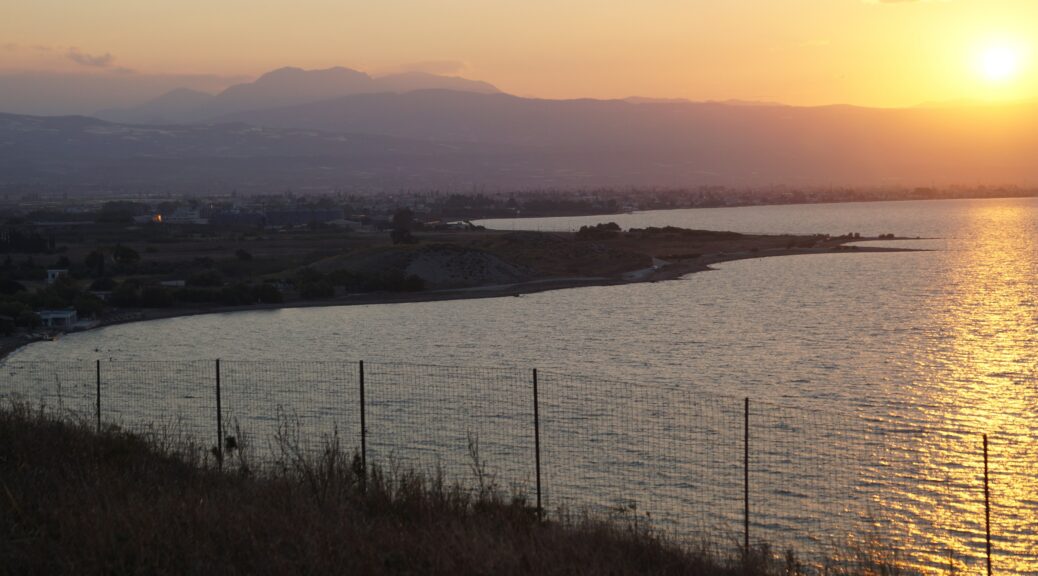
Prior to excavating LBA Pylos, Blegen excavated at a number of other prehistoric sites in the Peloponnese, one of which is Korakou. This site, located on the bluffs overlooking the Corinthian Gulf at the outskirts of modern Corinth, was excavated in 1915 and 1916, and formed the basis for Blegen and Wace’s ceramic chronology of the Greek mainland for the Greek Bronze Age.
Blegen’s excavation notebooks have been scanned and made publicly available by the American School of Classical Studies at Athens and the Corinth Excavations (among other things). As my colleague Bill Caraher pointed out in his blog (about two years ago!), these are a fantastic resource, but they are static. There is no opportunity for scholars to add metadata to the digital scans. As Bill put it,
as I thought about this I began to imagine a parallel site where scholars could upload their transcriptions of notebook pages. These would be keyed to the stable urls provided by the American School and presented in a wiki which would allow for and track revisions. I am sure that some notebooks are useful enough and commonly investigated enough to warrant this.
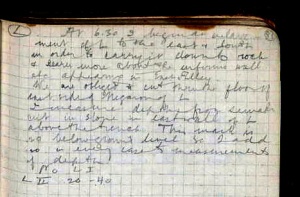
I think that Bill is right, and I wanted to provide here a small example of the kind of thing that he envisioned, using Blegen’s Korakou notebooks as an example. As Bill noted, Blegen’s handwriting can be difficult to read. Transcriptions of all the Korakou notebooks were made in 2005 by myself and Sarah James, and could provide a valuable resource to scholars working on Korakou. We are not the only scholars who have made transcriptions of the Korakou notebooks, however. Others who have worked with the Korakou material have also transcribed sections for their own work, and in some cases there are discrepancies between their readings and ours. In Notebook 84, p. 81, Blegen writes (on my reading, based on autopsy):
I measure depth from semadi cut in stone on east wall of L above the trench. This mark is .20 below ground level so I add .20 in every case to measurements of depth.
This differs from the reading of Jerry Rutter (also based on autopsy, published in his 1974 dissertation, p. 108):
I measure depth from [?……?] cut in slope in east wall of L above the trench. This mark is .20 below ground level so I add .20 in every case to measurements of depth.
Below is the image of the passage in question. I’ve increased the contrast so that the writing is more clear, but you can see the original scan here.
This difference in readings is somewhat significant for how we understand the archaeology of Korakou and indeed Blegen’s methods in the field. Rutter goes on to argue, based on his reading of this passage, that (Rutter 1974: 108-109)
Not too much credence should be given to Blegen’s depth measurements…since the ground level to which these measurements refer no longer existed and had to be estimated at 0.20 above some obscure “cut”. It is quite possible that Blegen began his…sounding at ca 0.40-0.50 below ground level, the level of the earlier floor which he had uncovered on 19 June. In this case, the uppermost wall in the sounding would have appeared not at 0.60 below ground level, but at 0.80-0.90, roughly the level of the bottom of the LH IIIB 1 fill on which House L was built.
If, on the other hand, we use my reading of Blegen’s notebook, then the measurements were taken from a mark (semadi is a transliteration of the Greek σημάδι) cut into a stone. This stone belongs to a wall of House L, and the tops of these walls are, as Blegen notes, 20-30 cm below ground level (Corinth NB 81, p. 220). Thus his measurements are reliable. And this potentially changes Rutter’s interpretation of this area, as Sarah James and I noted in an unpublished report that we submitted to Corinth Excavations in the summer of 2005:
Rutter suggests that Blegen’s enlargement of [Trench] L began at ca. 0.40 m below ground level, where he exposed an earlier floor. However, Blegen only exposed this floor “in the southern part of the Megaron,” and his enlargement of the pit in L is “to the east and south.” It is likely that the southern part of the Megaron is roughly equal to the area south of the pit in L, which cuts diagonally across the northern half of the main room of House L (the Megaron). However, the enlargement of the pit in L extended to the south and east, and to the east of pit L Blegen apparently had not dug down to 0.40. Thus, L II probably represents an operation taking the enlargement down to 0.40, and then L III included both the eastern and southern parts of the enlargement. As the eastern part of the enlargement is directly west of the eastern wall of House L, it makes good sense for Blegen to use the wall as a benchmark from which to measure depths.
In short, this means that Blegen does reveal a wall (with L III, NB 84, p. 127) whose top is only 0.60 m below ground level. This is problematic for Rutter’s reconstruction of this area, specifically his argument that the “habitation level” revealed at a depth of 0.80 in the East Alley, and the “floor of hard earth” at a depth of 0.80 in Trench L (NB 81, p. 375), represent a terracing line for a fill of LH IIIB:1 date upon which House L was built. Perhaps the “habitation level” at 0.80 is actually a floor associated with the construction of a building (represented by a wall whose socle rises 0.20 above its floor), which was then covered by the same LH IIIB:1 fill.
My primary interest here is not the interpretation of the area around House L at Korakou. Rather, it is that while static publications of excavation notebooks are invaluable, they do not (as they might) capture the scholarly arguments that build on these notebooks. What the American School has done — making a vast quantity of scholarly materials publicly available on the web — is laudable, but the next logical step is to turn these static materials into a dynamic scholarly space. A parallel wiki on the Corinth notebooks such as Bill and I are suggesting would allow scholars to add value to the static scans in a way that would benefit students and scholars of Greek archaeology for years to come.
[Originally posted to englianos.wordpress.com on 26 December 2012]