All posts by Dimitri

“Data” and interpretation in the humanities

Last night Miriam Posner gave an interesting talk in the “Exploring Digital Humanities” series at the University of Colorado Boulder that explored the unease that humanists often feel when their materials are described and treated as “data.” The creation of data requires careful categorization so that the materials in question can be counted and queried, but really good scholarship in the humanities, she pointed out, seeks to break received categories. Certainly this has been how I’ve understood my own work – as a sustained attack on the binaries that structure the study of the Bronze Age – but I nevertheless found that I didn’t have as much of a problem with understanding my materials as “data” than many in the audience seemed to.

Maybe this is because I’m not much of a humanist – my theoretical inclinations have always tilted towards the social sciences -, maybe it’s because I’m an archaeologist and archaeologists seem to be more comfortable with the notion of “data,” especially as field teams have grown in size and the number of specialists required to run an archaeological project has increased. These specialists and team members produce interpretations and materials that need to speak to one another, and here digital tools are invaluable (as many of the contributions to the excellent Mobilizing the Past for a Digital Future emphasize).

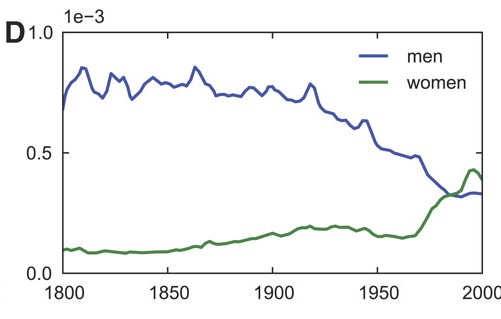
Prof. Posner’s talk began (sort of, I was late since I came straight from class) with the Culturomics paper in Science, published in 2011 (which, I am embarrassed to admit, I had never heard of), and she focused on what I might call the “front end” of a digital humanities project: taking the mass of cultural materials and making them amenable to the structure of a database. What I found more objectionable about Culturomics, on the other hand, was the “back end”: the interpretations produced by Culturomics’ quantitative analysis. That is to say, once the data have been carefully cooked (since we all know that raw data do not exist) and analyzed, there is a tendency for the interpretation to follow simply and directly from whatever numbers are spit out. For instance, the conclusion drawn from these data

5dculturomics

is that “in the battle of the sexes, the ‘women’ are gaining ground on the ‘men’.” Is this meant to be serious? It’s certainly presented as such but it’s hard to believe that anyone would say this with a straight face about “a new type of evidence in the humanities.”

For me, this is a good illustration of the worst kind of research (in the humanities or not). Good research requires time, careful thought, and most of all, a real and sustained passion for materials (or data, or evidence, or whatever you want to call them). We need to spend thousands of hours with our materials before we can make them sing, just like a musician or an athlete needs to practice and practice and practice. In that way academic work is like a craft: ideas are well and good, but we need to work with materials and follow many dead ends before we can make our ideas do work. Any research that involves taking 5 to 50 seconds to come up with an interpretation is (usually? always?) bad research. (Also, where’s the fun in coming up with a dumb interpretation that didn’t take you any hard work?)

For reasons that I don’t really understand, it seems to me that there is a market for this kind of work (regardless of whether it’s digital or analog). In Greek archaeology, my field, the equivalent seems to be something like, “Look, I excavated this temple, and I think it’s this temple mentioned in this Classical text. The end.” That’s fine as far as it goes – it’s not the worst thing to try to connect material culture to texts – but it’s not really a conclusion as much as it is a banal observation. And it seems odd to me that so many people seem to want to take shortcuts, to make interpretation easier, when in fact it should be hard. Digital tools give us the opportunity to make sense of more and diverse materials, to integrate them and to let them communicate – but none of that makes interpretation any easier. In fact, it can make it harder: harder, for example, to ignore evidence that doesn’t agree with our interpretation. And that’s good. It’s supposed to be hard.
“They walk”

In my last blog post, I argued that our faith in technology in archaeology was – or could be – a problem, since there was no magical technological bullet that could solve our interpretive dilemmas. That was a reaction to the excessive (to my mind) criticism of GIS that I’ve seen in archaeological literature.

The flip side to this problem would be the overstating of the value of new technologies. Here too, I think that the same article by Elaine Sullivan provides an example of what I’m talking about. In what is a balanced and nuanced discussion, Sullivan claims that

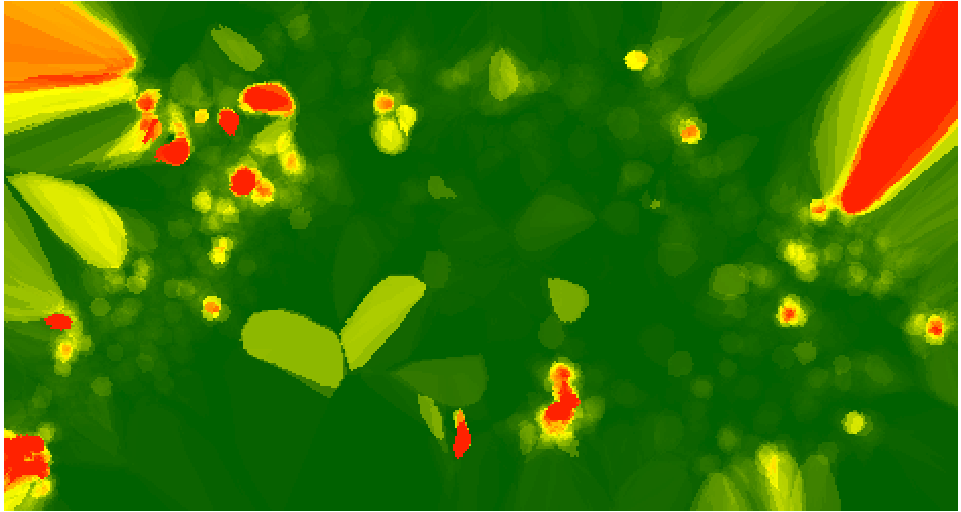
by utilizing a 4D model of a site incorporating architecture and environmental factors not present today, a new form of phenomenological study can be attempted. The 3D Saqqara model allows the researcher to simulate human viewpoints within the cemetery, examining how specific visual and spatial relationships between people and monuments impacted the meaning of that place.

That seemed to me like quite a strong claim. What Sullivan actually concludes from her use of the 4D model is the following:

It is only with the advent of Dynasty 3 and the construction of the step pyramid at Saqqara that there is a clear shift in conceptualization of the landscape. Netjerykhet (Djoser) and his successors conceived of a new form of primeval mound, the pyramid, intended to be witnessed from the floodplain. This is a stark break with tradition and leads directly to a new type of royal engagement with the Memphite landscape; one where the burial mound of the king now permanently dominates. It is at this point that the kings of the unified Egyptian state begin to monopolize visible space as a means to materially express their growing individual power and authority.

This is a useful conclusion, no doubt, and one aided by the use of this new technology, but it’s not what I think of as a phenomenological study of the meaning of place. What I had expected was something like the kind of contrast drawn by Michel de Certeau in The Practice of Everyday Life in the chapter “Walking in the City,” where he contrasts the panoptic view of New York City from the World Trade Center to the experience of walking the city’s streets:

The ordinary practitions of the city live “down below,” below the thresholds at which visibility begins. They walk–an elementary form this experience of the city; they are alkers, Wandersmänner, whose bodies follow the thicks and thins of an urban “text” they write without being able to read it. These practitioners make use of spaces that cannot be seen; their knowledge of them is as blind as that of lovers in each other’s arms. The paths that correspond in this intertwining, unrecognized poems in which each body is an element signed by many others, elude legibility.

And so on. That is to say, the experience of place and of moving through a landscape, urban or not, is profoundly physical.

I started thinking about this issue some more after reading over the break a wonderful book by Shannon Lee Dawdy, Patina: A Profane Archaeology (University of Chicago Press, 2016). Among other things, Patina made me want to get to know New Orleans better. It evokes New Orleans not so much through visual descriptions and representations of buildings, but through a thick description of the feel of the city and its many parts, the patinated aesthetic that suffuses the city.

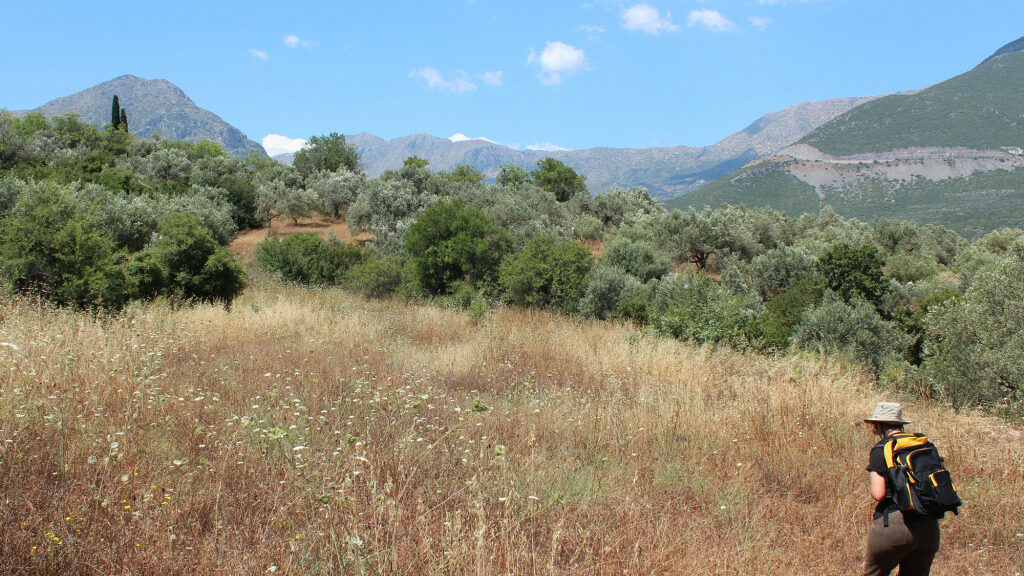
But what about non-urban landscapes? Certainly three years of fieldwork in the Western Argolid have encouraged me to understand that particular landscape from the perspective of a walker. I’m constantly noting what can and can’t be seen from different places, especially famous and conspicuous sites like the castle of the Larissa that hangs above Argos or the Bronze Age citadel of Mycenae. But I wouldn’t say that my experience of place in the Western Argolid is primarily a function of vision. On our project’s blog, we talk about what we can see, but also about bodily and haptic experiences: the feel of the wetness on (and in) our boots from an overnight rain that’s still adhering to grass in agricultural fields that haven’t been recently plowed, the difficulty of walking through prickly oak and dried-out wild sage and thistles, the ache of knees and ankles and feet at the top of a slope covered with cobbles, the heat of the Greek summer, the impossible-to-photograph glow of olive trees in the afternoon light, the trauma of cutting up your leg badly and getting fleas in a single field day, the sounds of the landscape (church bells and tractors and human voices), our allergies, spiders (of course), and the feel of different types of fields under your boots. And that’s just the beginning: there’s the wonderful pleasure of a breeze kicking up on a hot afternoon, the sound of the tall trees rustling just before the wind hits your skin, and the way the leaves of the olives trees glint and change their color as they turn from side to side in the air. And there are all of the other things that give us a sense of place, too: the field where a kind farmer made us cold(-ish) instant coffees, the dirt road where you got laughed at (with literal knee-slapping) by an old shepherd when you told him how you got fleas, the bit of shade where you once had a great rest and ate sweet Oreos and salty potato chips (as the archaeology gods intended).

That is to say, there is no sense of space or place without movement, without experience, and without interaction. Certainly tools like 4D GIS can force us to reorient ourselves to that scale and perspective of that experience and they can act as a kind of substitute for it. They can, as Sullivan’s article makes clear, provoke new perspectives. As she puts it:

these 3D environments allow modern viewers to experience elements of each lost landscape, seeing what an ancient person potentially saw, virtually moving at human eye level through and around a place, providing a perspective unattainable through 2D media. Again, this can never be a full recovery project, only a partial remediation of disappeared spaces. But it is through this more human-centred representation that we can find fresh perspectives, ‘the point of view that allows us to discern patterns among the events that have occurred.’

While 4D GIS is undoubtedly useful, then, it is still a very, very poor substitute for experience. In fact, I would hesitate to use the word “experience” at all. What kind of experience is it, really? Not one that fully engages any of the senses other than perhaps sight, not one with risk or feeling or emotion, or one that will make memories. I wonder if these attempts to simulate experience can actually make things more difficult for us, by allowing us to pretend that we are getting closer to something human while in fact we are inching away from it, by confusing technical sophistication with embodied experience.

There is no magic bullet

he most recent issue of the Bulletin of the Institute of Classical Studies has a great little cluster of three articles about digital approaches to the Mediterranean world that I read over the last couple of days with great interest. I was particularly interested in Elaine Sullivan’s advocacy for 4D GIS visualizations, which, she argues, “afford new potential for the examination of now-altered ancient landscapes from a human viewpoint, specifically for exploring aspects of experience that changed through time and space” (71).

I don’t know nearly enough about Egyptian archaeology to evaluate Sullivan’s paper as a contribution to that field; I’m more interested in her contention that certain technologies (specifically 4D GIS) are better positioned to contribute to (in her terms) humanistic and qualitative analyses of the ancient world than others (specifically traditional 2D GIS). Sullivan’s rhetoric is measured and her discussion is thoughtful. I do worry a little bit about the idea that certain technologies in and of themselves are good for one thing and not for another, at least as it is usually expressed, since it seems to me overly simplistic.

Let me explain. Sullivan begins her discussion with an exposition of the limitations of traditional, two-dimensional GIS. It’s a criticism that all archaeologists (I presume) know well, since it’s been out there since the late 1990s. As Sullivan explains,

With its powerful aggregation and layering tools, GIS offers numerous avenues to approach ancient landscapes quantitatively. However, the limitations of GIS systems have led to serious critiques that question its larger potential for archaeology. In the 1980s and 1990s, post-processual archaeologists rejected GIS as reductionist, positivistic, and lacking engagement with cultural and social factors. Landscape was theorized as more complex than an environmental stage onto which human actors were dropped – and the human-environmental relationship was redefined as dialectic. Archaeologists investigating how embodied humans would have experienced and interpreted specific cultural places still in many cases see GIS as antithetical to exploring this relationship, creating false objectivity in what were subjective spaces. Current theorists emphasize that landscape studies must include the ‘material, cognitive and symbolic’ aspects of this dialectic.

Indeed, traditional GIS lacks many features providing the type of contextual information vital to approaching humanistic research questions. The platform works primarily in a two-dimensional coordinate system, which lacks the qualitative aspects that reflect the inhabited human world. People do not engage with the world from an overhead, omniscient viewpoint, but from the perspective of a single viewer. Cartesian space does not replicate human sense of scale, physical relationships between people and things, or aspects of ‘local distinctiveness’ that create cultural meaning in specific places. Also, human movement through space and the changing perception of spaces through time cannot be duplicated in traditional GIS. As one leading scholar in the field succinctly stated: ‘GIS are currently ill-equipped to deal with space as it surrounds an individual.’

I’ve always found this criticism of GIS a little bit – okay, a lot – misplaced. Sure, GIS represents the world in particular ways that do not correspond to the ways that humans experience the world, but that’s hardly surprising. GIS doesn’t even represent the surface of the earth accurately, after all, since it’s constrained by the limitations of cartography. It’s essentially a mapping program (at least as it’s used by archaeologists), and I don’t think that anyone worries that maps are too positivistic; they’re ways of displaying simply a complex reality. Certainly there is a problem if one thinks that GIS represents reality unproblematically, but does any normal person actually think this? If we get a sense of false objectivity from GIS, it is because we are not doing enough thinking.

Moreover, if we’re going to wring our hands about GIS, then it seems to me that we need to wring our hands about everything else. We have to worry about maps of all kinds, representations of all kinds, rulers and compasses, survey tapes and GPS units. This criticism of GIS feels a little bit to me like the lack of recognition that there is a difference between a model of reality and reality.

9673ce03ee5252000945641c50f91527

Or, put more famously, “all models are wrong, but some are useful.”

So sure, it’s true that human beings do not live in a digital panopticon, but none of the tools at our disposal for the study of the ancient world really capture the lived lives of ancient people. Maybe 1% of all ancients could read and write but we don’t seem to be too concerned that our primary mode of communicating is the academic text.

I never really understood why GIS was the target of this post-processual assault (I say this as someone who uses GIS quite a bit and whose theoretical framework is essentially post-processual). The only thing that I can think of is that the problem is the faith that many practitioners have in their tools. If you think that there is a technological magic bullet, then any technology that falls short is a false idol that must be denounced.

That seems like exactly the wrong approach to me. This isn’t me picking on Sullivan; she’s really using this pre-existing critical discourse about traditional GIS to pivot towards her discussion of 4D GIS. But her treatment of 4D GIS is balanced; she doesn’t claim that it will solve all of our problems, merely that it is a useful tool. (I have more to say about that, but I think in another blog post).

Ultimately it’s our faith in various technologies that is at fault here more than anything else. We need to remember that no technology will (on its own) allow us to really understand the lived experiences of anyone. If we aren’t mindful of this fact, we’ll just end up jumping from bandwagon technology to bandwagon technology.

New Year’s resolutions

This past semester has been a transition. I started a new job at the University of Colorado Boulder in the Classics department. I acted (and am acting until the end of the academic year) as director of graduate studies, I taught a new and challenging class (even if it involved very familiar material), and got used to operating in a new administrative and educational environment. My family also had health problems that made it hard to think about much besides keeping ourselves alive and our heads above water.

My New Year’s resolution, then, is get back to basics: to read more and to write more. Research involves writing, and I need to practice my craft in different forms: short and long, formal and informal, online and offline. I also need to get to reading. Despite coming off of a sabbatical, I feel impossibly behind in all of my reading. Here’s what’s on my reading list, in no particular order:

  1. Shannon Lee Dawdy, Patina: A Profane Archaeology (Chicago 2016)
  2. Daniel Jew, Robin Osborne and Michael Scott (eds.), M.I. Finley: An Ancient Historian and his Impact (Cambridge 2016)
  3. Brian Epstein, The Ant Trap: Rebuilding the Foundations of the Social Sciences (Oxford 2015)
  4. Erin Walcek Averett, Jody Michael Gordon, and Derek B. Counts (eds.), Mobilizing the Past for a Digital Future: The Potential of Digital Archaeology (Grand Forks 2016)
  5. Maurizio del Freo and Massimo Perna (eds.), Manuale di epigrafia micenea: Introduzione allo studio dei testi in lineare B, 2 vols. (Padova 2016)
  6. Mario Liverani, Imagining Babylon: The Modern Story of an Ancient City (Berlin 2016) 
  7. Eva Von Dassow, State and Society in the Late Bronze Age: Alalah Under the Mitanni Empire (Bethesda 2008)
  8. Bruce Routledge, Archaeology and State Theory: Subjects and Objects of Power (London 2014)
  9. Margaretha Kramer-Hajos, Mycenaean Greece and the Aegean World: Palace and Province in the Late Bronze Age (Cambridge 2016)
  10. Justin Jennings, Killing Civilization: A Reassessment of Early Urbanism and Its Consequences (Albuquerque 2016)
  11. Nicholas Postgate, Bronze Age Bureaucracy: Writing and the Practice of Government in Assyria (Cambridge 2014)
  12. Evi Gorogianni, Peter Pavuk, and Luca Girella (eds.)., Beyond Thalassocracies: Understanding Processes of Minoanisation and Mycenaeanisation in the Aegean (Oxford 2016)
  13. David Pettegrew, The Isthmus of Corinth: Crossroads of the Mediterranean World (Ann Arbor 2016)

Plus all the ones I’m forgetting about because they’re sitting in my office on campus…

A network analysis of the AIA’s 2017 meeting

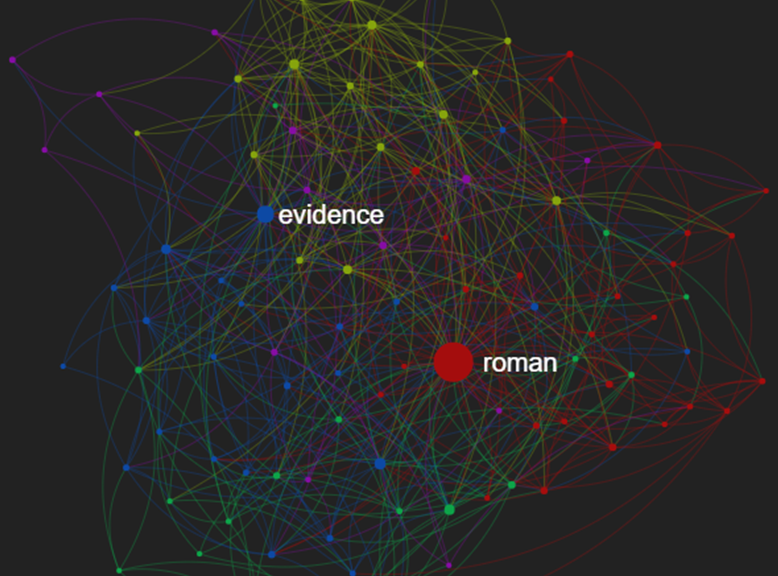
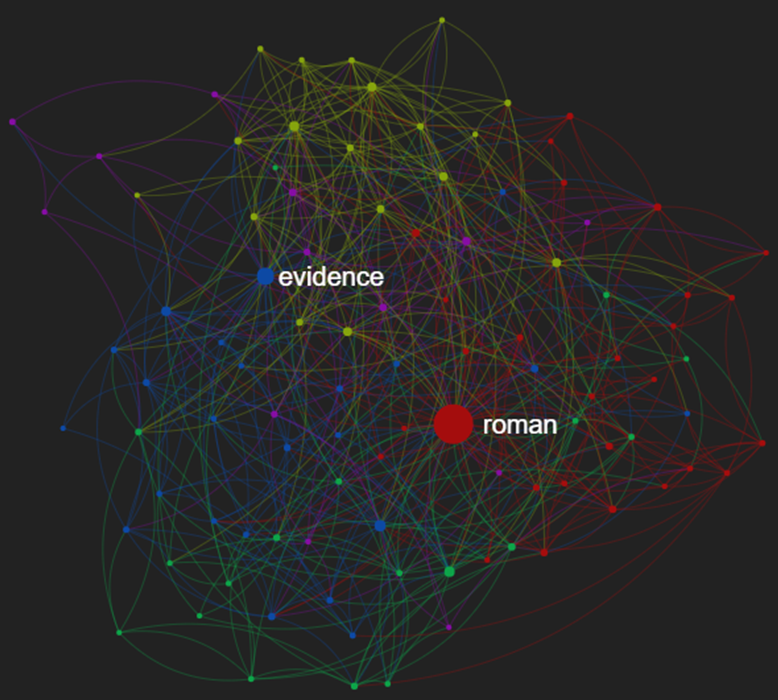
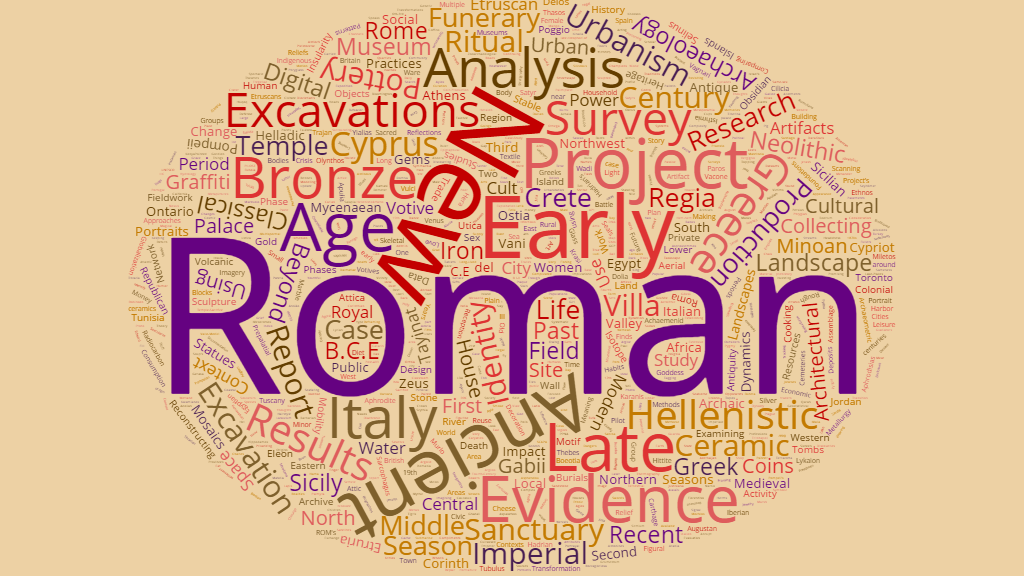
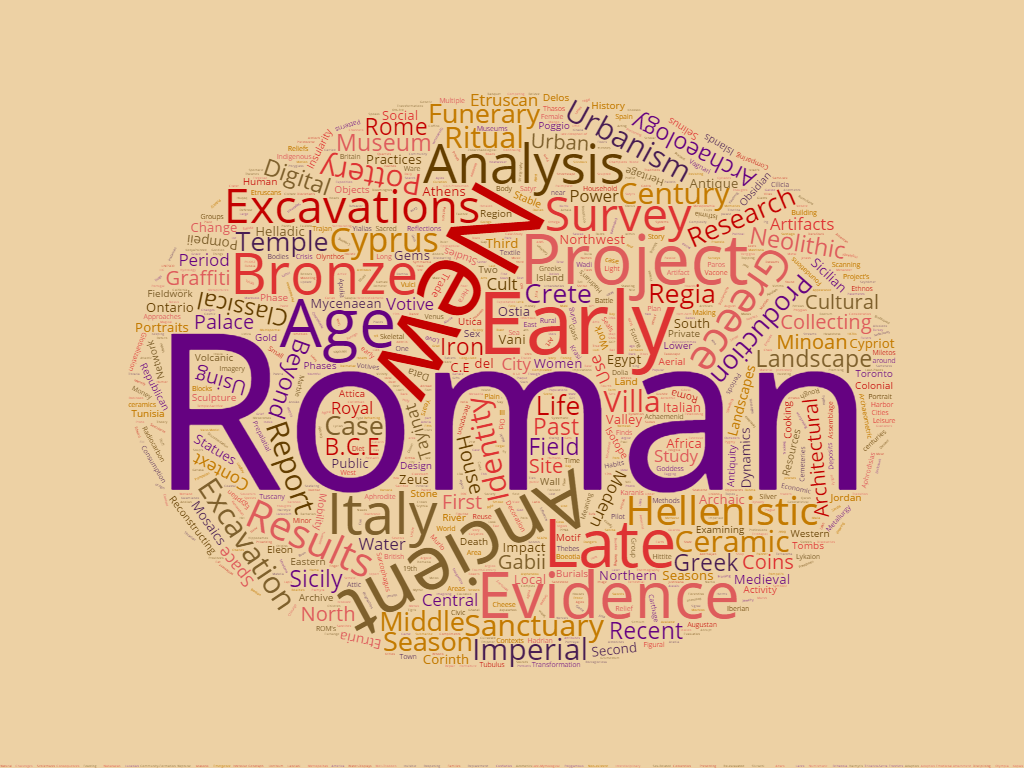
As a follow up on my last post, in which I made a word cloud from the paper and poster titles of the 2017 annual meeting of the Archaeological Institute of America, I thought it would be neat to run a (simple, because I have no idea what I’m doing) network analysis on the same data set. Well, almost the same data set: I removed all the articles and prepositions, punctuation, numbers and things like the “IA” of “LM IA.” Some of the titles look really fun without any of the connecting words, actually. I inputted this cleaned-up text file into http://textexture.com/ and here is the result (link to a dynamic page):

This should work as an embedded dynamic image: http://www.textexture.com/index.php?text_id=85497&embed=1&width=500&height=500

I guess the AIA this year is full of Romanists who are really empirical. That’s not too surprising, I suppose.

Additionally the textexture algorithm determined that the following are the most influential keywords in this text: roman    evidence    analysis    case  

And the most influential contexts in this text were
#0:   roman    imperial    temple    graffito
#1:   evidence    analysis    bronze    italy
#2:   case    study    identity    modern
#3:   excavation    project    etruscan    site

Against the universal museum

or some time now, I’ve been fairly suspicious of arguments for the universal museum (the museums themselves I have no problems with). There has been some momentum in this area: James Cuno has been banging the drum for some time now, and he’s been joined recently by Tiffany Jenkins. The latter author’s work has been especially visible lately, both in articles written for the popular press and in reviews of her published book, most recently in the Wall Street Journal.

The argument, distilled down, goes something like this (this is taken from the summary of Cuno’s book linked above):

“Antiquities,” James Cuno argues, “are the cultural property of all humankind,” “evidence of the world’s ancient past and not that of a particular modern nation. They comprise antiquity, and antiquity knows no borders.”

Cuno argues that nationalistic retention and reclamation policies impede common access to this common heritage and encourage a dubious and dangerous politicization of antiquities–and of culture itself. Antiquities need to be protected from looting but also from nationalistic identity politics.

The universal museum thus saves antiquities from nationalism by putting them into a global context.

My suspicion with this argument is simply that while it is happy to criticize others, it does not engage in a self-critique. That is to say, the politics of the universal museum are not something that is interesting to those who make these arguments. Indeed, the politics and the history are actively white-washed.

Take, for the example, the review of Jenkins’ book in the WSJ, written by Henrik Bering. He tells us that “From the early days of private curio cabinets and onward, the underlying idea of a museum was a desire to understand the world, an ambition to tell a common story.” Perhaps. But he tells us this immediately after reporting that “when things started to show up in British museums a decade later [after the 2nd opium war, 1857-1860], curators chose to display them as loot rather than art in order to underscore the military might of Britain.” (Chris Lovell brought this contradiction to my attention).

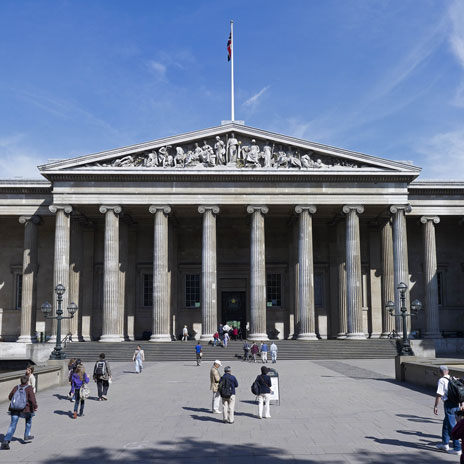
Indeed, it seems odd to argue that universal museums like the British Museum are somehow immune from the charge of nationalism. After all, Croker argued in parliament that the Elgin Marbles should be purchased

for the benefit of the public, for the honour of the nation, for the promotion of national arts, for the use of the national artists, and even for the advantage of our manufactures, the excellence of which dependent on the progress of the arts in the country.

whereas Grant argued “that that would be a mistaken economy, as well as bad taste, which would deprive this country of such valuable works of art as lord Elgin had collected” (emphasis mine throughout). It’s not like the British government is immune from the nationalistic desire to keep cherished artifacts from leaving the country – as this government ban from the sale of the dagger and robes of T.E. Lawrence abroad shows. Or see this. Or this. Or this. Or this. Or this. Or this. Where is the criticism of the petty nationalism that seeks to deny Kelly Clarkson ownership of a ring owned by Jane Austen? The UK’s Culture minister Ed Vaizey said of the export ban that it “provides us with a ‘last chance’ to save treasures like these for the nation so they can be enjoyed by all of us.” (Emphasis mine).

It’s worth noting that British nationalism, or American nationalism, is never flagged as a problem by those discussing repatriation and the proper home for material culture. Instead, the nationalism problem is always framed as Us against Them. Consider the opening of Bering’s review, which begins as follows:

Pity the plight of today’s museum director: What used to be a quiet kingdom with creaky floorboards and sleepy custodians has become a raging battlefield where scarcely a day passes without a demand for the return of some of his treasures.

The Greeks have forever been clamoring for the Elgin Marbles,which have resided in the British Museum for two centuries. The Turks have their own list, including an ancient marble carving of a child’s head in the Victoria and Albert Museum. The Egyptians want the Nefertiti bust from Berlin, and from Boston, the Nigerians want the Benin bronzes, sacrificial idols still “caked over with human blood” when taken by a British punitive expedition against the king of Benin in 1897.

The Greeks. The Turks. The Egyptians. The Nigerians. These are homogeneous national groups. But the other protagonists in this drama have names, identities, carefully thought out opinions. Thus the discussion is structured to oppose the museum curators with academic credentials and carefully thought-out opinions to anonymous groups who apparently all think alike along narrow nationalistic lines.

Finally, we are told that these parochial, nationalistic museums that want their treasures back reproduce an ethos that “resurrects racial ways of thinking” (Jenkins). Indeed, we are told that “far from tearing down walls between people, these institutions erect new ones.” This is the ultimate twist of the knife: the victims of imperialism and colonialism are now accused of “racial ways of thinking” whereas the poor, downtrodden curators of the noble universal museum (the real victims in all of this!) don’t see race. In this they are not unlike Bill O’Reilly and Stephen Colbert. Instead, these brave men and women only see the grand sweep of the history of humankind. Yet neither do they see, for they choose not to see, their own past or for that matter their own present.

Arthur Evans on “The Eastern Question in Anthropology”

“Mycenaean culture was permeated by Oriental elements, but never subdued by them. This independent quality would alone be sufficient to fix its original birthplace in an area removed from immediate continguity with that of the older civilisations of Egypt and Babylonia. The Aegean island world answers admirable to the conditions of the case. It is near, yet sufficiently removed, combining maritime access with insular security. We see the difference if we compare the civilization of the Hittites of Anatolia and Northern Syria, in some respects so closely parallel with that of Mycenae. The native elements were there cramped and trammelled from the beginning by the Oriental contact. No real life and freedom of expression was ever reached; the art is stiff, conventional, becoming more and more Asiatic, till finally crushed out by Assyrian conquest. It is the same with the Phoenicians. But in prehistoric Greece the indigenous element was able to hold its own, and to recast what it took from others in an original mould. Throughout its handiwork there breathes the European spirit of individuality and freedom. Professor Petrie’s discoveries at Tell-el-Amarna show the contact of this Aegean element for a moment infusing naturalism and life into the time-honoured conventionalities of Egypt itself.”

page 919 of Evans, A. J. 1896. “‘The Eastern Question’ in Anthropology,” Report of the Sixty-Sixth Meeting of the British Association for the Advancement of Science, Held at Liverpool in September 1896, London, pp. 906–922.

Athens

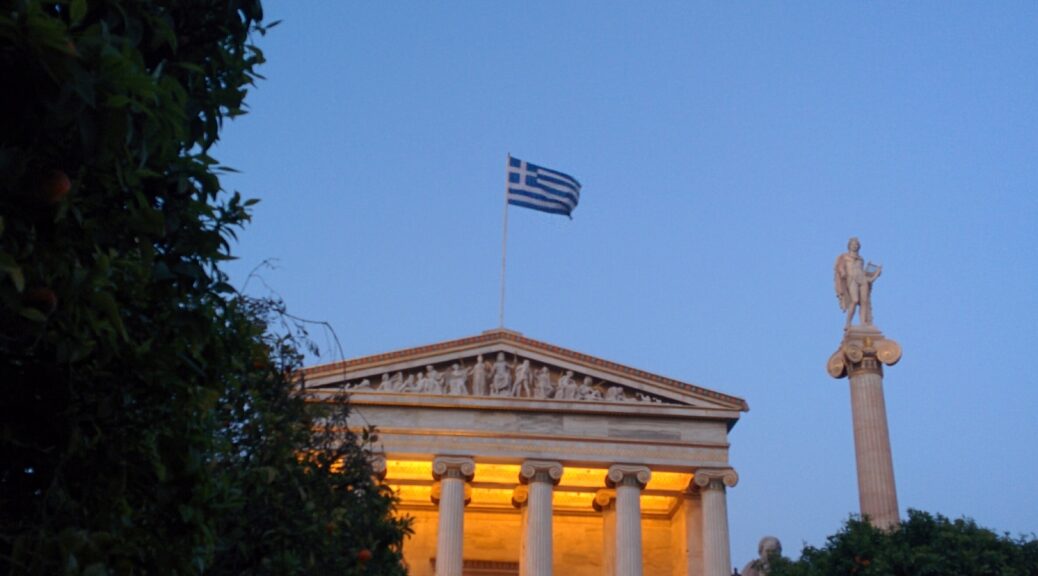
Athens is an amazing place of contrasts. It’s a real center of intellectual activity and talent from all over the world. I’ve never attended talks packed with as much academic firepower as I have in Athens (which is a terrifying thought; I’ve given two talks here in the past couple of months!) and there’s no place in the world with this density of archaeological institutions: all the foreign schools, the University of Athens, the Archaeological Society, the National Museum, and so on. There are multiple talks, every. Single. Night. Besides the foreign schools, there are seminars devoted to every single chronological and thematic region: the Palaeolithic Seminar, the Minoan Seminar, the Cycladic Seminar, the Mycenaean Seminar, etc. When I was a student at the School (2003-4), I didn’t take advantage of hardly any of this. Indeed, I was only marginally aware of it. Maybe it wasn’t as intense back then? I doubt it.

This intellectual activity is taking place in a radically different context from 2003-4. Then, Greece was a booming economy (GDP growth was 5.8% in 2003!); now, not so much. Athens is chugging along, but for those of us who have known the city for years, the signs of economic downturn are there. And of course everyone’s talking about the refugee crisis. My friends are volunteering at centers who need people to sort and deal with donations. The foreign schools are all collecting materials (canned goods, medical supplies) that they’re donating to refugee aid centers, a practice with deep historical roots. There are announcements before lectures start, reminding everyone to do their part. Meanwhile we keep hearing news about borders being shut, the horrible conditions in the camp at the border, and the rise of anti-immigrant parties and sentiment in Europe. This in a Greece where the local population is suffering economically, where pensions are set to be cut by 1% of GDP, and whose government can hardly afford additional expenses. After the past five years of crisis, it seems clear that the political class of Europe has been a colossal failure.

But I’m an archaeologist, not a policy wonk. I read Paul Krugman and nod, donate money to humanitarian organizations, and draw comfort from the history of the modern Greek economy, which is a story of setback and recovery. I am also amazed at the reaction here in Greece, which is incredibly noble and generous.

And through all of this, Athens is as amazing as it ever has been. I know many of my archaeologist friends don’t like Athens. I like to tell them that if you don’t like Athens, you don’t like Greece. Greece is a nation of many regions, each of them different: Crete is not like Messenia, which is not like the Argolid, which is not like the Corinthia, which is not like Thessaly, and so on. And the only place where people from all parts of Greece live together and break bread together is: Athens.

But besides that, Athens is a city of intellectual might, with plenty of grit and frenetic energy. There’s not a drop of Disneyfication here. I’ve barely scraped the surface of her depths and can’t imagine a better place to spend my sabbatical.

My sabbatical II: Old skool

Since the new year, my sabbatical has changed gears significantly. I’m currently based in the most old skool of old schools: the American School of Classical Studies at Athens. My daily routine now revolves around the Blegen Library and Loring Hall in a way that it’s only done in 2003-4, my regular member year. Regular membership is something that was considered de rigeur in my graduate program at the University of Texas at Austin and my regular year was a formative experience for my professional career and personal life.

I’ve found it really fun and productive to work in a carrel in a non-circulating library, surrounded by (almost) all of the books that I could want for my various projects.

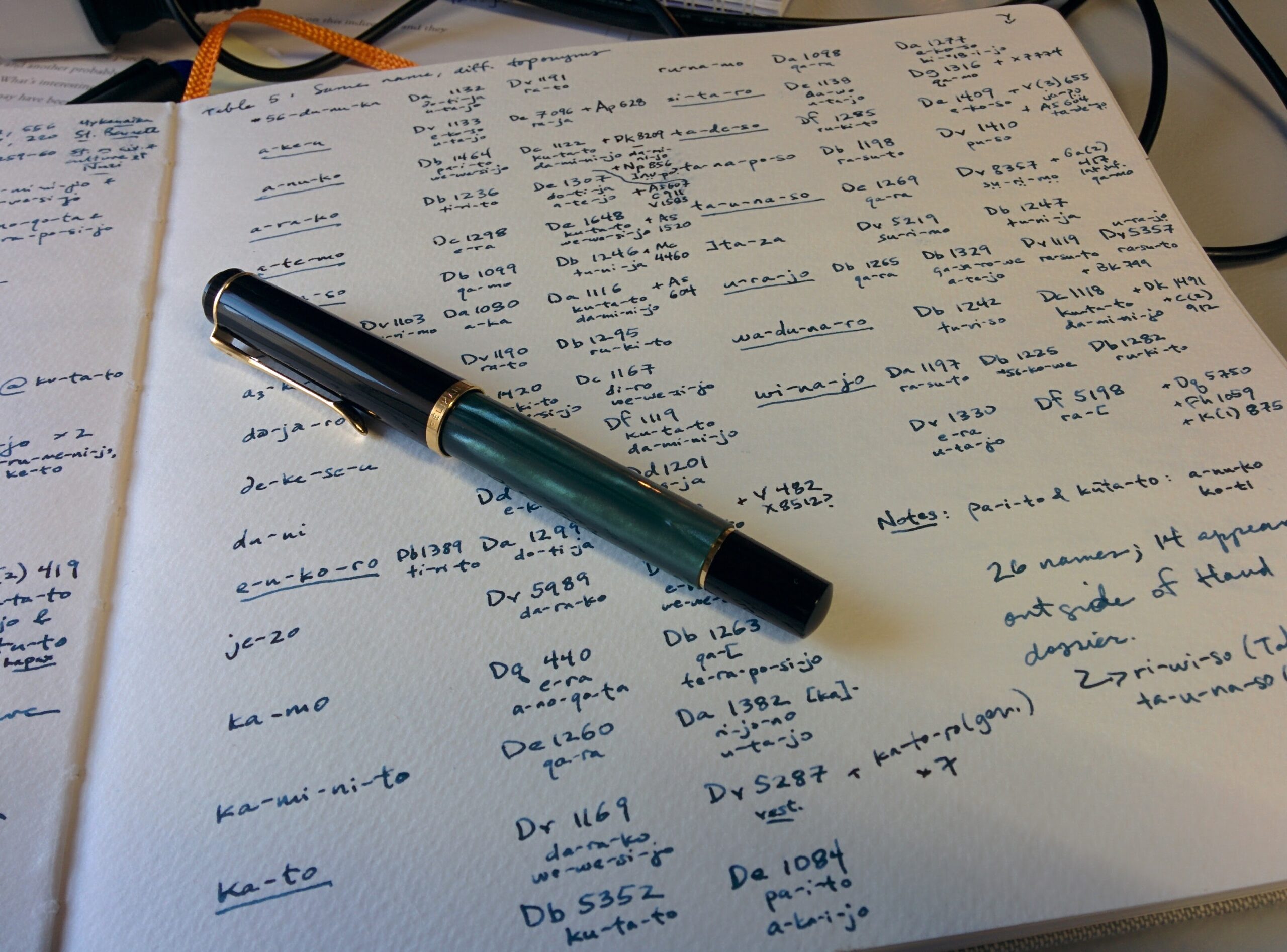
What else? I’ve also started keeping many of my notes in a notebook with high-quality thick paper to absorb the ink from my Pelikan fountain pen:

This isn’t some weird affectation or rejection of technology – it’s actually allowing me to make better use of my computer. My laptop, with only a 13″ screen, is perfect for travel and working on the go, two things that I do plenty of, but it means that it’s hard to have more than one or two things open at a time. When you’re working with Linear B texts, lexica, prosopographies, etc. all at once while writing a paper that you’re rapidly realizing isn’t close enough to done even though you’re leaving town in less than a week, it’s useful to have pen and paper handy in order to multitask. (And I do really love the way my fountain pen writes; it’s a really good pen. I’m not trying to be weird). It still feels awfully old-fashioned, but I’ve filled up this notebook faster than almost any other.

Being back at the American School has been weirdly nostalgic, but it’s also been an amazing place to work. It’s given me a boost in productivity when I’ve needed it most (I’ve given three papers in Athens, London, and Cambridge in the past month, with a fourth at the BSA in less than a week), it’s given me the opportunity to hang out with old friends and make some new ones. The American School and Athens can really feel like the center of the world, as well as a wonderful place to hole up in the library and read, read, and write. Once I’ve given my talk this Monday I’ll have a bit more unstructured time to do some things in Athens outside of the familiar walls of the School.